Obsolete Industrial Parts in Korea: What to Check When a Part Number Returns No Result
A missing catalogue result is not proof that a part is obsolete. Learn how to separate part identification, product status, stock offers and replacement approval when sourcing in Korea.
A part number returning no result does not, by itself, prove that the part is obsolete. When sourcing industrial parts in Korea, first establish which number you have, whether the item is standard or special-order, and what the manufacturer says about its current status. Only then choose between the original item, remaining stock and a proposed replacement.
This distinction matters when an overseas maintenance team is trying to keep equipment running. A missing catalogue entry can send a buyer toward a redesign unnecessarily. The opposite mistake is treating a seller’s “replacement available” reply as confirmation that the new part will fit.
Why a valid part can disappear from a search
The Festo Korea online-shop guide gives a useful example. Its FAQ distinguishes discontinued items, locally produced Korean items and special-order or assembled products. These can be absent from the shop’s quick-search results for different reasons. The guide directs users toward Quick Search Plus, as named in the guide, for discontinued items, part-number entry for local products, and customer support or sales for special orders such as SA items. These are Festo-specific instructions, not a universal coding rule.
Find the manufacturer’s lifecycle notice and successor reference.
Ask the local manufacturer or distributor to identify the ordering route.
Send the complete code and original order details to the responsible contact.
Start with the full label, not a shortened spreadsheet entry
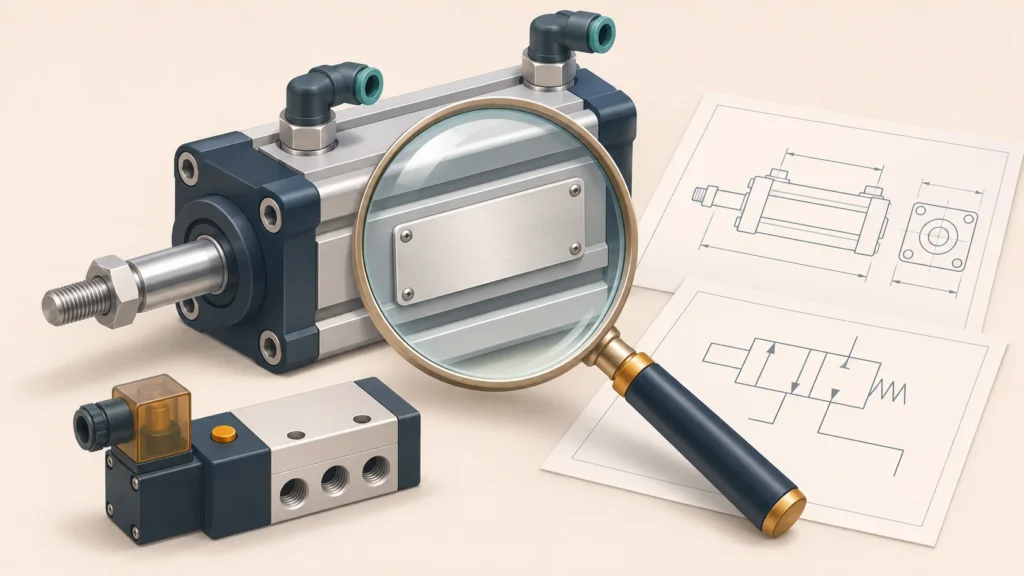
Photograph the complete label and the component in its installed position, where this is safe and permitted. Transcribe the manufacturer name, full type code, part or order number, and serial number into separate fields. Preserve suffixes, punctuation and revision markings. A spreadsheet reference may be your own stock code rather than a manufacturer’s orderable number.
Festo’s guide also explains that customer product numbers can be used after they have been matched to Festo numbers through customer support. That is a concrete reason to look for an old order confirmation instead of repeatedly searching the same internal code.
If the label is unreadable, send what you have rather than inventing the missing characters. An old invoice, machine parts list, drawing or equipment serial number may give the original supplier another route to identification. Ask that supplier to confirm the complete number in writing before requesting a price.
Separate product status from the offer in front of you
For procurement, keep three questions separate: what the manufacturer currently supports, what a particular seller can supply, and whether the offered item meets your application. A seller’s listing answers none of these completely on its own.
Manufacturer notice or written response, exact model and date checked.
Seller, exact quantity, condition, location, dispatch estimate and quote validity.
Original versus proposed specification, remaining differences and engineering decision.
If a seller offers remaining stock, ask whether it is new and unused, unused older stock, used or refurbished. Request photographs of the actual labels and packaging, not only a catalogue image. Ask what testing, storage information, warranty and return terms accompany that specific offer. Record unanswered points as open items rather than filling them with assumptions.
If the answer is only “we can get it,” ask what has actually been confirmed: the exact item, quantity, condition and expected dispatch date. A quoted lead time should identify what it depends on. Your purchase approval should refer to the written offer, not to an informal availability statement.
A named successor still needs a compatibility check
SMC’s official CG1/CDG1-Z discontinuation page lists December 2025 as the discontinuation date and CG1/CDG1-Z1 as the replacement series. It also identifies mounting interchangeability as “Partially incompatible.” This is a manufacturer example of why a replacement reference is a starting point for engineering review, not automatic permission to install it.
Use the complete old and proposed order codes, not only the series names. Obtain the relevant dimension drawings and specifications from the manufacturer. For a pneumatic component, the comparison may include mounting, stroke, connections, pressure range and sensor arrangement. For an electrical component, the relevant questions may instead include supply, connectors, signals, software and configuration. Ask your equipment manufacturer or responsible engineer which differences matter for the actual machine.
| Compare | Existing part | Proposed part | Decision needed |
|---|---|---|---|
| Complete ordering code | Copy from label and old order | Copy from written quote | Same item or alternative? |
| Drawing and mounting | Record drawing revision | Record drawing revision | Any changes required? |
| Connections and operating limits | Existing application requirements | Manufacturer specifications | Within required limits? |
| Accessories and configuration | What the machine uses | What the offer includes | What must be added or changed? |
A practical example: the supplier offers a different code
Illustrative purchasing scenario: a maintenance buyer needs two replacements for a cylinder on an existing machine. The online search finds nothing. A distributor replies with a different series and a price.
- Resolve identity. Send the full label photograph and old order. Ask whether the original code is discontinued, local, special-order or simply incomplete.
- Resolve the route. If the original remains orderable, request its exact quote. If it is discontinued, request the official notice and the complete proposed replacement code. Ask separately whether matching original stock is being offered.
- Resolve the difference. Put the two drawings and specifications into the worksheet. If the manufacturer flags a mounting difference, ask for the affected dimensions rather than assuming an adapter will solve it.
- Close the purchasing record. Obtain the responsible engineer’s decision, then make sure the final quotation uses the approved code, condition and scope. If approval is still pending, keep the inquiry open instead of presenting the substitute as accepted.
The useful outcome is not merely “found a supplier.” It is a traceable answer: the original code is identified, the supply route is stated, and the proposed item has a clear approval status.
A request you can send to a Korean supplier
Attach only documents you are authorized to share. Replace the bracketed fields and remove questions that do not apply.
Hello [name],
We need [quantity] for [equipment / application], with a required date of [date]. Attached are the complete label photo and [previous order / drawing].
Please confirm:
1. The complete manufacturer ordering code and whether this is a standard, local or special-order item.
2. Whether the original item remains orderable. If discontinued, please share the manufacturer notice and proposed replacement code.
3. For the item you can supply: quantity, condition, supplier-stated availability, dispatch estimate and quotation validity.
4. If you propose an alternative, please provide its specification and drawing, identify differences from the original, and state any additional accessories or changes required.
Our technical team will review any alternative before purchase. Please mark any points that still need manufacturer confirmation.
Thank you,
[name / company]
Official references and related reading
- Festo Korea online-shop guide: product-number entry and FAQ, printed pages 3 and 17–18. Guide publication date is not stated in the reviewed file; checked November 15, 2026.
- SMC CG1/CDG1-Z discontinuation and replacement information: checked November 15, 2026. Confirm the exact order code and market-specific supply with the manufacturer.
- Comparing Korean supplier quotations: review what each price includes once the item has been identified.
The source examples above concern international manufacturers supplying industrial components; they do not identify those brands as Korean manufacturers. The worksheets and inquiry sequence are KOD’s practical recommendations.

Need someone in Korea to follow up on the part?
If the seller communicates in Korean or the online information leaves the exact item unclear, Korea Ops Desk can contact relevant manufacturers, distributors and suppliers, request identification and quotation details, and organize their responses in English. Any proposed alternative goes to your technical team for approval.
Send Colin the manufacturer and complete code, label photo, old order or drawing if available, quantity, and required date. Start with the information you have. Scope and quotation are agreed before work begins.
See our Industrial Parts Sourcing service · Korea Ops Desk is operated by JS Network Inc. · 24/7 inquiry support.