Korean Manufacturer or Trading Company? Check Who Will Make Your Order
Check a Korean supplier's production role: compare registration records, map in-house and outsourced processes, and match evidence to your order.
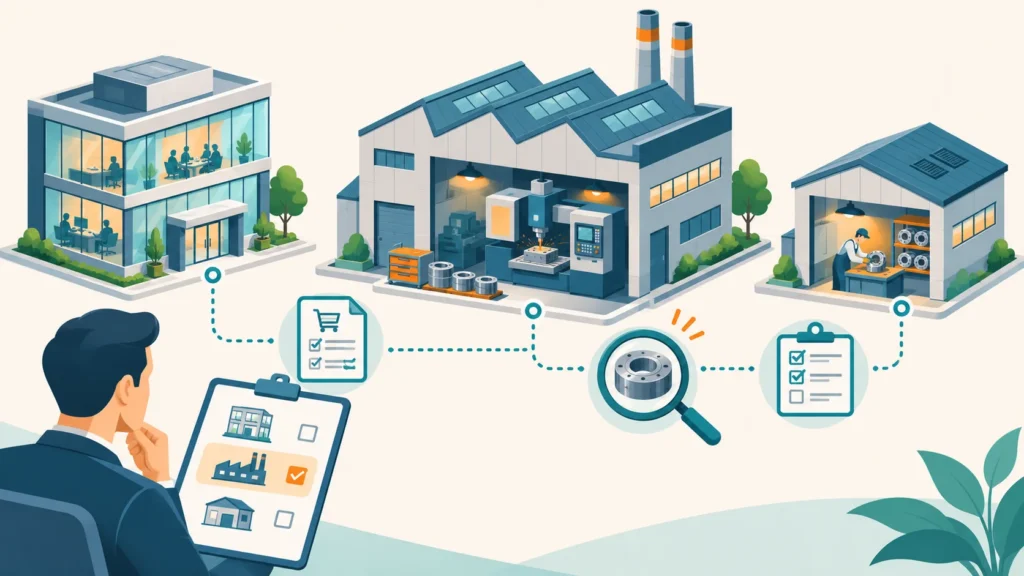
A Korean supplier can sell your product, assemble it and arrange export without performing every manufacturing step itself. To find out who will make your order, connect the seller’s legal identity to the production address, the process performed there and the evidence for your specific product. A company name or a factory photograph answers only part of that question.
The practical objective is a clear production and responsibility map. A disclosed trading company or outsourced process can fit the purchase; an unexplained gap between the quotation, production plan and responsible company needs an answer before you rely on it.
1. Separate the seller from the production roles
Start with the company that issued the quotation. Ask for its Korean legal name, business registration number and address, then ask which entity operates the proposed production location. Keep the English trading name alongside the Korean name rather than using one to silently replace the other.
Next, identify who handles engineering, manufacturing, final inspection and corrective action. One company may perform several roles. If another business performs a step, record its role and the route for resolving a technical problem. “We take care of everything” is a useful promise only after the parties have made the responsibilities concrete.
 Korea Ops Desk
One order, three questions
Quotation and contract entity; commercial contact.
Production operator, address and process allocation.
Inspection, changes, defects and corrective-action owner.
Do not infer the answer from a fast response, a slow response, an impressive website or the words “Trading” and “Manufacturing” in a name. Instead, ask an answerable question: “For product [reference], which operations will your company perform at [address], and which operations will be performed elsewhere?”
2. What Korean registration records can tell you
Registration documents help establish which business you are discussing. Their usefulness depends on the question, the document’s date and the fields you actually compare.
| Record or check | What the official service covers | How to use it in the buying file |
|---|---|---|
| Business registration information / status | The National Tax Service service distinguishes matching submitted registration details from checking business status, tax type and closure date. | Compare the registration number and supplied identity details. Save the result, source and check date. |
| Corporate registration certificate | Government24 describes a corporate record covering fields such as the corporation’s name, registration number, head office, purposes and officers. | For a corporate supplier, compare its Korean legal identity and relevant registered details with the quotation. A sole proprietor is not a corporation. |
| Factory registration certificate | Government24 describes certification of information entered in the factory registration ledger for the relevant establishment. | Ask the supplier for the current document relevant to the proposed factory and compare the named business and location. |
Official references: National Tax Service registration/status service description, Government24 corporate registration certificate and Government24 factory registration certificate. These source pages are in Korean.
Begin by requesting a copy of the supplier’s business registration certificate and comparing its Korean business name, number and address with the quotation. The National Tax Service link above describes its data service; it is not an instant lookup form. Where a current status check is needed, use an accessible National Tax Service lookup channel or arrange Korean-language assistance and retain the dated result. For every document, record its issue date and whether you obtained it from the issuing service or received a supplier-provided copy. Reviewing a copy is different from establishing its authenticity.
Use these as identity and record checks, then investigate the production claim separately. A registration match does not demonstrate that the company will make your model, in your quantity, at the stated location. Likewise, a manufacturing purpose in a corporate record is not observation of a production operation. If a supplier cannot provide a requested factory document, ask why and what evidence is available rather than declaring it a false manufacturer on that fact alone.
3. Ask about processes, not just “your factory”
Break the product into the operations that matter to its performance. For a machined component, that might be material procurement, machining, heat treatment, surface finishing, assembly and inspection. For another product, the relevant steps will differ. Your technical owner should choose the steps that could change the purchasing decision.
Send a short worksheet and ask the supplier to complete it for the quoted product and drawing revision. A general brochure can introduce a capability, but the worksheet should describe the proposed route for this order.
| Process | Company and location | Evidence requested | Open question / owner |
|---|---|---|---|
| [Machining] | [Operator; production address] | [Relevant equipment and proposed work route] | [Which drawing revision? Technical lead] |
| [Surface finishing] | [In-house or named external provider] | [Specification; batch linkage; inspection record] | [Who reviews conformity? Quality lead] |
| [Assembly and final inspection] | [Operator; address] | [Inspection plan and acceptance criteria] | [Who approves changes? Buyer/supplier contacts] |
For example, if a supplier machines a housing at its own site but uses a partner for anodizing, the important follow-up is how the finish specification, batch identity and acceptance criteria travel between the two businesses. Ask who receives a nonconforming batch, who contacts the finishing provider and who agrees a corrective action with the buyer. A simple “all in-house” checkbox would miss that workflow.
Korea Ops DeskFollow the product through the process
Site A · drawing revision · part or batch reference.
Site B · finish specification · transfer record.
Inspection owner · results · unresolved deviations.
4. Match evidence to your order
Choose evidence that answers the remaining question. If the issue is location, identify the address and operating entity. If it is whether a process is available, ask which equipment and personnel would perform it. If it is whether the product meets your specification, involve the technical reviewer and define the required test or inspection.
Keep three labels in the file: supplier statement, document reviewed and direct observation. Add the date and the product, process or site the evidence covers. A permitted photograph of a machine can document its visible presence; it does not on its own prove available capacity, ownership, maintenance condition or the result your product will achieve.
Where the supplier shares a sample report, identify it as a sample. For a completed work record, ask which product, revision, batch and date it concerns. Commercially sensitive details may need redaction or an agreed confidentiality arrangement. Ask for the minimum evidence required to resolve the issue, not an indiscriminate collection of another customer’s files.
If the evidence and the quotation disagree, list the exact discrepancy. For example: “The quotation identifies Company A, while the factory document identifies Company B. Please explain their relationship and confirm which company will perform the machining and which company remains our contractual supplier.” Keep that clarification with the quotation rather than burying it in a general email chain.
5. Plan a visit around the remaining question
A useful visit brief starts with one unresolved question: “Can we observe the proposed assembly operation at this address?” or “Which of the listed processes are visible at this site?” Confirm the host, address, planned production activity, available personnel and photography permission before arranging travel.
Ask whether the relevant product or operation will actually be available during the visit. If the line is idle, record that condition and request the agreed alternative evidence. If an external process is material to the purchase, decide whether it needs a separate visit or a document review; do not quietly treat a visit to Site A as evidence about Site B.
Have the report distinguish what was seen, what the host said and what was inaccessible. A specialist performance test needs a defined method, instruments, acceptance criteria and competent reviewer. An ordinary site visit should not be described as completion of that test. KOD’s factory and site visit service documents agreed visible conditions, permitted images and answers in an English report.
6. A supplier request you can adapt
Hello [Name],
Before we finalize our review of quotation [reference], please confirm the production arrangement for [product and drawing revision].
1. What is the Korean legal name and business registration number of the company issuing the quotation?
2. Which company operates the proposed production site, and what is its address?
3. For [list key processes], please identify the operations performed at that site and those performed by another company or location.
4. Who is responsible for final inspection, technical changes and corrective action? Please share the proposed inspection criteria and the relevant product or batch references.
5. What documents or permitted observations can support these answers? Please identify any information that is unavailable or requires a confidentiality arrangement.
If a visit is appropriate, please confirm whether [specific process/product] can be observed, who can answer our technical questions and which photographs or records may be collected.
Please flag any proposed change to the named production site or process allocation so we can review it before proceeding.
Best regards,
[Name / company]
7. Decide what is resolved and what remains open
End the review with a decision record, not a vague “verified supplier” label. Record the question, evidence, conclusion, unresolved item and person responsible for the next action. Your purchasing and technical team can then decide whether to proceed, request more evidence or revise the proposed scope.
Korea Ops DeskClose the question, not just the email
Record exactly what the evidence establishes and its date.
Name the missing item, responsible contact and next review date.
Resolve the specific mismatch before relying on that claim.
If there is no reply, follow up with the named business contact using the numbered questions. If a different production location is proposed, update the worksheet and have the responsible reviewer assess the change. For product-specific technical acceptance, keep the evidence and approval separate from the company’s identity check.
Useful next reads: finding Korean suppliers through buyKOREA and tradeKorea, and matching a pre-shipment report to the goods being shipped.
Official sources
- National Tax Service: business registration verification and status API description.
- Government24: corporate registration certificate issuance.
- Government24: factory registration certificate.
Source pages checked 17 November 2026. The production worksheet, evidence labels and supplier request are KOD’s practical review framework.
Need help clarifying a Korean supplier’s production role?
If the documents, addresses and production explanations do not line up, Korea Ops Desk can help request clarification, coordinate an agreed visit and organize findings in English. The assignment can distinguish public information, supplier statements, visible observations and open questions.
Send the supplier’s name or website, product or drawing, quotation reference, proposed factory address and the question you need answered. Start with what you have. Colin will confirm the feasible scope, deliverables and price before work begins.
24/7 inquiries · colin@koreaopsdesk.com
Supplier verification scope · Factory and site visits