Korean Supplier Changed Bank Details? Check the Request Before Payment
A practical workflow for Korean supplier bank-detail changes: independent callback, beneficiary questions, invoice comparison, approval records and urgent action after a suspicious transfer.
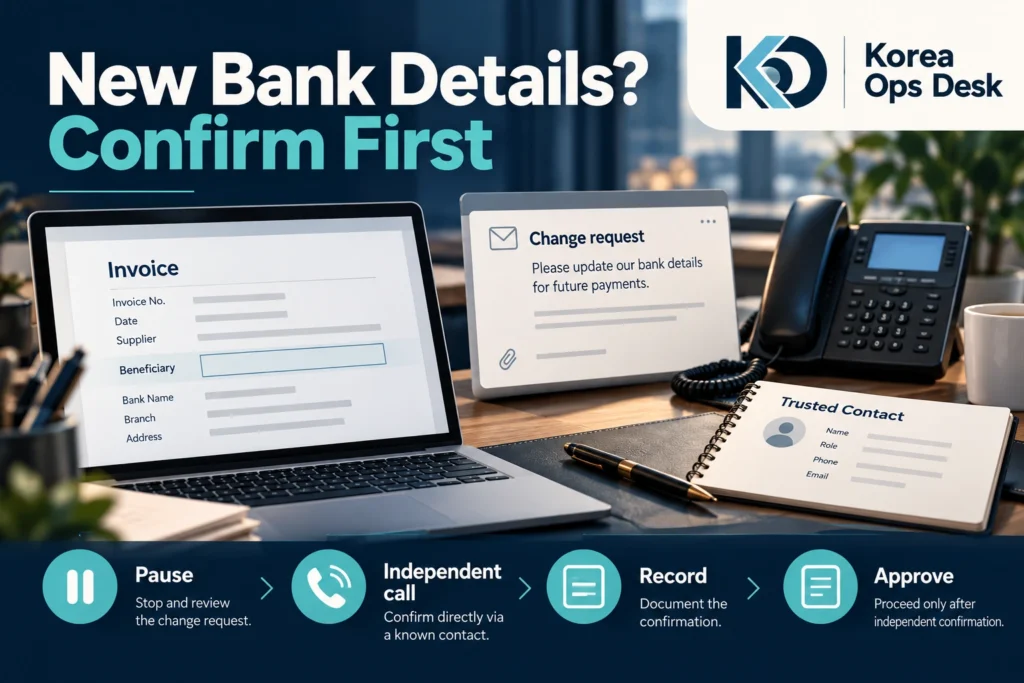
Your Korean supplier sends a revised invoice just before payment: “Please use our new bank account.” It may be a genuine administrative change, but it is also the exact point at which an ordinary purchasing process can redirect money to the wrong recipient. The useful response is a calm, documented confirmation process that works even when the email looks familiar and the shipment is urgent.
1. Separate the payment hold from the supplier relationship
A verification hold does not accuse the supplier of fraud. It means the payment information has changed and must be checked. Tell your purchasing and finance colleagues which invoice and payment are affected, then prevent the new details from being entered or used until the review is complete. Otherwise one colleague may investigate while another pays the revised invoice.
The FBI’s business email compromise guidance recommends independently checking payment changes and warns about pressure to act quickly. The practical lesson for an overseas purchase is simple: urgency should trigger a faster verification effort, not removal of the verification step.
| Immediate task | Useful internal record |
|---|---|
| Identify the request | Supplier, invoice, order and message date |
| Hold the affected action | Payment and vendor-master change awaiting confirmation |
| Name the coordinator | Person handling supplier contact and collecting evidence |
| Name the approver | Person authorized to accept the verified change |
| Preserve the original material | Original email, attachments and previous approved instructions |
| Set the next update | Time for a status update, without promising payment approval |
Use the same process whether the request arrives by email, messenger, telephone or an amended PDF. A request delivered through several channels is not automatically independent confirmation if the contact details in those channels all came from the same unverified message.
 Korea Ops Desk
Four steps before changed payment details are used
- 01
Pause
Hold the affected payment and data change
- 02
Contact independently
Reach the established supplier through a separate route
- 03
Resolve the details
Match the request, beneficiary and invoice
- 04
Record approval
Keep the confirmation and internal decision together
2. Why a familiar email thread is not enough
Scamwatch’s payment-redirection guidance explains that a fraudulent invoice may appear in an existing message thread and may copy business identifiers and logos. It recommends using an independently sourced telephone number rather than the contact information in the suspect message. An apparently familiar conversation therefore does not settle who controls the new payment instructions.
Look for differences, but do not make visual inspection your only control. Check the actual sender address and reply-to address, the beneficiary, bank country, invoice reference and wording around the change. A small spelling difference may be informative. Conversely, the absence of a spelling error does not establish authenticity.
| What you notice | What it means operationally |
|---|---|
| Urgent deadline or shipment pressure | Keep the hold; prioritize independent contact |
| New beneficiary or different country | Ask why the recipient differs from the contracting seller |
| A new phone number in the message | Do not use that number as your independent verification route |
| Request to keep the change confidential | Escalate internally through your normal approval process |
| Correct logo and company details | Treat them as identifiers to compare, not proof of control |
| Same existing email thread | Still confirm the changed instruction independently |
A bank letter, account screenshot or stamped invoice supplied in the same unverified exchange is another document to review. It does not independently establish the sender’s authority. Record what you received and obtain confirmation through the separate contact route your company has selected.
3. Choose a contact route that is independent of the change request
Start with supplier contact information your company established before the change: the approved vendor record, a previously verified main office number or another independently confirmed business contact. Ask the company to connect you to the person responsible for the invoice or finance administration. Record how you obtained the contact details, who you reached and their role.
If your only contact is the person who sent the new instructions, do not call a number copied from that email and treat the circle as closed. Establish another route. A public company website may help locate the business, but inspect the domain carefully and compare it with established records. If you cannot establish a credible independent route, keep the payment hold and escalate the gap to the internal decision owner.
- Identify your company and the order or invoice reference without disclosing banking passwords or authentication codes.
- Explain that a payment-detail change was received and that you are confirming it through the company’s established contact route.
- Ask whether the company issued the request and who is authorized to confirm it.
- Confirm the specific beneficiary and payment instruction through your approved secure process.
- Record the name, role, date, time and contact route used.
- Request corrected or reconfirmed commercial documents where the change affects the invoice.
A Korean-language call can resolve a practical communication barrier: whether the salesperson knows about the change, which finance contact owns it, and what document the company intended to issue. The call record should state exactly what was confirmed. It should not claim bank-account ownership or a guarantee of safe payment that the caller has not independently established.
4. Compare the changed instruction line by line
Create a restricted comparison record for the finance team. Keep the previous approved instruction beside the new request and identify every changed field. Do not circulate full account information to everyone working on the shipment; share only what each person needs for the review.
| Field | Question to resolve |
|---|---|
| Contracting seller | Which legal entity accepted the order? |
| Invoice issuer | Does the revised invoice come from that entity or another explained party? |
| Beneficiary name | Who is to receive the payment, and how does that relate to the seller? |
| Bank and location | What changed from the approved instruction? |
| Account/payment reference | Which exact instruction is being confirmed through the approved process? |
| Currency and amount | Did the payment amount or currency change as well? |
| Effective date | Which invoices are affected by the change? |
| Reason and authority | Who authorized the change and how was that independently confirmed? |
A genuine transaction can involve an English trading name, a Korean legal name or a separately documented group entity. Do not assume either that every difference is fraud or that every difference is harmless. Ask for the relationship to be explained in writing, then have the appropriate internal approver resolve the change before payment.
If the beneficiary is a third party, the issue is broader than a bank-account update. Your team needs to understand why a party other than the contracting seller is receiving the funds and what written arrangement supports that instruction. Keep it as a separate approval question instead of hiding it in a note marked “bank changed.”
Korea Ops DeskMatch the commercial relationship as well as the bank fields
- 01
Order
Who accepted the purchase?
- 02
Invoice
Who is asking to be paid?
- 03
Beneficiary
Who will receive the funds?
- 04
Authority
Who confirmed and approved the instruction?
5. Use a clear confirmation script and written recap
The purpose of the conversation is to verify a specific instruction, not to ask a vague “Is everything okay?” question. Identify the affected order and the fact of the change, then confirm through the company’s authorized process. Keep sensitive payment details within the channels and access controls your finance team uses.
Subject: Payment-detail confirmation required: invoice [reference]
We received a request dated [date] to change the payment instructions for invoice [reference] / order [reference]. The affected payment and vendor-detail update are on hold while we complete our normal verification.
Please identify the person authorized to confirm this change and explain which invoices it applies to. We will contact your company through our independently established contact route.
Please also clarify any change to the invoice issuer, beneficiary entity, currency or amount. If the commercial document has changed, please provide the current invoice revision through the agreed channel.
Thank you for helping us complete the confirmation promptly.
[Name / Company]
Use the message to organize the review; do not treat the reply itself as independent verification. During the callback, confirm the points your finance team requires. Afterward, prepare a recap that records the contact route and actual answers without expanding them into conclusions the call did not support.
Subject: Internal confirmation record: supplier payment instruction
Request received: [date and channel]
Affected payment status: [held / other actual status]
Independent contact route: [source of number/contact record]
Person reached: [name and role]
Date and time: [including time zone]
Confirmed points: [specific answers]
Documents received: [references and versions]
Unresolved points: [items]
Next action and owner: [details]
Approval decision: [authorized approver / date / conditions]
Keep the full payment instruction in the approved restricted finance record.
If the supplier contact says the request is genuine but cannot explain the new beneficiary, the case is still incomplete. Record the partial answer and ask for the responsible finance contact. The aim is a resolved instruction, not merely a completed phone call.
6. Handle common obstacles without losing the control
| Obstacle | Practical response |
|---|---|
| The salesperson is travelling | Ask the established office contact to identify the authorized finance contact |
| Korean and English entity names differ | Obtain the names and relationship in writing; compare them with the vendor record |
| The supplier says dispatch will be delayed | Explain the hold, prioritize verification and record the actual shipment consequence |
| Nobody answers the independent number | Keep the hold; document attempts and use another independently established route |
| An intermediary requests payment | Clarify its role and authority separately from the product discussion |
| The invoice has several revisions | Identify the current authorized revision and mark superseded versions |
| The supplier denies the request | Preserve evidence, stop using the suspect channel and involve finance/security immediately |
Avoid a token workaround such as assuming a small successful transfer proves that the account belongs to the intended supplier. It proves only what your bank confirms about that transfer. The unresolved question is still whether the recipient and instruction are authorized for your purchase.
For a small business where one person handles purchasing and payment, introduce a documented second review for a changed beneficiary instruction where possible. The reviewer should see the comparison and independent confirmation record, not only the latest invoice. This is a practical process design suggestion; your company should apply its own approval authority and banking controls.
7. If money has already been sent, act immediately
If you suspect a transfer has gone to the wrong recipient, contact your bank immediately through its official channel. The FBI advises contacting the financial institution at once and asking it to contact the receiving institution. Do not wait for the supplier to reply or for a routine commercial support appointment. Recovery is not guaranteed, and the bank needs the actual transaction details promptly.
Prepare the transfer reference, date/time, amount/currency, recipient details and the original payment request for the bank’s process. Tell your internal finance and security contacts what happened, preserve the original messages and attachments, and stop further payments based on the suspect instruction. Follow the bank’s directions and the appropriate reporting route in your jurisdiction; the FBI identifies IC3 for US-related BEC reporting.
Separately contact the real supplier through the independent route to establish whether its records or messages were affected. Keep the incident investigation separate from normal order follow-up so that a request for shipment status does not obscure the urgent payment issue. Korea Ops Desk can assist with Korean-language supplier communication, while the bank handles the financial response.
Korea Ops DeskAfter a suspicious transfer, do not wait for ordinary follow-up
- 01
Contact the bank
Use the official urgent reporting route
- 02
Provide transaction evidence
Reference, time, amount and recipient details
- 03
Preserve and escalate
Original messages and internal incident contacts
- 04
Reach the real supplier
Independent communication alongside the bank response
8. Build a simple rule for the next purchase
Agree the payment-change procedure when the supplier relationship begins. Tell the supplier that bank-detail changes require independent confirmation and internal approval. Save the initial approved contact route and payment instruction in your vendor record. That makes a later change easier to verify without rebuilding the relationship from scratch.
- Establish supplier identity and authorized commercial contacts during onboarding.
- Store the approved payment instruction with controlled access.
- Define who may request, review and approve a vendor-detail change.
- Hold affected payments when a change arrives.
- Independently confirm the request and resolve beneficiary differences.
- Record the evidence and approval before updating the finance record.
- Ensure the payment uses the approved current instruction.
- Keep superseded instructions identifiable so they are not reused.
Consider a buyer who receives a revised invoice with a new beneficiary two days before dispatch. The buyer holds the payment, reaches the established office number and learns that the salesperson did not issue the change. Because the revised PDF was not immediately copied into the payment system, the team can investigate before releasing funds. In a genuine change, the same process produces the written explanation and approval needed to proceed. This is an illustrative workflow, not a KOD case history.
The Korea-side task is often very concrete: find the appropriate supplier contact, explain the issue in Korean, obtain the current documents and return a clear English record. That is where a local communication desk can reduce delays while keeping your finance team’s decision and controls intact.
Need Korean-language help confirming a supplier’s change request?
Korea Ops Desk can contact the supplier through an agreed independent route, clarify the request and organize the written responses for your finance team. Tell us which point remains unresolved so we can focus the follow-up.
Send us: Supplier name and established contact details, order/invoice reference, the change requested and your deadline. Share only the information needed for the inquiry; never send banking passwords or authentication codes.
24/7 inquiries · colin@koreaopsdesk.com
Related practical guides
Expanded on 2 November 2026. Worked transactions and message templates are illustrative examples.