ICPI WEEK 2027 and KOREA PACK 2028: Plan the Right Korean Sourcing Visit
Plan the right Korean sourcing visit: ICPI WEEK 2027 and KOREA PACK 2028 dates, specialist shows, buying briefs, supplier meetings and follow-up.
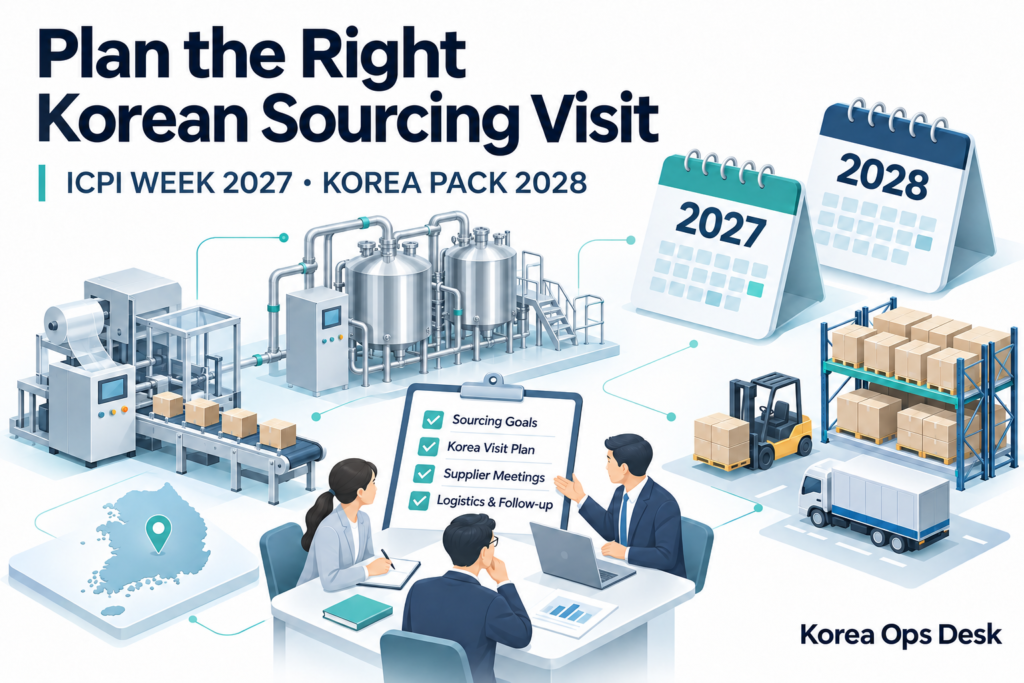
 Korea Ops Desk
ICPI WEEK is scheduled for 20–23 April 2027 at KINTEX, while the next KOREA PACK is scheduled for 18–21 April 2028. Overseas buyers planning a Korean packaging, process-equipment or logistics sourcing visit should choose the relevant specialized exhibition before making a meeting list. The organizer describes KOREA PACK as biennial and the associated ICPI WEEK exhibitions as annual. The organizer’s current guidance separates the two editions.
For a buying team, the useful next step is to connect a defined purchasing requirement to the right show, participating supplier and meeting objective. This guide explains how to build that connection, request the information needed before travel and turn booth conversations into comparable supplier responses.
Trade Shows & Exhibitions · Official information checked 8 November 2026
1. Which event and year should you use?
The official ICPI WEEK English site currently displays 20–23 April 2027 and KINTEX. The KOREA PACK site displays 18–21 April 2028 and explains the biennial schedule. Save the exact event name, edition, dates and source URL in your planning file so colleagues and suppliers use the same reference.
Some navigation labels and page titles still refer to 2026. Read the dated event information inside the page and check the edition attached to an exhibitor directory, floor plan or registration form. If a supplier appears in an older directory, ask it to confirm participation in the edition you intend to attend. Before committing travel costs, revisit the organizer’s current visitor information and obtain any missing practical details directly.
Korea Ops DeskTwo calendars, one clear planning record
20–23 April · KINTEX. Select the specialist exhibition relevant to the buying requirement.
18–21 April · KINTEX. Keep this edition separate in your event and travel records.
2. Choose a specialist exhibition by purchasing need
The organizer directs companies considering 2027 participation to the relevant specialized ICPI WEEK exhibitions. Its list includes KOREA MAT, KOREA COLD CHAIN, KOREA DARK FACTORY, ESG PACK, KOREA CHEM, COPHEX, CI KOREA, KOREA PHARM & BIO and KOREA LAB. Follow the linked specialist website from the official event guidance, then check its current scope and participant information.
Start with the process or purchasing problem rather than the broadest event name. A team sourcing a conveyor, a temperature-controlled shipment system and a laboratory instrument may need three different supplier conversations. Put each requirement on its own line and assign a technical owner who can decide whether an offered product fits.
| Your requirement | What to search in specialist directories | What to ask before booking a meeting |
|---|---|---|
| Move packed goods through a warehouse | Handling, storage and internal logistics equipment | Can the supplier handle the load, dimensions, throughput and site interfaces in the brief? |
| Keep a product within a temperature range | Cold-chain equipment, packaging and monitoring | Which transport or storage conditions can the proposed system address, and what evidence is available? |
| Fill, process or package a product | Equipment matching the product and production step | What product samples, container drawings and operating requirements are needed to assess the application? |
| Measure or test a material | Laboratory and analytical equipment | Which method, sample properties and required measurement range should the buyer provide? |
This is a buyer’s screening framework. Use the current specialist exhibition scope and the supplier’s written response to decide where to spend meeting time. A familiar company name alone does not tell you which product or technical contact will be available at its booth.
3. Prepare a one-page buying brief suppliers can answer
A buying brief is a short description of what you need and how your team will evaluate a proposal. Give it a reference such as “Project P-01, revision 1” and use that reference in every meeting request. Keep a dated copy so changes to the requirement remain visible.
- Describe the application. State the product or material, the operation to be performed and the destination country. For machinery, explain where it fits into the existing process.
- Specify the essential limits. Include relevant dimensions, capacity, operating conditions, utilities and interfaces. Attach an approved drawing or specification if available, with its revision.
- Separate required and preferred features. A required feature determines acceptance. A preferred feature can be compared against price, delivery or another benefit.
- Define the evidence you need. Ask for a model-specific data sheet, drawing, sample plan, demonstration conditions or quotation scope. Name the document rather than asking for “more details.”
- Identify the decision and timing. Explain whether the visit is for supplier discovery, technical screening, a sample discussion or quotation clarification. State your target date and ask the supplier to distinguish availability, dispatch and arrival.
For an RFQ, or request for quotation, add quantity and the proposed delivery destination or trade term your team wants priced. An RFQ gives suppliers a common basis for pricing. It works best after the application is sufficiently clear to avoid comparing different configurations.
Korea Ops DeskBuild the brief in four layers
Product, process, destination and the problem to solve.
Mandatory limits, preferred features and known interfaces.
Drawing, data sheet, demonstration, sample or quotation needed.
Buyer’s reviewer, unresolved question and target next step.
4. Build a meeting list around questions that change a decision
Use one worksheet for company name, official website, exhibition and edition, participation confirmation, product, contact, meeting status and the main question. Add a source and checked date for the participation claim. Mark an unanswered request as pending rather than treating silence as confirmation.
Rank suppliers by the decision each meeting could unlock. A high-priority meeting might resolve whether a machine can run your container size or whether a supplier can provide the documents needed for your technical review. A lower-priority conversation may simply introduce a product range. Leave space between meetings for notes and movement between locations, and update booth details against the current floor plan when available.
Ask whether the person who can answer your questions will attend. Where interpretation is needed, agree on the language and technical vocabulary beforehand. Share only the information required for that discussion, using your company’s normal process for confidential drawings or product details.
5. Send a meeting request with a clear purpose
Example email: adapt the bracketed fields
Subject: ICPI WEEK 2027 meeting request — [application / project reference]
Hello [Name],
We are reviewing suppliers for [product or process] in [destination country]. Please confirm whether your company will participate in [specialist exhibition] during ICPI WEEK on 20–23 April 2027, and share your booth details when confirmed.
Our requirement is [brief description], with [key capacity, dimensions or operating condition]. We would like to discuss [two or three specific questions]. The attached [brief/drawing reference and revision] gives the current requirement.
Please advise which model or product family you recommend, which information you need from us and whether a technical representative will be available. If a demonstration is possible, please explain the material, configuration and conditions it will cover.
Our preferred meeting window is [date and time, Korea Standard Time]. Please suggest an alternative if needed. Before the meeting, could you send [specific data sheet/drawing/quotation detail]?
Best regards,
[Name / company / business contact]
If the supplier has not yet confirmed attendance, keep the technical discussion moving through its established contact. Record exhibition participation separately from product suitability. A useful product response can still support sourcing research while the meeting remains unconfirmed.
6. Example: an overseas buyer planning a packaging-line visit
Consider an illustrative buyer reviewing equipment for a new bottle size. The team has a container drawing and target output, but the filling material and downstream conveyor interface are still being finalized. It starts with a process brief and searches the relevant specialist show information rather than assuming every packaging supplier will attend the same event.
The buyer sends each candidate the same container drawing revision, an initial material description and the target output. It asks which missing properties are needed to assess filling performance. One supplier requests viscosity and temperature information; another asks for physical containers before recommending handling parts. The buyer assigns these questions to the product and engineering owners and updates the brief once the answers are ready.
For the meeting, the team prepares three decisions: which configuration deserves further review, what trial would test the main uncertainty, and which quotation details remain open. After a demonstration, it records the actual material, speed, configuration and observed result. If those conditions differ from the intended production process, the next request identifies the remaining test or confirmation required.
The purchasing team then compares offers using the same accepted scope. It records optional equipment, installation responsibilities, documentation, packing and the event that starts the stated lead time. For a more detailed commercial worksheet, see how to compare Korean supplier quotations. Before a machinery order progresses to shipment, use the factory acceptance test planning guide to organize the agreed test and evidence.
7. Turn meeting notes into an answerable follow-up list
At the end of each meeting, confirm the next document, responsible contact and expected response date. Write the product reference and drawing revision on the note. Ask permission before taking photographs and label each permitted image so your colleagues know which equipment or document it shows.
Korea Ops DeskFrom booth conversation to a reviewable offer
Record the contact, exact product, question and answer.
Send the agreed points and requested documents in writing.
Assign missing or conflicting information to a named owner.
Review complete offers against the same current buying brief.
| What happens | Next action | Record to keep |
|---|---|---|
| No reply to the meeting request | Follow up with the company’s established business contact and restate the specific unanswered question. | Pending participation and meeting status, with the next follow-up date. |
| Brochure and quotation show different specifications | Identify the conflicting fields and ask which document applies to the offered configuration. | Corrected quotation or written clarification linked to the model and revision. |
| Requested specialist is unavailable at the booth | Collect the relevant technical contact and agree how the questions will be forwarded. | Contact name, question list and promised response date. |
| A demonstration uses different materials | Record its actual conditions and ask what additional trial is needed for your application. | Observed conditions, open test question and responsible reviewer. |
| Supplier proposes a changed configuration | Ask for a differences list and return it to the technical owner before commercial comparison. | Revised scope and the buyer’s review decision. |
For each open item, use a simple status: awaiting supplier, awaiting buyer information, under technical review or resolved with evidence. When several people share the work, keep one current worksheet and put older versions in an archive. The result should be a clear purchasing record your team can use after the show.
Official sources and planning date
- ICPI WEEK official English website: displayed 2027 dates, venue and specialist exhibition links.
- KOREA PACK official exhibition guidance: biennial schedule, 2028 dates and 2027 specialist exhibition guidance.
Official pages checked 8 November 2026. Dates are the organizer’s currently published schedule. The buying brief, meeting email, example and follow-up workflow are Korea Ops Desk’s practical guidance.
Need someone in Korea to follow up with exhibitors?
If arranging these conversations from overseas is difficult, Korea Ops Desk can contact selected Korean suppliers, follow up on missing information and coordinate agreed trade-show coverage. For a defined booth visit, we can collect contacts, public materials and permitted photographs and organize the findings in English.
Send Colin the event and edition, priority suppliers, product or buying brief, questions and target timing. Start with what you have; the first discussion can identify which details are still needed. Colin handles consultations directly.
24/7 inquiries · colin@koreaopsdesk.com
Explore Korea trade-show coverage
Korea Business Insights is published by Korea Ops Desk, operated by JS Network Inc., Republic of Korea.