Buying Machinery from Korea? Agree the Factory Acceptance Test Before Shipment
Plan a Korean machinery FAT: test scope, evidence, punch lists, shipment release and SAT handover, with a supplier email and practical examples.
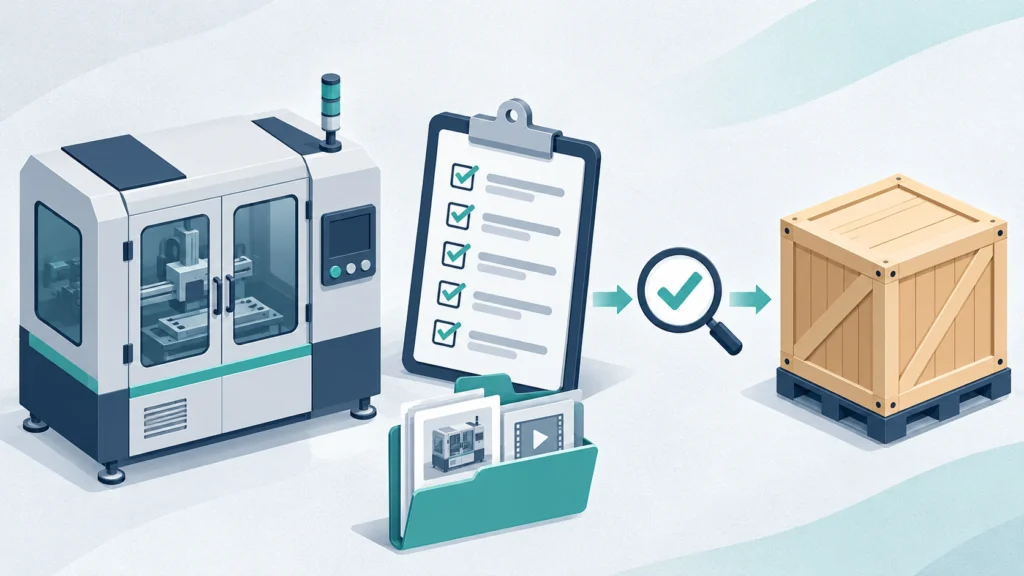
A Korean machinery supplier sends a video: the machine runs, the operator smiles, and packing is about to begin. Your production team still has three questions. Was the agreed material used? Were all purchased functions tested? Who decides whether the remaining issues must be closed before shipment?
A factory acceptance test (FAT) is an agreed examination of equipment at the supplier’s facility before delivery, using the project’s requirements and test conditions. Its value comes from a reviewable record, not from the name of the meeting. Before confirming travel or a video call, connect each important requirement to a test, a result, supporting evidence and an authorized decision.
Buyer guide · Sources checked 5 November 2026. The workflow and templates below are Korea Ops Desk’s practical recommendations. Manufacturer procedures and the historical project example are identified separately.
1. What a Korean equipment project shows
In a 23 November 2023 announcement, Morrow Batteries described FAT work for production equipment from several suppliers, primarily in South Korea. It reported 396 checklists and nearly 17,000 checkpoints, with remaining open points to be rectified before packing and shipment. Those figures describe that project, not a recommended checklist size for another buyer.
The useful lesson is the connection between test findings and the next project decision. The same release outlined planned later site acceptance testing (SAT), involving equipment operating in the correct process flow at the destination and serial-production tests. SAT addresses the installed system under the project’s agreed site conditions. A factory demonstration and an installed-line assessment answer different questions.
Korean equipment manufacturer KGA’s published product process also presents factory testing and site acceptance as separate stages. SGS Korea’s FAT service description covers completeness, functional testing or simulation, contractual requirements and documentation. Together, these sources support planning the test scope and records explicitly rather than assuming that “FAT included” defines everything.
For an individual purchase, begin with the signed contract, approved machine specification and agreed acceptance procedure. FAT, SAT, payment milestones and shipment permission may be linked in that contract, but they are not interchangeable labels. Have the responsible commercial and technical people resolve any missing acceptance terms before the test.
 Korea Ops Desk
Three decisions, different evidence
Does the identified equipment meet the agreed requirements under the recorded factory test conditions?
Has the authorized buyer approved dispatch, with unresolved items handled as agreed?
Does the installed equipment meet the agreed site and integration requirements?
Carry machine identity, revisions, open items and deferred tests from one stage to the next.
2. Turn the purchase specification into a test plan
Ask your project engineer or production lead for the approved specification, layout, order options and latest agreed drawings. Ask the supplier’s project manager for its proposed FAT procedure and report template. Put the document number and revision on both. A revision is the identifiable version of a document; it prevents a test against yesterday’s requirement from being presented as approval of today’s machine.
Work through the requirements that determine whether you can use the machine. These may include the product or material handled, output quality, operating rate, changeovers, utilities, installed options and required documentation. For each requirement, state what will be tested, how the result will be measured and what counts as acceptable. Your qualified technical lead should agree numerical limits, test duration, measurement method and safety-related procedures with the supplier.
| Field | What to enter | What to compare it with |
|---|---|---|
| Requirement and test ID | A unique reference, such as T-01, linked to the relevant specification clause | Approved purchase specification and revision |
| Equipment configuration | Machine reference, fitted options, software/configuration version where relevant | Order scope and approved drawings |
| Test conditions | Material, tooling, utilities, setup and agreed duration or sample quantity | The intended application and agreed procedure |
| Acceptance criteria | Defined result, measurement method and permitted variation | Technical requirements approved by the buyer |
| Evidence | Result sheet, measurement record, sample reference or permitted recording | The document-delivery list |
| Responsibility | Who operates, witnesses, evaluates and approves | Named project roles and signing authority |
Separate physical testing from simulation, visual inspection and work deferred to SAT. Simulation means representing a condition or signal rather than testing the complete real operating situation. It can be useful when agreed, but the report must say what was simulated. “Function checked” is not enough if your engineer needs to know whether the actual downstream equipment was connected.
Krones’ official FAT specification provides a concrete reason to ask these questions: its defined procedure can use provisional test arrangements and does not necessarily assemble or test every purchased component at FAT. That is one manufacturer’s stated scope, not a rule for Korean suppliers. Ask your supplier to identify its own exclusions and substitutions in the plan before anyone treats the meeting as a full-line performance test.
3. Confirm readiness before booking attendance
A proposed test date is not the same as a ready machine. Request a short readiness confirmation from the supplier’s project manager: equipment identification, assembly status, outstanding parts, internal checks completed, proposed procedure revision and the materials needed from you. If a required item is missing, ask which tests would be affected and whether the appointment should move or proceed with a clearly limited scope.
For test materials, obtain the exact type, quantity, preparation and required arrival date from the supplier. Then ask your production or quality colleague to identify the batch or sample you will provide. Confirm receipt and suitability before travel. Krones’ specification explicitly addresses timely test-material availability; the broader buying lesson is to avoid arriving with a valid test plan but unsuitable material.
When shipping samples internationally, have the supplier and transport provider confirm the receiving details and applicable handling requirements before dispatch. Do not assume a supplier can receive an unidentified liquid, battery or other restricted sample. Keep that shipment task separate from the engineering decision about whether the material represents your production conditions.
- People: name the supplier operator, project manager, buyer’s technical reviewer and person authorized to approve the result or shipment.
- Timing: record the date and start/end time in Korea Standard Time and each remote participant’s local time.
- Language: agree who explains technical terms and who records decisions in the working language.
- Access: confirm visitor requirements, permitted areas and photograph/video permissions.
- Agenda: link each session to test IDs, allowing time to review results and unresolved items.
For a remote FAT, agree camera coverage, live questions, access to readings and how original files will be delivered afterward. Krones’ 10 May 2021 account of live remote FATs describes advance planning and technical participation. A short edited video can document a particular observation, but it should not replace an agreed live or recorded evidence method for the tests you need.
4. Collect evidence your engineers can review
Before the first test, confirm that the machine and procedure match the planned references. Have the supplier operate the equipment under its approved procedures. Safety-function tests and technical judgments belong to suitably qualified personnel; a purchasing visitor should not improvise fault tests or bypass guards to obtain a better view.
Use a result sheet with one row per test. Record the actual condition, measured result, pass/fail or pending status, evidence-file reference and any deviation. A deviation is a difference from the agreed requirement or procedure. Record it even if the machine appears to run normally, because your reviewer must know whether the result answers the original question.
Korea Ops DeskMake every important result traceable
Specification clause and approved revision.
Test ID, machine configuration and actual conditions.
Result sheet linked to measurements, sample IDs and permitted files.
Technical finding, unresolved point and named decision-maker.
For example, name a permitted file using the machine reference and test ID rather than “final video.” Put its filename in the result row. If a measurement instrument is important to the result, ask your technical reviewer which identification and calibration evidence is needed. If samples are retained, label them so the reviewer can connect each sample to the run and conditions.
Keep observations, supplier explanations and buyer decisions in separate fields. “Display showed the agreed setting” is an observation. “Supplier says the replacement component has identical performance” is an explanation awaiting review. “Buyer’s engineer approved the identified substitution” is a decision. Combining them into “all OK” removes information your team may need later.
5. Make unresolved items actionable
A punch list is a structured list of unresolved defects, deviations and missing deliverables. It should tell the supplier what to do and the buyer what evidence will close the item. “Please fix the manual” is not a closure instruction. Identify the missing section, required version, responsible person and reviewer.
Illustrative example: the machine runs, but the evidence is incomplete
A buyer orders a packaging machine for its own product and pack format. At FAT, the supplier uses a substitute material because the agreed material has not arrived. The buyer also receives a manual that omits the ordered changeover option.
Record the observed run under the actual substitute-material conditions. Do not label it a pass for the original product requirement unless the authorized technical reviewer accepts that evidence against the agreed criteria. Create one item for the material-dependent test and another for the missing manual section. Ask whether a repeat factory test, additional evidence or an expressly agreed site test will resolve the first item. Review any effect on shipment and payment against the contract.
This is a worked purchasing example, not a KOD customer case or an equipment approval.
| Item | Finding and next action | Closure evidence | Decision to record |
|---|---|---|---|
| P-01 / T-03 | Agreed material unavailable. Supplier and buyer engineer to agree representative material or revised test arrangement. | Approved procedure revision and the resulting test record | Who decides whether the original requirement is met and whether shipment can proceed |
| P-02 / DOC-02 | Manual lacks the ordered changeover option. Supplier documentation owner to issue the complete revision by the agreed date. | Identified revised manual, reviewed for the missing content | Whether this deliverable is required before dispatch under the agreement |
| P-03 / SAT-01 | Integration with the buyer’s upstream line is deferred to the destination site. | SAT plan naming the interface, conditions and responsible people | Explicitly deferred, not recorded as a completed factory test |
In a live record, add the owner’s name, due date, current status, reviewer and closure date. If the parties disagree, record both positions and the precise requirement in dispute. Send that point to the authorized technical or commercial decision-maker rather than letting a meeting summary imply agreement.
6. Separate test completion from shipment release
At the closing meeting, review the completed tests, failed or pending tests, excluded functions and punch list. Confirm who will issue the final report and when. Read the wording around each signature: attendance, witnessing, technical acceptance and authorization to ship can have different consequences. Sign only within the authority assigned to that representative.
Then record the shipment decision separately in the form required by the purchase agreement. If dispatch is authorized with agreed outstanding work, list that work and its conditions explicitly. If release depends on corrective action, state what evidence the buyer must review and who will provide the decision. Do not assume that an invoice, a booked collection or an unsigned draft FAT report settles acceptance.
Korea Ops DeskClose the finding, then record the decision
Link it to a requirement and explain what remains unresolved.
Name the owner, due date and evidence or retest needed.
The authorized reviewer closes it or records what is still missing.
Approve or defer shipment under the contract, with any agreed conditions written down.
Before packing, match the final report and closure evidence to the machine being shipped. Request the agreed identification, packing inventory and outstanding-document status. If parts were removed for transport, make sure the relevant reassembly or installation instructions reach the receiving team. Carry the SAT list into the installation handover rather than leaving it in the FAT meeting minutes.
7. Send a focused supplier request
Use the following illustrative message before committing to attendance. Replace the bracketed fields with your approved references and omit points already agreed.
Subject: FAT plan and shipment-release record for [machine / PO]
Hello [Name],
Before we confirm the FAT date for [machine / purchase order], please send the proposed test procedure and report template against specification [number and revision].
For each test, please identify the requirement, equipment configuration, test conditions, acceptance criteria and evidence to be supplied. List any functions or components that will be simulated, excluded or checked later during SAT.
Please confirm the required sample materials, quantities and arrival date, as well as the machine’s readiness and any outstanding parts. Propose the participants and agenda in Korea Standard Time, and confirm photography, recording and remote-access arrangements.
We would also like to agree the punch-list format, corrective-action owners, closure evidence and process for authorizing shipment. Please identify any effect on the existing contract, schedule or charges before we approve a change.
Our technical reviewer is [name/role]. Our authorized shipment decision-maker is [name/role]. Please send the plan by [date] and identify any questions you need us to resolve first.
Best regards,
[Name / Company]
8. Handle missing materials, delays and disagreements
- No supplier test plan: send the requirement table and ask the project manager to propose a procedure. Have your technical lead review it before treating a visit as an acceptance test.
- Late reply: follow up with a short list of the exact missing decisions, the meeting reference and the date by which attendance must be confirmed. Ask for the responsible project or engineering contact.
- Changed specification: compare the old and new revisions, identify affected tests and agree whether earlier results remain usable. Preserve both files and the change decision.
- Unavailable test material or option: document the affected tests and obtain approval for the proposed alternative. A convenient substitute is not automatically representative.
- Recording not permitted: agree an alternative evidence package before attending, such as controlled result sheets, permitted close-ups or a supervised remote view. Respect the supplier’s access rules.
- Corrective action reported complete: request the agreed closure evidence or retest result. A supplier’s “done” email and the buyer’s closure approval are separate steps.
- Additional test requested: define the reason, method, cost and schedule impact, then obtain approval from the people authorized to change the scope.
The practical endpoint is a coherent handover: identified equipment, an agreed procedure, reviewable results, a controlled punch list, a recorded shipment decision and a clear SAT plan. That gives purchasing, engineering and the receiving site the same account of what has and has not been demonstrated.
Official sources
- SGS Korea: Factory Acceptance Test. Service scope; no publication date displayed.
- Krones FAT specification, TD10031037 EN 02. Scope, test materials, deviations and remote options; one manufacturer’s procedure, with publication date not established.
- KGA: Product Process. Korean equipment manufacturer’s project stages; no publication date displayed.
- Morrow Batteries: FATs concluded in South Korea, 23 November 2023. Historical project example; later milestones in the release were plans at publication.
- Krones: Live remote FATs, 10 May 2021. Historical account of remote-test preparation.
Sources checked 5 November 2026. These sources inform the purchasing workflow; the actual test criteria and acceptance decisions follow your machine, technical review and agreement.
View the Original FAT Service Description
Need clear FAT arrangements from a Korean supplier?
Korea Ops Desk can contact the supplier, coordinate the appointment and permitted local attendance, request the agreed records and follow up on unresolved documents or actions. Your technical specialists retain the engineering review and acceptance decisions.
Send what you have:
- Supplier name, contact and factory location.
- Machine or purchase-order reference and approved specification.
- Proposed FAT date and test plan, if available.
- The missing answers or records holding up your decision.
- Your technical contact and required decision date.
You do not need a complete file to start. Send the existing plan or email thread, and we can define the Korea-side coordination work.
24/7 inquiries · colin@koreaopsdesk.com
Related preparation: verify the Korean supplier’s identity and role, and prepare a clear brief for local assistance.