Requesting Product Samples from Korea: Decide What You Need to Learn Before Shipment
Request comparable Korean supplier samples by defining the evaluation question, sample identity, common review conditions and the decision after receipt.
 Korea Ops Desk · Practical sourcing notes
A useful sample request starts with a question, not a pickup date. Before asking a Korean supplier to send a product, decide what you need to learn, what evidence would answer that question, and what decision you will make afterward. This keeps sample spending connected to a purchasing decision rather than a growing collection of interesting objects.
If you are comparing several suppliers, give them a common brief wherever possible. Otherwise, a difference in size, finish, packaging or preparation may look like a difference in supplier capability. Receiving a sample is a logistics milestone. Evaluating it and deciding whether to proceed are separate steps.
1. Choose the question the sample must answer
“We want to check quality” is too broad to guide a supplier or an evaluator. A more useful question names an observable issue: Does the handle fit our existing assembly? Can our team distinguish the two finishes under the intended lighting? Does the label remain readable after our agreed handling exercise?
Separate questions you can answer by looking from questions requiring measurement, use or specialist testing. Photographs may help document appearance and visible condition. They do not establish composition, durability, regulatory compliance or performance in an application. If those are your decision criteria, arrange an appropriate evaluation rather than treating collection photos as a substitute.
Choose a small number of priority questions. A sample selected to compare colour may be unsuitable for evaluating a production process. Ask the supplier whether it is a showroom item, a handmade prototype, an existing stock item or a unit from the proposed production route. Record the answer as a supplier statement, not as something you independently verified.
2. Make supplier comparisons genuinely comparable
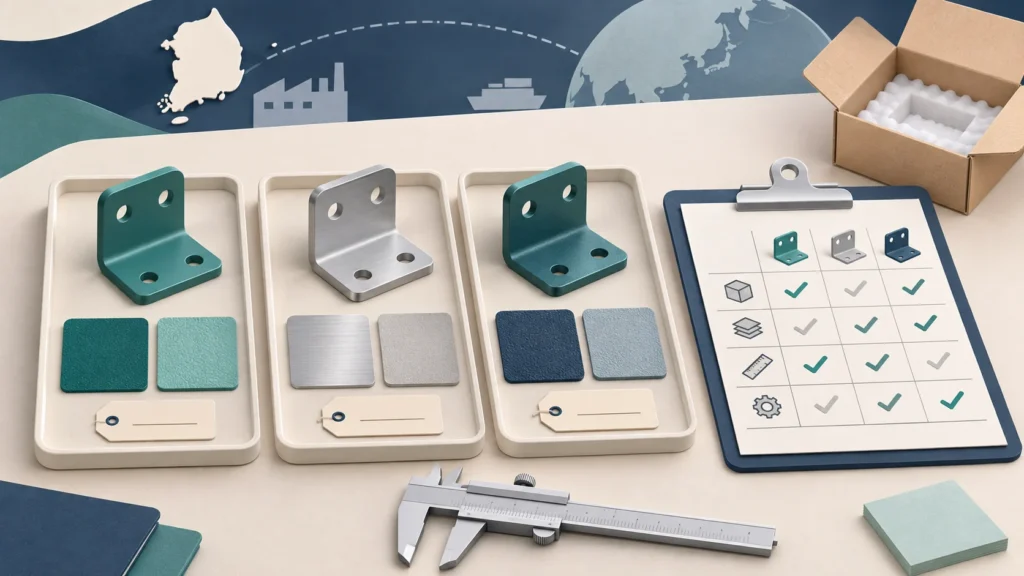
For each supplier, identify the requested model, dimensions, material, finish and configuration. Where a drawing or reference image is used, attach the same version to every request. This avoids comparing different products without noticing.
Ask suppliers to identify any departure before dispatch. A substitute colour or a similar-sized model may still be useful, but only if you know which questions it cannot answer. Keep those limitations beside the results instead of hiding them in a separate email chain.
| Comparison field | Supplier A | Supplier B | Interpretation |
|---|---|---|---|
| Requested configuration | Exact requested finish | Alternative finish | Colour results are not directly comparable |
| Evaluation conditions | Same fixture and evaluator | Same fixture and evaluator | Keep the method consistent |
| Sample origin | Supplier says stock unit | Supplier says prototype | Record different origins explicitly |
| Evidence gap | Material not tested | Material not tested | Neither result verifies material composition |
Use the same evaluation method where it matters: the same fixture, lighting, measuring method, handling sequence and assessor instructions. If different people evaluate different samples, give them the same questions and explain how to record an uncertain result. Consistency makes differences easier to interpret.
A few selected samples should not be treated as statistically representative of future production. They may reveal a problem or justify further investigation, but they do not establish a lot-wide defect rate. Decide whether the next step needs additional samples, production-process evidence or a qualified inspection or testing arrangement.
3. Example: compare fit without claiming durability
Suppose a buyer wants to compare three Korean suppliers’ reusable storage containers for an existing shelf system. The first decision is whether to shortlist a supplier for a more detailed discussion, not whether to approve a large order.
The buyer requests the same nominal container size and lid configuration, asks each supplier to identify substitutions, and uses the same shelf and loading arrangement for the initial fit check. Each item receives a supplier-and-sample ID. The evaluator records clearance, lid operation and any visible damage, with photographs showing the setup.
If one supplier sends a smaller model, the buyer labels its fit result “different configuration” rather than declaring it the winner. If all three fit, that answers only the initial fit question. It does not show long-term durability, food-contact suitability or consistent production dimensions. Those questions need their own evidence before a purchasing commitment.
4. Label evidence so observations do not become promises
Keep four categories distinct: requested specification, supplier statement, observed result and not checked. For example, “supplier states polypropylene” is different from “material independently verified.” Likewise, “three packages collected” is different from “every item inside inspected.”
A simple record should connect the sample ID to its supplier, request date, configuration, received condition and evaluation notes. Keep original labels and packaging information when useful. If the sample is modified or damaged during evaluation, record that before anyone interprets later photos.
Do not let a delivery acknowledgement become an accidental approval. If the supplier needs a decision, state precisely what has been accepted, what remains unresolved and whether further work is authorized. A positive sample evaluation alone does not define production specifications, inspection arrangements or the terms of an order.
5. Agree costs and responsibility before dispatch
Clarify who pays for samples, domestic collection, extra packing, international carriage and any destination charges. Ask whether a sample charge is refundable or credited against an order, and obtain the conditions in writing. Do not assume “free sample” means free transport or no import costs.
Assign an owner for carrier booking, shipping documents, destination receipt and evaluation. Agree what happens if the item is not ready, the supplier changes the configuration or the proposed carrier will not accept it. Also decide whether the sample will be retained, returned or used in a potentially destructive evaluation.
6. Prepare a separate dispatch brief
The evaluation brief explains why the sample matters. The dispatch brief explains what is moving: accurate item description, quantity, value, dimensions, weight, supplier release contact, pickup window and destination. Identify batteries, liquids, powders or other potentially restricted contents before arranging collection.
DHL’s commercial-invoice guidance calls for specific goods information and explains why descriptions such as “samples” alone are insufficient. Required documents depend on the shipment and route, so confirm them with the responsible exporter and carrier. DHL commercial invoice guide.
FedEx’s goods-description guidance also notes that samples have a value. If no purchase price is charged, do not invent a token value or assume zero is appropriate; confirm the correct basis with the responsible shipping or customs professional. FedEx goods-description guidance.
For potentially dangerous goods, FedEx Korea advises checking classification and obtaining a Safety Data Sheet from the supplier or manufacturer when uncertain. Acceptance and preparation requirements need carrier confirmation before pickup. FedEx Korea dangerous-goods guidance. Confirm carrier acceptance and KOD’s agreed handling scope before collection.
A supplier request you can adapt
We are requesting samples to evaluate [specific question] before deciding [next step]. Please quote [quantity and exact configuration] and identify whether the items are prototypes, stock units or from the proposed production process.
Please flag substitutions before dispatch. We will evaluate them using [conditions and criteria]; this request is not a production-order approval. Please confirm sample costs, readiness, packing details, shipping information and who will provide the required documents.
Official carrier sources checked 18 November 2026. The evaluation framework and example above are KOD’s practical purchasing guidance.
For the local handling step, see the Korean sample pickup and courier handoff guide.
Need someone in Korea to coordinate the next step?
Korea Ops Desk can scope sample collection, agreed condition photos and carrier handoff, and discuss supplier-question follow-up. Collection records support your evaluation process; they do not replace technical testing or your purchasing decision.
To start, send: (1) your evaluation question, (2) the sample configuration and quantity, (3) supplier contact and location, (4) available item and packing details, and (5) destination and target timing.
Review sample pickup and forwarding support or WhatsApp Colin. Scope, responsibilities and price are agreed before work begins.
Send Your RequestDiscuss on WhatsApp
24/7 inquiries · Start with the information you have.