Your Samples Are Ready in Korea. Who Gets Them to Your Courier?
Get samples from a Korean supplier to your courier with clear release instructions, packing details, accurate documents, pickup windows and handover evidence.
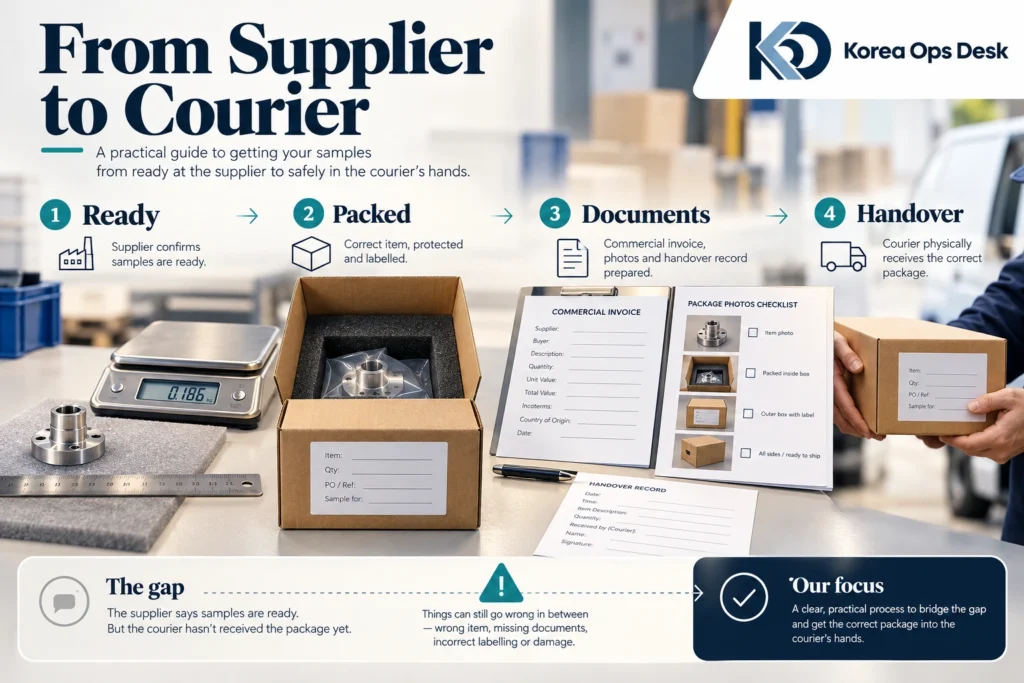
Your Korean supplier says the samples are ready. Your product team is waiting overseas, and you already have a courier account. Yet the parcel has not moved. The missing work is often the handover: confirming the correct samples, obtaining release permission, preparing the package and documents, and making sure someone can physically give the parcel to the carrier.
1. Find out what “ready” means before booking
A sample can be physically complete but still unavailable for collection. It may be waiting for the supplier’s internal approval, payment confirmation, labelling, packing or a person authorized to release it. Ask what is complete and what remains. The answer should identify the actual items, their location and the person who can release them—not simply repeat “ready.”
| Milestone | What should be known | Useful evidence |
|---|---|---|
| Sample complete | Exact sample reference, revision and quantity | Supplier confirmation tied to the current request |
| Released for collection | Who may receive it and any outstanding conditions | Written release instruction |
| Packed | Carton count, dimensions, gross weight and packing suitability | Package details and agreed photos |
| Documents prepared | Consistent sender, receiver, item description and values | Reviewed shipment documents |
| Pickup booked | Carrier, booking reference, address and time window | Booking confirmation |
| Collected | Physical handover has occurred | Carrier acceptance event or handover record |
If the supplier can pack, document and ship the sample directly under an agreed arrangement, that may be the simplest route. Local coordination becomes useful when someone must collect the sample in person, obtain agreed photographs, resolve a release issue or connect a supplier with a buyer-appointed carrier. Identify the actual gap before adding another handover.
Keep product approval separate from collection readiness. A buyer may approve collecting a prototype for testing without approving its performance or accepting it for production. Use that wording in the brief so collecting the box is not confused with approving the sample itself.
 Korea Ops Desk
Six milestones before the parcel is moving
- 01
Sample ready
Correct item and revision identified
- 02
Release agreed
Authorized recipient and conditions
- 03
Packed and documented
Package data and matching paperwork
- 04
Pickup booked
Address, contact and collection window
- 05
Physically collected
Handover evidence recorded
- 06
Receipt followed up
Recipient informed and delivery monitored
2. Create a pickup brief that all parties can follow
A pickup brief should connect the supplier, local collector if any, carrier and overseas recipient. Each party needs the same item reference and the same current address. Avoid relying on an address copied from an old invoice if the sample is now at a factory, laboratory or warehouse elsewhere.
| Information | What to obtain | Why it matters |
|---|---|---|
| Supplier and collection site | Company name, full Korean address, building/floor/entrance | A driver needs the actual pickup point |
| Release contact | Name, local phone, availability and backup | The parcel must be released by someone present |
| Sample list | Item reference, full model or drawing revision, quantity | Prevents collecting a similar but wrong sample |
| Release instruction | Who is authorized to collect and what they may receive | Avoids waiting for approval at the desk |
| Package information | Cartons, dimensions, gross weight and any handling needs | Supports service selection and booking |
| Recipient | Company, named contact, complete delivery address and phone | Connects shipping and destination follow-up |
| Documents and payment | Who prepares paperwork and whose authorized account is used | Prevents last-minute responsibility gaps |
| Deadline | Required date and reason, with a realistic decision point | Helps identify whether an alternative is needed |
For an illustrative example, “two machined prototype brackets, drawing Rev C, one of each marked A and B” is more useful than “two metal samples.” The collector can compare labels with that description and report a difference. Your engineering team can also identify the samples when the parcel arrives.
If you provide a courier account, follow the carrier’s authorized billing and booking process. Do not put account passwords in a shared email chain. Decide who will make the booking and who can resolve an account or billing issue. A local collector should not have to improvise payment arrangements at the counter.
Subject: Sample pickup readiness: [project / sample reference]
Please confirm the following before we arrange collection of [sample reference]:
1. Exact items, revision and quantity ready for release.
2. Full collection address in Korean, including building, floor and entrance.
3. Name and local phone number of the person who will release the package.
4. Any payment or approval still required before release.
5. Packed carton count, dimensions and gross weight.
6. Available collection date and time window, Korea Standard Time.
7. Who will prepare the shipment documents and provide the final package details.
[Collector / carrier] will collect only the agreed items. Please advise us before making any substitution or changing the package.
Thank you,
[Name / Company]
3. Agree the photographs before sealing the carton
Photos are most useful when each one answers a question. Ask for the sample identifier, the actual quantity, the agreed visible condition and the package arrangement. If a photograph is needed before the box is sealed, say so early. Reopening a completed package may take time or disturb protective packing.
| Photo | Purpose | Instruction |
|---|---|---|
| Overall sample view | Identify the physical items | Include each agreed item or a clear group with references |
| Label or marking | Connect the sample to the drawing/model/lot | Make the relevant characters readable |
| Requested visible detail | Let the buyer review a specific feature | Name the connector, surface or accessory needed |
| Inner packing | Show how the agreed items are separated and protected | Take before final sealing if permitted |
| Closed carton | Record package identity and visible exterior condition | Show carton count/marks and any damage |
| Shipping label | Connect the package to the agreed destination | Check details with the authorized recipient |
Do not open sealed or sensitive packaging merely because a generic checklist says to take more photos. Agree which views are needed, who may take them and whether the item can be handled. If only the outer carton is available, record that limit accurately. The buyer can then decide whether further evidence is necessary before collection.
File names should connect the image to the item: “Project-17_Sample-A_Label” and “Project-17_Carton-1_Closed” are easier to use than a folder of camera numbers. Keep original images and a short index. If a label is not readable, request a closer view or ask the supplier to transcribe it; do not guess the missing characters.
Korea Ops DeskConnect the sample to the shipment
- 01
Item reference
The model, drawing or sample identifier
- 02
Visible evidence
Labels and agreed photographs
- 03
Package reference
Which carton contains which item
- 04
Handover reference
Booking and actual collection record
4. Prepare accurate documents even for a free sample
A sample supplied without a sales charge still needs an accurate shipment description and the appropriate value information. Do not replace a goods description with “sample” or automatically enter zero because the buyer is not paying for the item. FedEx’s goods-description guidance explains that the description should identify the goods, material and use, and that samples and other non-sale shipments still have value.
Use a worksheet to collect the facts from the people who know them. The manufacturer or supplier should confirm product facts; the sender and recipient should establish the correct shipping-party information; the person preparing the documents should confirm the applicable shipment requirements with the carrier. Do not make up a classification, origin or valuation basis to fill a blank quickly.
| Document field | Who should provide or confirm it | Cross-check |
|---|---|---|
| Sender and recipient | Authorized shipping contacts | Names, full addresses, phone numbers and roles |
| Goods description | Supplier/product team | Specific product, material, intended use and model |
| Quantity and unit | Supplier and packing record | Actual items and unit of measure |
| Value and currency | Responsible sender with transaction facts | Reasonable documented basis for the shipment |
| Country of origin | Supplier’s product information | Do not infer from the pickup country alone |
| Classification if required | Person responsible for customs information | Matches the actual goods and destination requirements |
| Shipment purpose | Buyer and supplier | Testing sample, sale, return or other actual purpose |
| Package data | Person who packs and measures | Carton count, gross/net weight as applicable and dimensions |
A more useful description example
Instead of “parts sample,” a starting description could be “two aluminium prototype mounting brackets for evaluation in an industrial assembly.” Add the actual model or drawing reference and any other required facts. This is an illustrative description, not a classification or a universal customs description; the actual goods may need additional detail.
Keep the commercial invoice or other required invoice document, packing information and carrier booking consistent. If the quantity changes after packing, update every affected document. A corrected invoice attached to an old shipping label may still leave the carrier with conflicting information. Identify the final version and tell the people booking and handing over the package which version to use.
For postal shipments, Korea Post’s EMS address-label guidance emphasizes accurate sender/recipient information and contents/value details for business samples. Choose the instructions for the actual service and destination rather than assuming that a document prepared for one carrier automatically fits another.
5. Check the goods and packaging against the transport plan
Before arranging a collection, identify anything that affects carrier acceptance: batteries, liquids, chemicals, powders, magnets, pressurized contents, temperature requirements, fragile features or unusually large dimensions. Give the carrier the actual product and packing details and request the applicable instructions. A small quantity or the word “sample” does not answer whether a particular service can carry the item.
If the sample contains a battery, identify whether it is installed in equipment, packed with equipment or shipped separately, and obtain the relevant battery information. If the sample is a chemical, obtain the current product-specific safety information from the supplier. Share the requested documents with the transport provider before booking. Do not let a local pickup proceed on the assumption that an unidentified item can be accepted at the counter.
Agree who packs the goods. Collection support and specialist packing are different tasks. A supplier may know how to protect a delicate sample better than someone collecting it for the first time, but the package still needs to be suitable for the selected transport. If repacking is required, determine the materials, handling permissions and responsibility before the visit.
| Packing question | Why to resolve it before pickup |
|---|---|
| Is the item loose, boxed, crated or palletized? | Determines the handling and collection arrangement |
| Are dimensions and weight final? | Avoids booking against estimates that change materially |
| Can the item be opened or handled? | Protects seals, sample condition and agreed evidence |
| Does it require special transport handling? | Allows carrier acceptance and document checks before collection |
| Who can correct a packing problem? | Prevents the collector arriving with no way to resolve it |
6. Book a workable collection window
Use the supplier’s actual availability when booking. A driver cannot collect a parcel from an office that closes before the end of the booking window or from a laboratory where the release contact is in a meeting. Confirm the earliest time the package will be ready and the latest time someone can release it, then align those with the carrier’s offered service.
FedEx Korea’s pickup guidance describes collection as a window between the ready time and the latest available time, rather than a guaranteed appointment at the first time shown. Give the supplier that window and the booking reference. If a collection is missed after the window passes, check the booking details and contact the carrier through its support route.
- Confirm package readiness, release permission and final documents.
- Book the actual pickup address and reachable local contact.
- Record the date and time window in Korea Standard Time.
- Send the supplier the booking reference and collection instructions.
- Confirm who will monitor the pickup while the overseas buyer is unavailable.
- After collection, obtain evidence that the parcel was physically accepted.
A created shipping label or tracking number is not proof that the courier has the package. In the tracker, distinguish “label created” from “collected.” If the supplier says the parcel left but the carrier has not recorded acceptance, ask for the handover details and allow the carrier’s stated update process before concluding where the parcel is. Record the uncertainty rather than reporting an unconfirmed shipment as completed.
Subject: Collection confirmation for [reference]
Collection has been arranged with [carrier] for [date], between [ready time] and [latest time], Korea Standard Time.
Booking reference: [reference]
Collection address: [full address]
Release contact: [name / phone]
Packages: [count / identifying details]
Please keep the agreed package and final documents ready throughout the collection window. If collection cannot take place, please contact [responsible person] before changing the arrangement.
After handover, please send the collection confirmation or the available handover details.
Thank you.
7. Record the handover and manage exceptions
A handover record does not need to be complicated. It should identify the items or packages, who released and received them, the time and location, visible issues, the accompanying documents and the next destination. Where the carrier provides a collection record, retain it with the booking. Where a local person first collects the samples and later gives them to the carrier, record both transfers.
| Record field | Example of what to capture |
|---|---|
| Reference | Project, sample and package references |
| Collection details | Date, local time and actual pickup location |
| Parties | Supplier release contact and receiving collector/carrier |
| Package count | What was actually handed over |
| Visible condition | Agreed observations and photos; any noted damage |
| Documents | Invoice/packing document references and versions |
| Difference from brief | Missing sample, changed revision or extra carton |
| Next step | Carrier handover, storage by agreement or buyer decision |
If the supplier offers a substitute, compare it with the authority in the brief. A collector should not accept a different technical revision just because it is available. Send the difference and supporting evidence to the buyer, and follow the agreed instruction if the decision-maker cannot be reached. The same applies when a package is visibly damaged or the count does not match.
If pickup fails, identify the failed step: supplier release, package readiness, documents, address, timing or carrier acceptance. Then assign the corrective action. Rebooking without correcting the cause can repeat the same failure. If the shipment deadline is at risk, provide the buyer with the current facts and available options rather than a vague “we are following up.”
Korea Ops DeskA missed pickup needs a specific correction
- 01
Identify the gap
Release, package, documents or booking
- 02
Assign the action
Name the person who can fix it
- 03
Confirm readiness
Check the corrected information
- 04
Rebook and follow through
Record the new plan and actual handover
8. Example: two prototypes and one missing document
Suppose two prototype components are ready at a Korean supplier. The buyer has a courier account, but the samples are not packed and the person who issues the invoice is away. Booking immediately would create a collection appointment without a package or complete paperwork.
The coordinator first asks the supplier to confirm the sample references and release contact. The packing colleague provides carton measurements and agreed photos. The supplier identifies who can prepare the invoice, while the buyer confirms the recipient and shipment purpose. Once the documents and package details match, the courier is booked for a window the release contact can attend.
The resulting update is specific: “Two agreed samples in one carton were handed over at [time]; the final invoice and packing photos are attached; the carrier reference is [reference]; the recipient has been informed.” If something remains outstanding, state it in the same update. This lets the engineering team prepare for testing and gives purchasing a clear record of what was sent.
- The exact samples and current revision are identified.
- The supplier has authorized release to the named collector or carrier.
- Packing, package measurements and required evidence are ready.
- Shipping documents describe the actual goods consistently.
- Carrier acceptance questions have been resolved for the actual contents.
- The pickup window matches the release contact’s availability.
- Actual collection is recorded separately from label creation.
- The recipient knows what is coming and who will handle a delivery question.
Samples ready in Korea, but the handover is still unresolved?
Send KOD the supplier’s message and sample details. We can coordinate release, request the agreed photos and documents, arrange the local collection task and follow the handover to your chosen carrier. You receive a clear record of what was collected and what still needs attention.
Send us: Supplier contact and pickup address, sample references and quantity, destination, required date, carrier arrangement if already chosen, and any special handling information.
24/7 inquiries · colin@koreaopsdesk.com
Related practical guides
- Write a practical brief for local assistance in Korea
- Prepare battery information before arranging transport
- Match chemical sample documents to the supplied product
Expanded on 2 November 2026. Worked transactions and message templates are illustrative examples.