Buying Used Machinery in Korea? Get the Evidence Before You Commit
Buying used machinery from Korea? Build a useful photo and visit brief covering serial identity, condition, accessories, demonstration evidence, packing and seller follow-up.
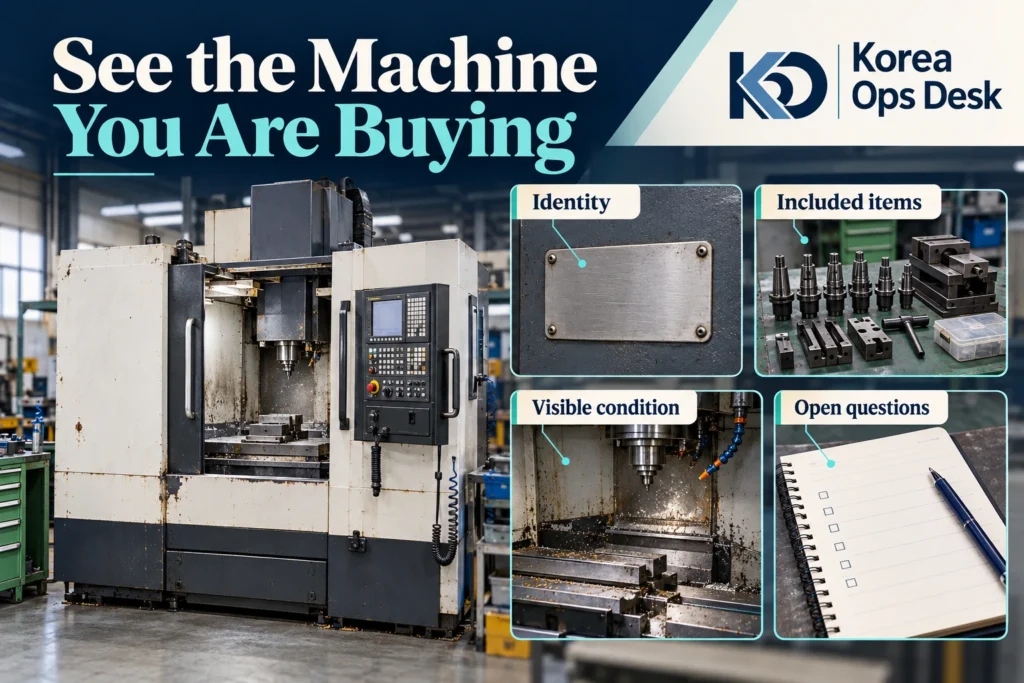
A used machine listing can look convincing and still leave the buying decision unresolved. You may see a clean front panel but not the serial plate, a running video without a clear machine identity, or a tool cabinet whose contents are excluded from the price. Before committing to a purchase in Korea, turn the listing into a specific evidence request that your purchasing and technical colleagues can actually review.
1. Identify the exact machine before discussing condition
Create one record for each physical machine. Give it your own reference, then link that reference to the seller’s listing, location, manufacturer, complete model and serial number. A dealer may have several similar machines. “The blue CNC in your warehouse” is not a reliable identifier when photographs and quotations move between colleagues.
| Record | Ask the seller for | How to use it |
|---|---|---|
| Machine identity | Manufacturer, full model, serial number and clear plate photo | Match the listing, quotation and photographed unit |
| Location | Current storage or operating address and contact | Arrange access to the correct machine |
| Seller role | Whether the seller owns the unit or is arranging its sale | Identify who can approve a visit and agree sale terms |
| Configuration | Controller, major options and modifications | Compare the actual unit with your requirement |
| Current status | Installed, operating, disconnected, stored or dismantled | Understand which observations are possible |
| Listing date | When the supplied photographs and video were taken | Separate current evidence from earlier marketing material |
Ask for a wide photograph showing where the plate sits on the machine, followed by a sharp close-up. This gives reviewers context and readable detail. If the plate is missing or unreadable, record that explicitly and request the available ownership, maintenance or other identification records. Do not fill the serial-number field from a similar machine’s brochure.
A model designation describes a product family or configuration; a serial number identifies a particular unit. Both matter. Where there are separate plates for the machine, motor, controller and auxiliary equipment, label each image accordingly. Otherwise an electrical plate for one component can be mistaken for the rating of the entire machine.
 Korea Ops Desk
Build one evidence folder for one physical machine
- 01
Identity
Model, serial number and location
- 02
Condition
Current dated photographs
- 03
Scope
Included and excluded items
- 04
Open questions
What the buyer still needs to establish
2. Send a photo list that follows the buyer’s questions
A useful photo request covers the whole machine and the details that could change your decision. Ask the seller to take a normal wide view before a close-up. A close-up of corrosion, for example, is more useful when a second photograph shows where it is located. Keep the original-resolution files where practical; a small image pasted into a quotation may hide the detail your technical reviewer needs.
| Photo group | Suggested views | Question answered |
|---|---|---|
| Overall machine | Front, rear, both sides and surrounding workspace | Is this the correct unit and what is visible around it? |
| Identity plates | Context view plus readable close-up of each relevant plate | Which machine and components are being offered? |
| Working area | Accessible table, bed, chuck, tooling area or process zone | What visible wear, damage or missing items need follow-up? |
| Controls | Controller model, normal display and any visible message | Which control configuration is present and what was displayed? |
| Visible condition | Leaks, corrosion, damaged covers, repairs and cable condition | What has been observed rather than merely described? |
| Accessories | Each item separately and one overall inventory photograph | What is included in the quoted price? |
| Documents | Manual covers, maintenance record index and relevant service entries | What records can the seller provide? |
| Removal route | Machine position, doorway/access route and loading area | What must be planned before collection? |
Ask the seller to identify anything that cannot be photographed and why: restricted access, the unit already crated, no permission to open a cover, or an unavailable operator. An unavailable view is an open item. It should not be silently treated as a satisfactory result.
Keep requests to normal, authorized access. Electrical panels, moving assemblies and energized equipment require appropriate personnel and procedures. Your purchasing shot list should state what evidence is needed; the site determines how it can be obtained safely. There is no benefit in asking a salesperson to improvise technical access for a photograph.
As a useful example of structured recording, Caterpillar’s Cat Inspect guidance combines asset identification with photos, comments and inspection records. The same recordkeeping principle helps a buyer: connect every observation to the correct asset and a specific question. It does not turn a purchasing photo report into a manufacturer inspection.
3. Describe visible condition without overstating what it proves
“Looks good” is a weak conclusion because different reviewers mean different things by it. Replace it with an observation: “The left cover has a dent; the seller says it occurred during storage; no internal examination was performed.” This gives your team a fact, an attributed explanation and the remaining question.
| Weak wording | More useful record | Next action |
|---|---|---|
| Machine is excellent | Front and side surfaces photographed; wear visible at [location] | Technical reviewer assesses whether additional evidence is needed |
| No problems | No abnormal message visible during the recorded sequence | Ask which functions were demonstrated and which were not |
| Recently serviced | Seller supplied service record dated [date] for [work] | Match the record to the serial number and review the scope |
| Fully equipped | Inventory lists [items], with quantities and photos | Confirm those items in the written offer |
| Ready to ship | Seller states packing can start after [condition] | Obtain actual packing and readiness arrangements |
Do not convert a seller’s statement into an independent finding. Label it “seller stated,” “document supplied,” “visible in photograph” or “observed during visit.” These categories are simple enough for a small business and prevent later confusion over what was actually established.
A photo may show a damaged cable jacket, but it does not measure electrical performance. A clean exterior does not establish internal wear. A movement video does not establish machining accuracy. If the purchase decision depends on a performance result, define the required demonstration or measurement with your technical team and request the appropriate record. Keep that requirement separate from the general photo visit.
4. Define what the operating demonstration must show
Ask what the seller can demonstrate in the machine’s current condition. A machine connected in an operating workshop allows different observations from one disconnected in storage. Establish this before booking a visit. Otherwise your representative can arrive with a detailed function list and discover that there is no power, tooling, material or operator available.
- Name the functions your technical reviewer wants to see and the conditions required for each.
- Identify who will operate the machine and whether the seller has agreed to the sequence.
- Ask for an identity shot at the beginning of the recording so the video can be linked to the unit.
- Record the displayed settings, relevant operating sequence and any messages that appear.
- Keep a list of functions not demonstrated and the reason for each.
- Agree what evidence your technical reviewer will accept before treating a demonstration as complete.
For a CNC purchase, the buyer may want to discuss axis movement, tool-changing operation or a defined machining demonstration. The exact scope depends on the machine and the buyer’s requirement. A short seller video of spindle rotation is not evidence that every function has been demonstrated. Ask the reviewer to identify which additional questions remain.
Subject: Demonstration request for machine [model / serial]
Before we arrange the visit, please confirm the current operating status of [machine reference].
Our technical reviewer would like evidence of the following functions: [list].
Please advise:
• Which functions can be demonstrated at the current location?
• Who will operate the machine?
• What material, tooling, power or other preparation is required?
• Are there any functions that cannot be demonstrated?
• May we photograph and record the agreed sequence for our internal review?
Please confirm the proposed date and any preparation costs separately.
Thank you.
Korea Ops DeskA useful demonstration has an agreed scope
- 01
Before the visit
Functions, preparation and operator
- 02
At the machine
Identity and agreed sequence
- 03
Evidence returned
Video, photos and attributed notes
- 04
Buyer review
Accepted evidence and unresolved questions
5. List every included item before comparing the price
A machine photograph often contains items that belong to the workshop rather than the sale. Mark the accessories, tools, fixtures, feeders, chillers, transformers, manuals and software-related items that are actually included. Ask for a separate list of excluded items that are visible in the listing.
| Inventory field | Example of a useful entry |
|---|---|
| Item and quantity | Tool holder: [type], [quantity], photograph A07 |
| Relationship to machine | Used with machine serial [reference] |
| Condition | Seller description plus visible evidence |
| Included status | Included in quotation [number/revision] |
| Documents or licences | Available documentation and any transfer conditions to be clarified |
| Packing location | Packed with the machine or separately in package [reference] |
If the seller offers optional accessories, show their prices and lead times separately. This lets you compare the machine-only offer with a complete package without losing track of scope. When an item is unavailable, ask whether the buyer must obtain it elsewhere before operation and pass that question to the technical reviewer.
Do not assume that a program stored on a controller, a software account or a maintenance arrangement transfers with the physical equipment. Ask the seller to describe what is included and obtain the relevant written terms. The purchasing record should identify the answer, not infer permission from a screenshot.
6. Plan removal, packing and collection while the machine is still accessible
A purchase can stall after commercial agreement if nobody has planned how the machine will leave its current location. Ask who is responsible for disconnection, draining where applicable, dismantling, lifting, packing, loading and handover. Obtain the proposed scope from the people performing the work, using the actual machine dimensions and access conditions.
| Workstream | Information to request | Record before collection |
|---|---|---|
| Preparation | What must be completed before movement? | Responsible party and agreed scope |
| Access | Doorway, floor route, lifting/loading access and site restrictions | Site information for the handling provider |
| Dimensions and weight | Machine information plus proposed final packing | Actual or estimated status clearly marked |
| Packing | Proposed protection, securing and package count | Packing specification and photographs when complete |
| Handover | Exact collection point and delivery term | Named location, contact and ready date |
| Documents | Invoice, packing list and agreed machine records | Correct identity and consistent quantities |
Use the same model and serial reference throughout the sale, packing and collection records. If accessories are packed separately, number the packages and map their contents to the inventory. Ask for photographs before closing a crate when these are needed for the buyer’s record, and agree that request early enough for the packing team to accommodate it.
Read the delivery term together with the practical arrangements. “Collection from Korea” does not identify who loads the vehicle or what packing is included. Resolve those points in the offer and collection brief, then give the final package information to the transport provider. Related details are covered in our Korean supplier quotation comparison guide.
7. Use a short visit brief and a disciplined follow-up log
A local visit is most useful when the representative knows what decision the buyer is trying to make. Send the seller details, machine identity, current quotation and prioritized questions before arranging the visit. Put essential evidence first. If time or access is limited, the representative should know which missing item would prevent the buyer from proceeding.
Subject: Photo and visit brief: [machine / seller / location]
Machine: [manufacturer / full model / serial if known]
Seller and location: [details]
Current quotation/listing: [references]
Priority 1 — identity and scope
[Plate photos, unit location, included inventory]
Priority 2 — visible condition
[Specific areas and existing concerns]
Priority 3 — agreed demonstration
[Functions, operator, permission and recording requirements]
Please return:
• A numbered photo list with short captions
• Seller answers attributed to the contact
• Documents received
• Items not checked and the reason
• Questions requiring the buyer’s technical decision
Buyer contact during visit: [name / time zone / contact]
After the visit, group the evidence into “answered,” “partly answered” and “open.” For each open item, assign a next action and a person. For example: “Controller screen photographed; installed options not documented; seller to supply option list by [date].” A folder containing 80 unlabelled images is much harder to use than 25 relevant images with a clear index.
If the seller cannot answer a question, preserve the exact gap. You may decide to request another document, arrange a specialist assessment or exclude the machine from the shortlist. The important point is that the purchasing decision should reflect the evidence available, including what remains unknown.
Korea Ops DeskTurn the visit into a decision record
- 01
Observed
Specific visible facts and photographs
- 02
Explained
Seller answers and supplied documents
- 03
Unresolved
Missing evidence and its consequence
- 04
Assigned
Next action, owner and date
8. Worked example: a promising listing with three unresolved items
Suppose an overseas buyer receives a listing for a used CNC machine. The price appears attractive, but the serial plate is unreadable, the photograph includes a tool cabinet, and the seller says the machine “worked before storage.” The buyer has three different questions: identity, sale scope and present operating evidence.
- Request a readable plate photograph linked to a wide machine view. Match the resulting identity to the revised quotation.
- Ask the seller to list the tool cabinet and its contents as included, optional or excluded. Do not value them from the listing photo.
- Establish whether power and an operator are available now. If not, record that no current demonstration can be provided at this stage.
- Ask the buyer’s technical reviewer what evidence is essential before purchase and what additional assessment is needed.
- Obtain the removal and packing proposal so the commercial comparison includes the practical work required.
- Keep the final decision tied to the exact machine, current offer and unresolved conditions.
This process does not need a large procurement department. One clear brief, a numbered evidence folder and a short open-item table can prevent weeks of repeated questions. Korea Ops Desk can handle the Korean-language follow-up and agreed local information collection, then organize the responses so your team can focus on the buying decision.
Need a clearer view of a used machine in Korea?
Send Korea Ops Desk the listing and the questions holding up your decision. We can contact the seller, request the missing records and arrange agreed Korea-side photo or visit support, with an English summary of the findings and open items.
Send us: Listing URL, seller contact, machine model/serial if available, current quotation, location and your priority questions.
24/7 inquiries · colin@koreaopsdesk.com
Related practical guides
Expanded on 2 November 2026. Worked transactions and message templates are illustrative examples.