How Overseas Businesses Can Arrange On-Site Assistance in Korea
Arrange local business assistance in Korea with a practical visit brief, access plan, photo list, authority rules, reporting template and follow-up workflow.
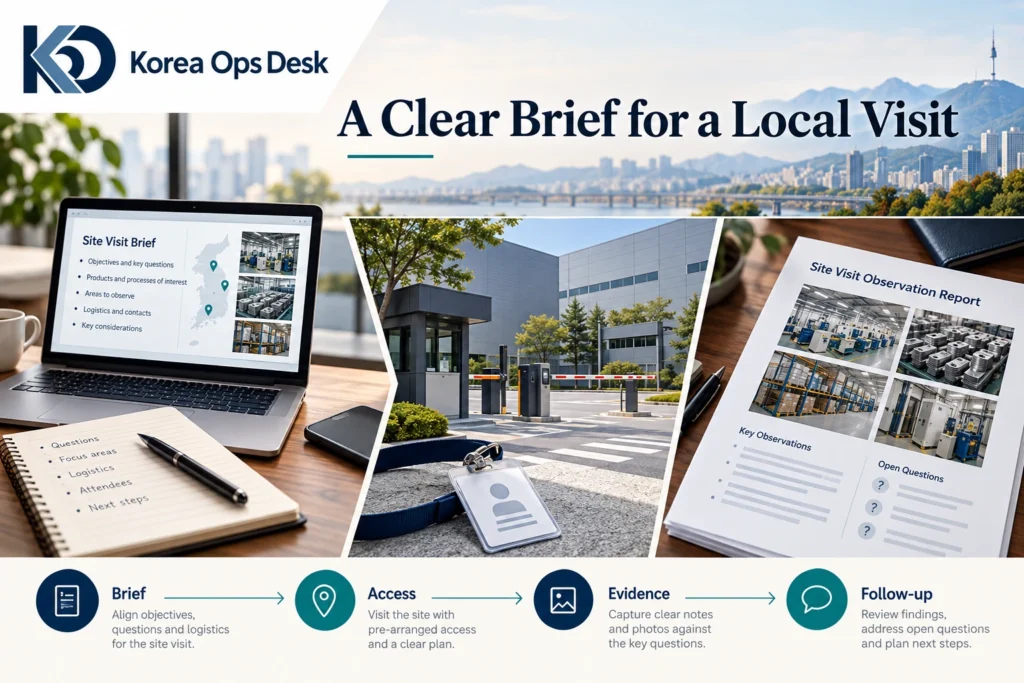
You need someone in Korea to attend a supplier meeting, photograph a machine’s identification plate, collect an agreed sample or visit selected exhibition booths. The task matters, but a flight just for that task may not make commercial sense. Local assistance works best when the person on site receives a brief they can execute and your team receives a report it can act on.
1. Choose the task by the result you need
Start with the decision your overseas team needs to make after the visit. “Please check this supplier” is too broad to execute consistently. “Confirm the meeting contact, collect the requested documents and photograph the agreed model labels so our engineer can compare them with the quotation” tells the person on site what matters. It also lets you assess whether a visit is necessary or whether a phone call and document request would resolve the issue.
| Assignment | Useful result | Preparation that makes it possible |
|---|---|---|
| Supplier meeting | Answers attributed to the relevant person, documents and follow-up commitments | Named host, agenda, priority questions |
| Equipment observation | Agreed photos of visible features and identification details | Exact equipment reference and permitted photo list |
| Sample collection | Identified items, condition record and documented handover | Release authorization, item list, packing and recipient details |
| Exhibition coverage | Responses from selected exhibitors, product references and next contacts | Current exhibitor list, priorities and meeting requests |
| Document collection | Named documents received from the agreed contact | Document titles, originals/copies required and recipient instructions |
For a machine, decide whether your team needs simple visible observations, measurements, a demonstration or a defined technical test. Those are different assignments with different preparations. Put any measurement method, required instrument or test procedure in the brief before arranging attendance. The ordinary presence of a person at a site should not be mistaken for a technical acceptance test.
A narrow assignment can still be commercially valuable. One clear photo of the correct model plate, a missing document collected from the right person or a written answer to the unresolved delivery question may be more useful than a long general tour. Build the visit around what will move your transaction forward.
2. Prepare a one-page brief with supporting files
Keep the main brief short enough to use on a phone during the visit. Attach detailed drawings, quotations and prior emails separately, with references to the exact pages or items needed. Avoid forwarding a long email chain without explaining what has already been settled and what remains open. Otherwise, time on site can be spent repeating old questions.
| Field | What to write | Example |
|---|---|---|
| Purpose | Decision the report must support | Confirm whether the offered unit matches our request before the next approval |
| Location | Korean address, building/entrance details and map reference | Office entrance differs from the loading gate |
| Host | Name, role, local phone and confirmed availability | Sales contact attends; warehouse colleague releases the sample |
| Priority tasks | Must complete, useful if time permits, optional | Readable model label is essential; general exterior photo is optional |
| Reference files | Current quotation, drawing or item-list version | Use quotation Q-03, not the earlier Q-02 |
| Evidence | Photos, document copies, notes or counts required | Photograph each of the three identified cartons |
| Authority | What may be agreed, signed, collected or spent | Collect released samples; refer substitutions to the buyer |
| Timing | Local visit window, overseas contact availability and report deadline | Use Korea Standard Time and a clear calendar date |
Give every item a simple reference. “Item A: controller, full model [model], quantity 1” is more reliable than “the small box.” If you want to compare a label with a quotation, provide both the requested text and the relevant quotation line. If the host uses Korean item names, add those when available so the person on site can connect the same product across languages.
State practical preferences that affect the visit: who introduces the assignment, whether the buyer’s name may be shared, which files may be shown to the host, and whether the overseas team wants a short live call. Share information through an agreed channel and only with the people who need it. A local visit brief should not accidentally expose unrelated supplier prices or customer information.
 Korea Ops Desk
A brief the on-site person can execute
- 01
Purpose
What decision should this visit support?
- 02
Priority tasks
What must be completed first?
- 03
Evidence
Which photos, documents and answers?
- 04
Authority
What can be done without another decision?
3. Confirm access with the host before travelling
A confirmed address is not the same as permission to enter. Ask the host to acknowledge the date, time, visitor name, purpose and agreed activities. Confirm where to meet and which entrance to use. Offices, warehouses and factories may have different entry arrangements, and the person who invited the visit may not be the person who can release goods or allow photography.
- Send the host a short agenda and the proposed local time window.
- Confirm the visitor’s name and the host’s reachable local contact.
- Ask which areas, equipment and documents will be available.
- Agree what may be photographed, copied or discussed remotely.
- Check site-specific entry instructions, clothing or protective equipment.
- Confirm who can release samples or documents and what acknowledgement is required.
- Reconfirm the arrangement when a material detail changes.
For exhibition work, check the current organizer’s registration and admission rules as well as the exhibitor’s willingness to meet. A venue calendar helps confirm where and when an event takes place; it does not by itself grant admission or permission to photograph a booth. For example, COEX’s official website provides event and visitor information, while each organizer manages its own event arrangements.
If photography is restricted, agree on an alternative that still serves the buyer’s purpose: a supplier-approved image, a written transcription of a label, a document copy or a host-approved video call. Decide this before the visit where possible. If the essential evidence cannot be collected, report that clearly so the buyer can choose the next step.
Subject: Visit confirmation: [company / purpose / date]
We would like to confirm the visit on [date] from [time] to [time], Korea Standard Time.
Visitor: [name / organization]
Meeting address and entrance: [details]
Purpose: [specific purpose]
The requested activities are:
1. [Priority question or observation]
2. [Agreed photographs or documents]
3. [Sample or document collection, if applicable]
Please confirm who will host the visit, which activities are permitted, and any entry or safety instructions. Please also let us know if an item or document will not be available.
Thank you,
[Name]
4. Design a photo and evidence plan
A good photo plan explains what each image should show and why your team needs it. “Take many photos” can produce attractive wide shots while missing the serial number or connection detail that matters. Ask for an overview to establish context, then closer views of the specific features your team needs to review. Name the files or group them by item so a label image can be connected to the correct unit.
| Evidence | Instruction | Useful reporting note |
|---|---|---|
| Location overview | Capture the permitted entrance or meeting location | Where the observation took place |
| Item overview | Show the complete agreed item from useful angles | Which unit or sample is pictured |
| Identification | Make model, serial or lot information readable where permitted | Transcribe unclear characters as uncertain |
| Requested feature | Photograph the named connector, accessory or visible condition | Record what is visible without inferring hidden condition |
| Package | Show carton identification, count and visible exterior condition | Tie images to the handover record |
| Document | Capture or collect the agreed version with permission | Title, issuer, date, reference and pages received |
For measurements, specify the points to be measured, units and required method. A ruler placed near an object in a photograph may help with general scale but may not answer a tolerance question. If your engineer needs a particular measurement, have them define it before the visit. Similarly, a short video showing a machine running should state what activity was observed; it should not be described as proof of every performance characteristic.
For a sample pickup, decide whether opening the packaging is permitted and necessary. Opening a sealed item without an agreed reason may create extra work. If only the outer carton is observed, say so. Record visible damage or a count difference before handover and seek instructions when it affects acceptance or transport.
Korea Ops DeskFour layers of useful visual evidence
- 01
Context
Where the observation happened
- 02
Whole item
Which equipment or sample is involved
- 03
Specific detail
The label, feature or condition requested
- 04
Connection
File reference linked to the visit notes
5. Use questions that produce actionable answers
Arrange questions in the order the buyer needs them answered. Start with identity and product references, move to the unresolved technical or commercial points, and finish with the next action. Keep yes/no questions for simple confirmations; use open questions where a short “yes” could hide important conditions.
| Broad question | More useful question | What to capture |
|---|---|---|
| Can you supply this? | Which exact configuration can you supply, and what differs from our attached request? | Model/version and deviations |
| Is it ready? | Which items are complete, and what remains before release or dispatch? | Ready items, unfinished tasks and owners |
| How long will it take? | What event starts the lead time, and what dispatch date follows from today’s status? | Starting condition and calendar date |
| Can you send documents? | Who will send which document, in what version, by which date? | Document, person and deadline |
| Can we get a sample? | Which sample can be released, at what cost, and who authorizes collection? | Sample identity and release arrangement |
During the meeting, separate what the host says from what the visitor sees. “The host stated that production will finish next week” is not the same as “production is complete.” If the buyer needs a commitment, ask the relevant supplier contact to confirm the agreed wording in writing. The visit report can then refer to that confirmation rather than relying on an ambiguous meeting impression.
A brief recap at the end of the meeting is useful: “We recorded these three answers; these two documents remain outstanding; the next update is due on this date.” It gives the host a chance to correct misunderstandings while everyone is still present. If a point requires another department, record the new contact and the promised response rather than treating the question as closed.
6. Agree how changes will be handled
Real visits rarely follow a brief perfectly. The intended contact may be absent, the machine may be at another location, or a sample may be different from the agreed specification. Before the visit, decide which changes can be handled on the spot and which need the buyer’s approval. This prevents a local representative from guessing while the overseas decision-maker is asleep.
| Change on site | Practical response | Decision needed |
|---|---|---|
| Host unavailable | Contact the agreed backup and record the attempted contact | Wait, reschedule or complete a limited task |
| Different item offered | Record the difference and obtain permitted photos | Buyer decides whether to accept a substitution |
| Additional travel required | Confirm location, time and extra scope | Approve before expanding the assignment |
| Photo permission withdrawn | Ask for an agreed alternative record | Decide whether the remaining evidence is sufficient |
| Unexpected document to sign | Identify what the document acknowledges | Refer commercial acceptance or commitments to the authorized person |
| Sample not ready | Record completed and incomplete preparation | Choose collection later or an alternative handover |
Give the local person an escalation contact and an availability window. If the buyer cannot be reached, specify a default action for the likely situations—for example, collect only the listed released items, leave substitutes with the supplier, and report the difference. These instructions are more practical than saying “use your judgment” for decisions that change cost, product or contractual commitments.
Also decide how extra time is handled. A meeting running long, an unplanned second location or a request to collect more items changes the assignment. A simple approval process keeps the visit focused and makes the final report easier to match to the agreed scope. It does not need to be a complicated contract; it needs to be clear enough for the people doing the work.
7. Ask for a report your team can use immediately
Agree the report format before the visit. The buyer usually needs a short decision summary first, then the supporting evidence. A large photo folder without an index makes the overseas team repeat the organizing work. Use a report with the visit details, completed tasks, findings, missing items and next actions, with links or file names for the evidence.
- Visit details: date, local time, location, attendees and purpose.
- Summary: the main answers and the points that affect the next decision.
- Task-by-task results: what was completed, partly completed or unavailable.
- Evidence index: photos and documents tied to the relevant item or question.
- Supplier statements: who said what, with any written confirmation.
- Open questions: missing answers and why they remain open.
- Action list: task, owner, due date and how the buyer will receive the update.
| Illustrative report entry | Clear wording |
|---|---|
| Observed | The label on the displayed unit reads [model]; see photos A-02 and A-03. |
| Supplier statement | The sales contact stated that the second unit would be available on [date]. |
| Document received | Quotation Q-03, two pages, issued by [entity], received from [contact]. |
| Not completed | The requested connector photo was not available because that area was not accessible during the visit. |
| Next action | Supplier to send the connector image; buyer’s engineer to review it before approving the configuration. |
For urgent assignments, agree a brief same-day update followed by the organized report. The first update can identify a decision that cannot wait; the final report should still preserve the evidence and exact references. Avoid presenting a quick message sent from the site as the complete record if supporting material is still being organized.
Korea Ops DeskMake the report easy to act on
- 01
Decision summary
What matters to the buyer now
- 02
Evidence index
Where each answer comes from
- 03
Open points
What was unavailable or unresolved
- 04
Next actions
Who does what and by when
8. Example: a supplier visit before a sample shipment
Imagine an overseas buyer has agreed to test two prototype components from a Korean supplier. The engineering team wants photographs of the current drawing revision on the labels, purchasing wants the sample invoice, and logistics needs a packed weight and collection address. The supplier says the samples are ready, but those three teams are asking separate questions.
A useful local brief combines the questions into one visit. The host confirms that the two samples will be available, allows label and packing photos, and names the person who can release them. The visitor receives the current drawing reference, the approved sample list and instructions to report a mismatch before collection. The buyer’s logistics contact prepares the courier arrangement once packing details are confirmed.
- Before the visit, the supplier confirms the sample references and permissions.
- On site, the visitor matches the visible labels to the brief and records any differences.
- The agreed documents and package information are collected from the responsible contact.
- If one sample differs, the buyer receives the evidence and decides the next action.
- The handover record identifies the items actually collected and their destination.
- The final report links each photo and document to the sample reference.
This approach turns several disconnected requests into one controlled information flow. It also gives the buyer a useful record if a sample later arrives without a label or the engineering team asks which revision was collected. The same logic can be adapted to a supplier meeting, equipment observation or selected exhibition visits.
- Can someone unfamiliar with the email history understand the brief?
- Has the host agreed to the visit and the essential activities?
- Are the items, documents and photo requests identified precisely?
- Is there a clear contact for decisions during the visit?
- Are changes and additional tasks handled through an agreed process?
- Will the report tell your team what to do next?
Need a local person to complete a business task in Korea?
Send KOD the location, purpose and deadline. We can help turn your request into a practical brief, coordinate with the host, carry out the agreed local support and report the findings in English. Start with the task you need completed—even if your documents are still scattered across several emails.
Send us: Company or event name, address if known, contact details, priority questions, requested photos or documents, target date and any files already received.
24/7 inquiries · colin@koreaopsdesk.com
Related practical guides
- Check a Korean supplier before arranging a visit
- Coordinate a Korean sample pickup and courier handover
- Prepare useful photo requests for used machinery
Expanded on 2 November 2026. Worked transactions and message templates are illustrative examples.