How Indian Companies Can Attend Korean Trade Shows Without Traveling to Korea
Indian companies can use Korea-side exhibition coverage to check product fit, MOQ, India sales channels and documents. Includes a booth brief, report template and supplier follow-up.
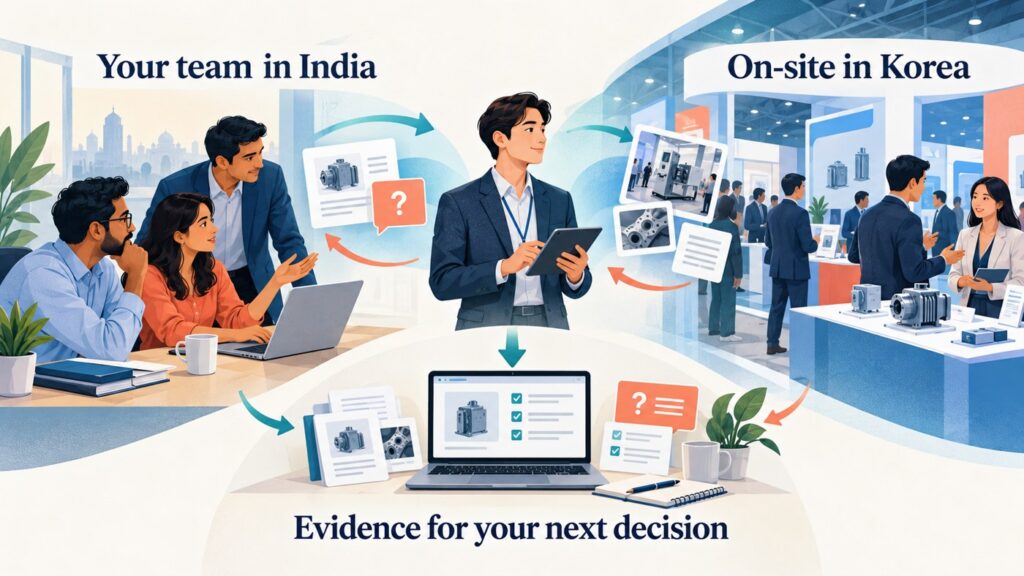
Do you need a flight to Korea, or clear answers from five exhibition booths? For an Indian importer, distributor or manufacturer, a focused local visit can establish product fit, trial quantities, India sales contacts and the documents needed for the next buying decision before your own team travels.
1. Don’t fly to Korea to discover the MOQ is wrong
A supplier can look promising in an exhibitor directory and still be a poor fit for your order size, application or market. Make those questions part of the first conversation.
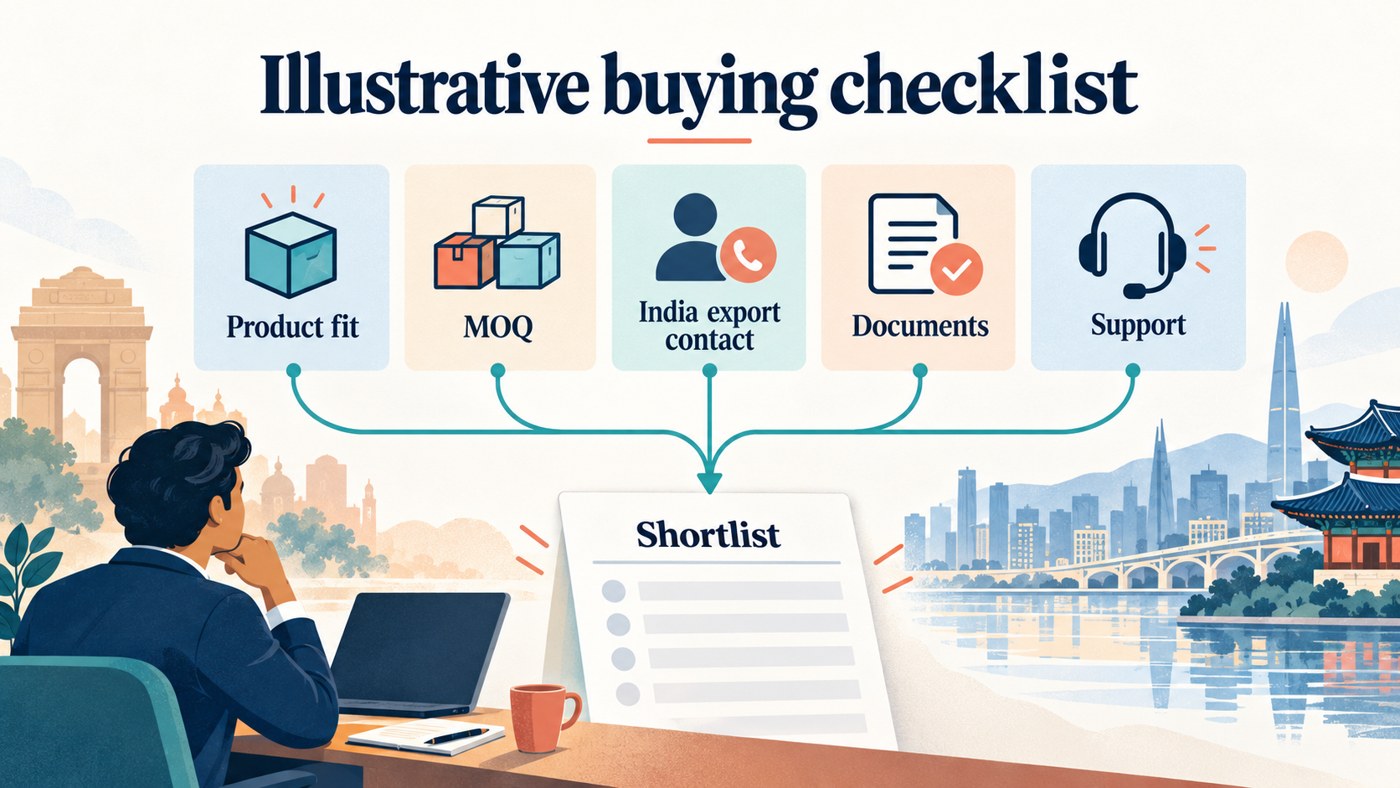
For an Indian importer, distributor or manufacturer, the useful early questions are specific:
- Does the company offer the exact product, configuration or manufacturing capability required?
- Can it work with your proposed trial quantity and expected order size?
- Does it handle enquiries from India directly, or through an existing distributor?
- Which specifications, commercial documents and product information can it provide?
- Who would handle technical questions, spare parts, training or after-sales support?
Put your own commercial limits into the brief before anyone enters the hall. If an exhibitor's minimum quantity is far beyond your initial requirement, your team should learn that before organizing a dedicated supplier visit.
2. Keep the buying work moving when travel is difficult
A trip involves airfare, accommodation, ground transport and staff days away. An engineer needed on your production floor may be difficult to release even when the travel budget is available.
If travel preparation or staff availability does not fit the show dates, define the questions that a local representative can pursue while your team remains in India.
The exhibition has a closing date. If your team cannot attend, a focused local assignment can still pursue the priority conversations while the booths are open.
Compare the quoted assignment with airfare, accommodation and staff days away. Decide which work genuinely needs your people in Korea and which information a local representative can collect first.
3. A website gives you a shortlist. Get the missing answers on site.
Official exhibitor lists are a good starting point. They help you identify companies, product categories and booth locations. Your brief should take the next step and identify what still needs an answer.
Free official services such as tradeKorea buyer matching can help narrow the field. KOD’s role is the specific work you need at the exhibition: approaching selected booths, pursuing prepared questions and collecting physical materials.
For an industrial component, that may be the full model number, connection type, included accessories and whether the displayed item matches your requirement. For machinery, it may be the demonstrated configuration, test conditions and the person who can review your application. For an OEM/ODM project, it may be sample development, packaging options and minimum quantities.
Questions worth taking to the booth include:
- Which exact product addresses this requirement, and what differences should our team review?
- Is the displayed version available to order, a prototype or a demonstration configuration?
- Which options, accessories or services are separate?
- What can you confirm in writing about quantity, availability and lead time?
- Who can answer the outstanding commercial and technical questions after the show?
An on-site representative can record visible details and request clarification. Your engineers still need the appropriate specifications, tests and technical review before approving a product. Build the assignment around information they can actually use.
4. Send KOD to the booths that matter most
A long exhibitor list can consume an entire day without resolving the important questions. Rank the companies before the visit.
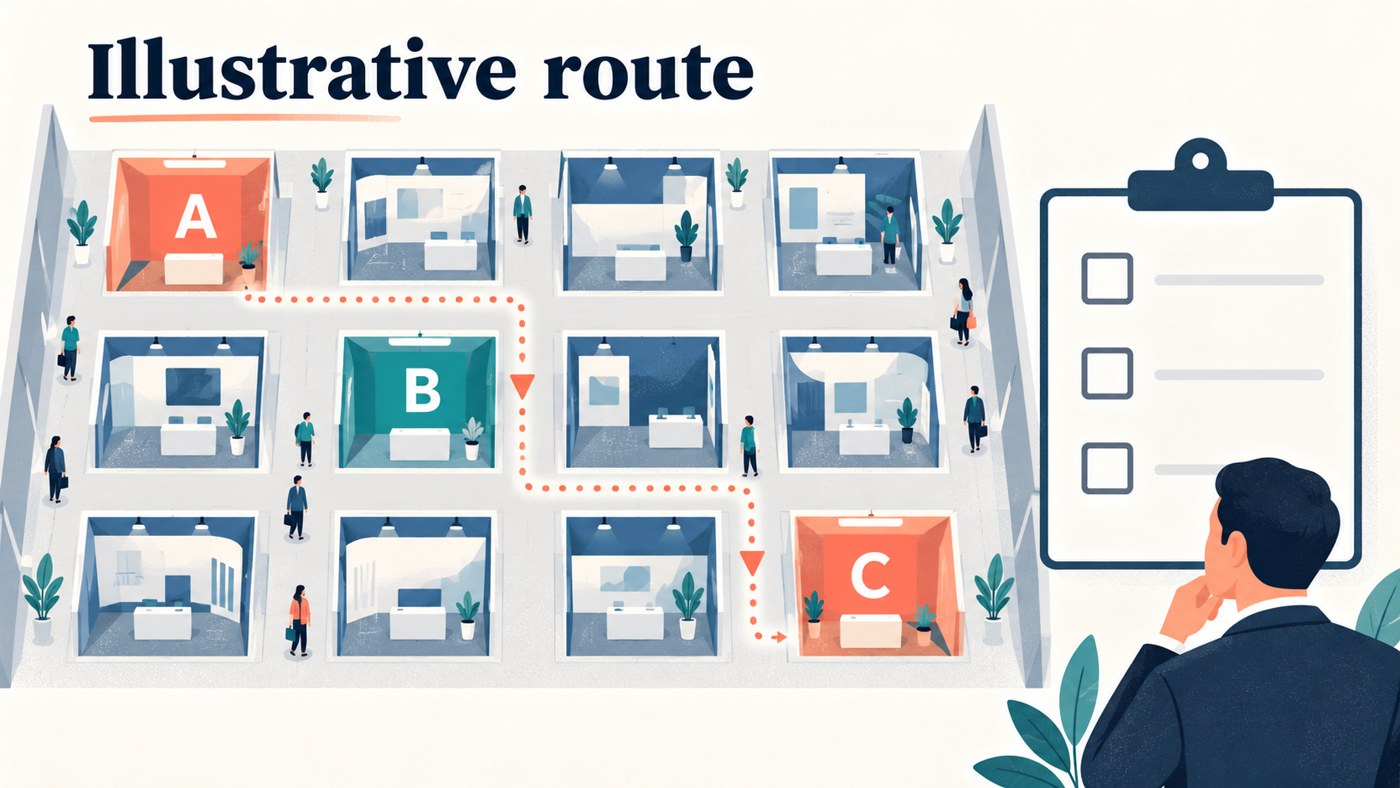
Put essential booths first. Give each one a reason for the visit, the questions to ask and the materials to request. Keep a second group for alternatives and a final group for broader discovery if time permits.
Share the product requirement, intended use, target quantity and destination market. Give KOD a short brief that can be discussed with exhibitors.
KOD can then assess the booth list against the event schedule, location and work required. The feasible coverage and deliverables are agreed before the assignment starts. A busy booth, unavailable specialist or restricted demonstration should be recorded as a follow-up item rather than quietly treated as completed.
Confirm registration and photography arrangements for the chosen event, and obtain permission for detailed product photographs or recordings.
5. Copy this brief for a Korea-side booth assignment
Start with a decision, not a request to “visit the exhibition.” If you need to decide which suppliers deserve a sample order, tell the representative what would qualify or disqualify a candidate. Put essential requirements above nice-to-have information. This makes a busy show day useful even if one export manager is unavailable.
| Brief field | What to provide |
|---|---|
| Buying decision | Select sample candidates / identify an export contact / compare configurations |
| Application and market | Intended use in India, customer type and product requirements |
| Commercial starting point | Trial quantity, expected repeat quantity and preferred delivery basis |
| Priority companies | Company, booth, reason for visit and must-answer questions |
| Documents wanted | Exact model sheet, quotation, catalogue or sample specification |
| Information to share | Approved company introduction and non-confidential requirements |
| Escalation contact | Person in India who can answer a live question |
| Report and timing | Required format, decision deadline and follow-up owner |
Subject: Korea exhibition coverage brief for our India buying team
We are reviewing [product/application] for [market/use in India]. We cannot attend [show, dates] and need answers from [priority companies].
Our immediate decision is [decision].
Must-have requirements: [list]
Trial quantity and likely repeat requirement: [details]
Questions for each booth: [list]
Documents/photos requested: [list]
What you may share: [company introduction / approved brief]
Contact available in India during the visit: [details]
Report needed by: [date]
Catalogue or sample collection needed: [details]
Please propose the practical coverage and deliverables for this brief.
India and Korea work on different time zones. Put both local times on a scheduled call invitation and name a backup contact. If the representative encounters an alternative product, it should know whether to collect basic information, request a call or leave that option for later. The brief can authorize a conversation without authorizing a purchase.
 Korea Ops Desk
Give the local visit a buying decision
- 01
Need
What your business is trying to source
- 02
Limits
Quantity, application and market fit
- 03
Questions
Answers needed from priority booths
- 04
Decision
Sample, technical call, visit or stop
6. Use a report that separates a sales answer from received evidence
A promising conversation is not yet a complete supplier file. Require one record per company, with the exact product and contact. Keep the material received beside the answer it supports. A supplier may say “we export to India,” but the useful next question is who handles your product and whether your company can buy directly or must work through a named channel.
| Report entry | Useful wording |
|---|---|
| Product | Model [reference], option [configuration], brochure page [number] |
| Observed | Displayed label and permitted photograph show [detail] |
| Supplier stated | [Name/role] said trial quantity could be reviewed |
| Received | Catalogue and model specification attached |
| Pending | Written MOQ and India sales-channel confirmation |
| Next action | Export manager to send quotation against attached brief |
| Owner and date | Named contact and agreed next update |
Avoid a single green “approved” label for a supplier that has only been met at a booth. Use stage labels such as “fit to investigate,” “documents pending,” “sample discussion” and “not suitable for this requirement.” They tell your purchasing team what to do next without implying a completed technical or commercial review.
A worked example: three booths, different outcomes
An Indian equipment distributor asks about a particular component range. Booth A has a suitable model but routes India sales through a distributor. Booth B offers direct sales but its trial quantity is above the buyer’s requirement. Booth C displays only a prototype. The useful report records those distinctions, identifies the India contact for A, requests a trial-quantity response from B and asks C for a product-release contact. It does not call all three “qualified suppliers.”
Korea Ops DeskMake each booth record actionable
- 01
Identity
Company, contact and exact product
- 02
Evidence
Documents and permitted photographs
- 03
Gaps
Unanswered or unsupported points
- 04
Follow-up
Named owner and next request
Link image filenames to the company and product rather than sending a mixed gallery. A photograph of a connector is far more useful when engineering knows the model, the side of the product shown and the question it was intended to resolve.
7. Turn the report into supplier replies, samples and a focused visit
Review the findings with purchasing and the relevant technical colleague. Choose a next action for every priority company. Send each supplier only the questions relevant to it, using the name of the booth contact and the model discussed so the conversation does not restart from zero.
Subject: Following our booth discussion: [product] for India
Korea Ops Desk spoke with [booth contact] on our behalf at [show] about [product/model]. We would like to review the next step for our India project.
Please send:
1. Specification for the proposed configuration
2. Trial-order and repeat-order quantity conditions
3. Quotation with currency, delivery basis and lead-time starting point
4. India sales/support contact and the proposed support route
5. Sample availability, cost and preparation details where applicable
The open technical questions are [list]. Please identify the person who can answer them and the expected reply date.
Thank you.
Treat sample collection as a defined task. Identify the supplier-approved sample, quantity, recipient, packaging and transport requirements before pickup. A sample offered at a booth may be a display piece, may require later preparation or may not be suitable for ordinary courier transport. Ask for the actual release and shipment information before promising a delivery date to your team.
- Choose suppliers for document follow-up and record why.
- Resolve model and quantity questions before comparing prices.
- Request samples only against a clear specification and review purpose.
- Arrange a technical call for the questions that need an engineer.
- Plan your own Korea visit around the suppliers and decisions that justify it.
Korea Ops DeskUse the show as the start of a buying process
- 01
Review
Sort the findings by fit and missing evidence
- 02
Clarify
Obtain comparable documents and terms
- 03
Evaluate
Samples or a technical discussion
- 04
Visit
Travel for a defined decision when needed
Korea Ops Desk can continue the Korean-language follow-up after the show, pursue promised documents and coordinate agreed local collection or visits. Send the findings and the unresolved questions; there is no need to build a new brief from scratch.
8. Give your team answers it can use after the show
A contact is valuable when your team knows why to follow up, what was discussed and what is still missing.
Agree a report format that keeps each booth visit together: company and booth, contact role, product discussed, materials collected, answers received and next action. Link any permitted photographs to the relevant product or observation.
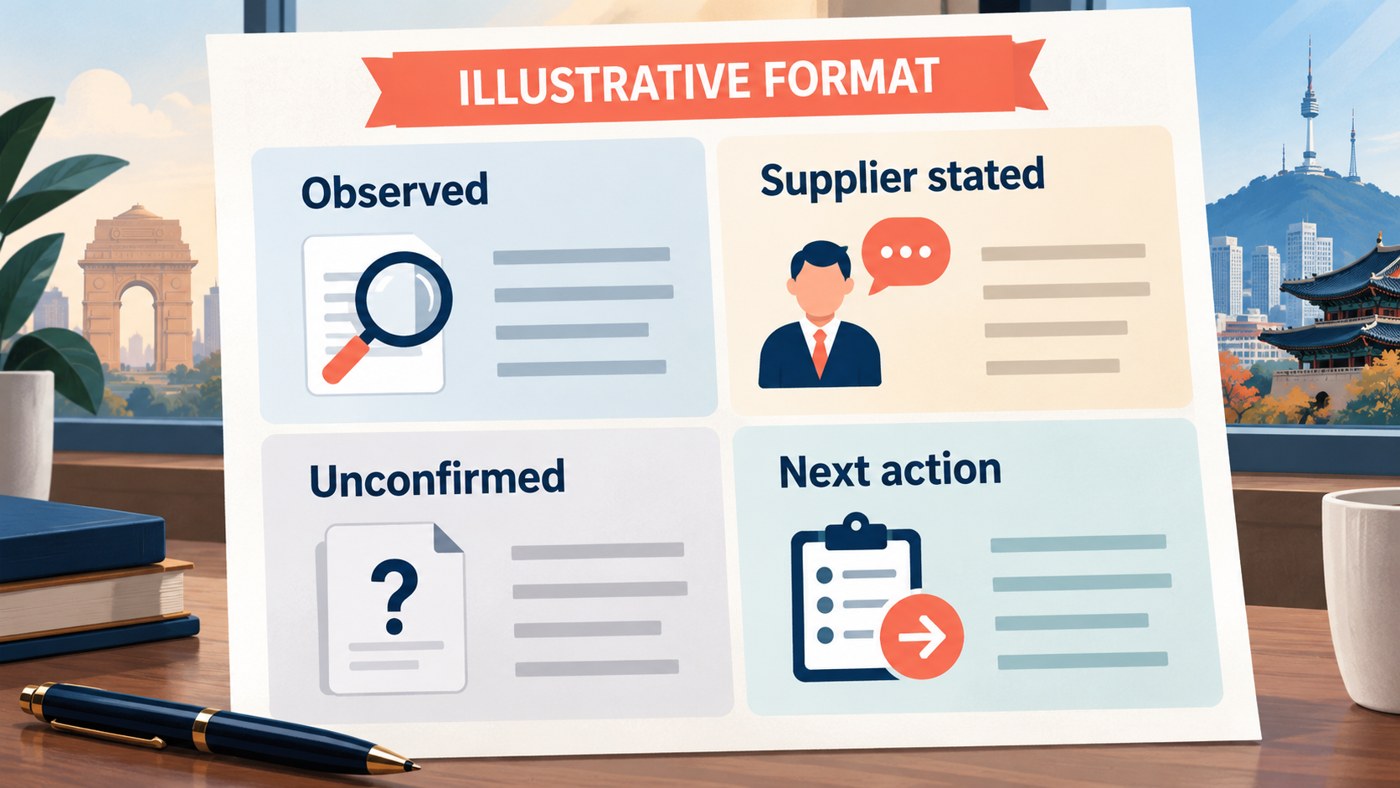
A useful structure separates four things:
- Observed: what the representative directly saw within the available access.
- Supplier stated: claims or proposed terms attributed to the company or person who provided them.
- Unconfirmed: unanswered questions, unavailable documents and details requiring further checking.
- Next action: the document, sample discussion, technical call or separate check needed to move forward.
Purchasing can assess the commercial response. Engineering can identify missing specifications. Management can decide whether a supplier merits more time.
Where language makes a conversation difficult, local communication can help clarify the request and identify the right colleague. Agree any specialist interpretation requirements in advance. Post-show supplier contact can also be scoped separately to pursue the promised documents and unresolved questions.
9. Bring the catalogues to your team in India
If physical catalogues matter to your review, include them in the assignment from the start. Specify the companies, product ranges and editions you want collected, where available.
Keep the materials connected to the visit record. A brochure should have a recognizable company, product and contact behind it. If an exhibitor provides a digital download instead, record that source so your team can find it later.
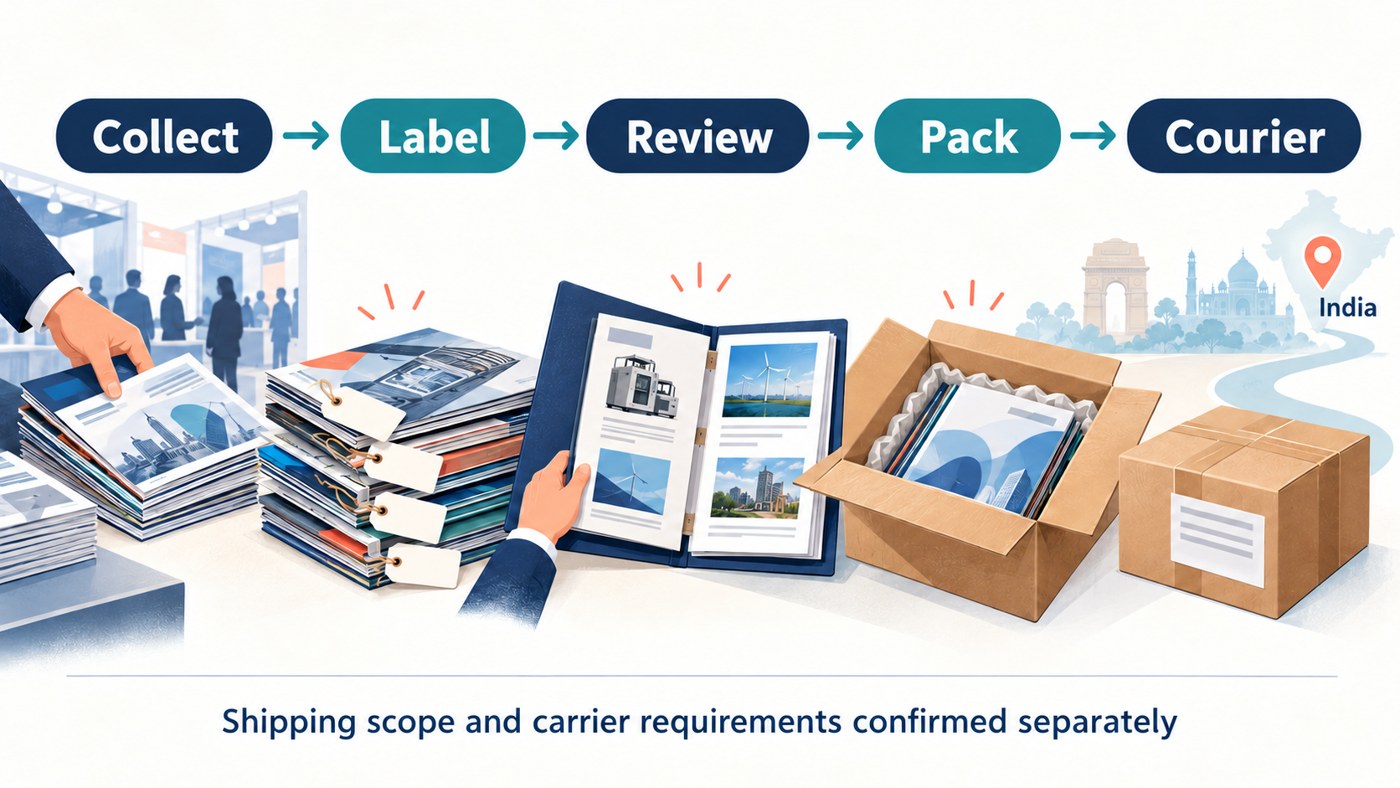
Ask KOD to include any required sorting, packing and onward courier coordination in the written scope. Confirm the receiving company and address, package details, shipping charges and carrier requirements before dispatch. Collection at the show, carrier acceptance and delivery in India are separate milestones.
Give the courier an accurate description of the actual contents and ask it to confirm the shipping and destination requirements before dispatch. Keep catalogues and product samples separately identified in the collection record.
If you also want samples, include them in the request so supplier release, handling and shipping can be assessed before collection.
10. Travel when you know who is worth meeting
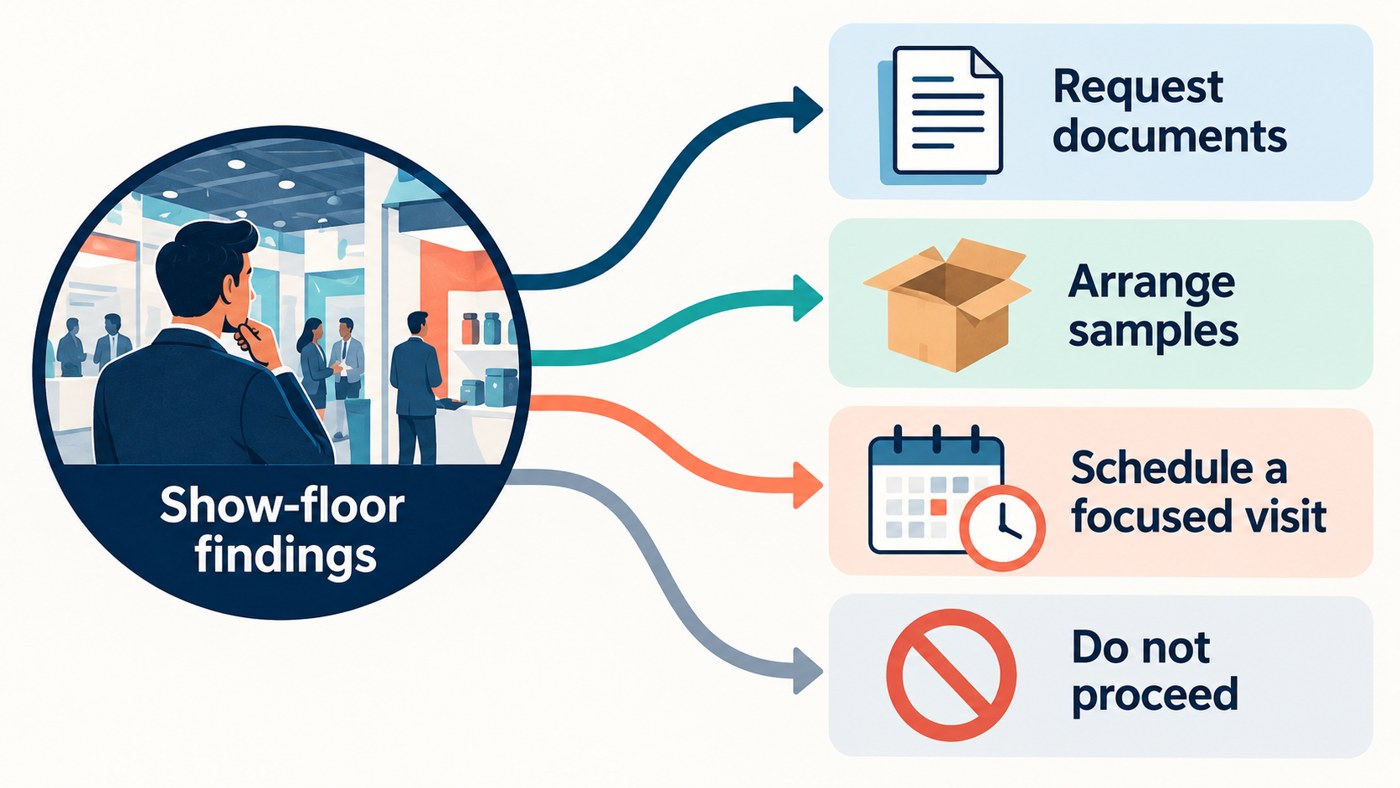
Once the findings are back, each company should have a clear next step.
Request missing documents from a promising supplier. Arrange a sample discussion where the proposed product fits. Set up a technical call if the application needs explanation. Consider a factory visit when a specific question requires access to the supplier's premises.
You can also decide to stop. A supplier may have the wrong product range, an unsuitable order structure or no workable route to the support you need. Discovering that early gives your team a reason to direct its attention elsewhere.
Your own visit becomes more purposeful when you already know who to meet, which product to discuss and which evidence remains outstanding. Complex technical evaluation, relationship-building and important negotiations may still warrant travel. Local exhibition coverage can prepare the ground for those meetings.
If the event has already ended, ask about supplier follow-up rather than treating the entire opportunity as lost. Booth access has a closing date; a discussion with an identified company may still be possible afterward.
Need answers from Korean exhibitors while your team stays in India?
Send Korea Ops Desk the show, priority exhibitors and the buying decision you need to make. We can organize a focused booth assignment and continue the supplier follow-up in Korea.
Send us: Exhibition and dates, product/application, target quantities, company shortlist, essential questions and required reporting date.
24/7 inquiries · colin@koreaopsdesk.com
Related practical guides
Expanded on 2 November 2026. Worked transactions and message templates are illustrative examples.