Shipping Machinery from Korea? Check the Wood Packaging Before Pickup
Check machinery wood packaging in Korea before pickup: plywood versus solid-wood components, ISPM 15 evidence, shipment-matched photos, dunnage and final packing changes.
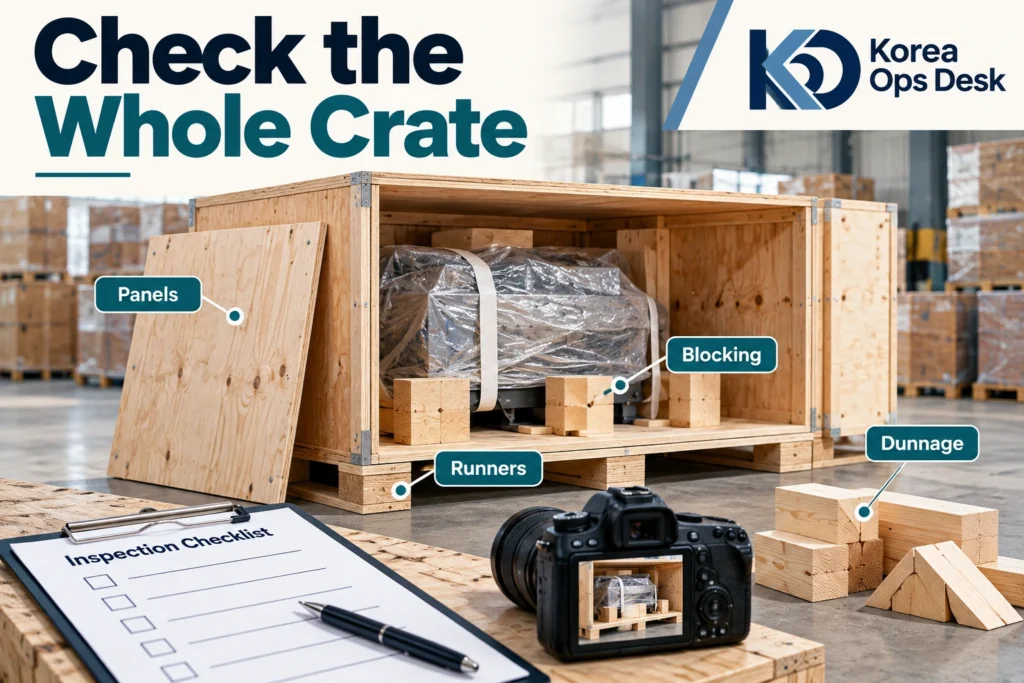
The machine is ready in Korea, the truck is booked and the supplier sends a photograph of a plywood crate. One question still matters: what wood has been used in the base, internal supports and loose packing around the load? A plywood panel does not describe the whole package. Check the final packing arrangement while the supplier can still show the materials and resolve questions before collection.
1. Review the whole packing unit, not only the crate walls
Machinery packing can combine different materials. A crate may have plywood walls, solid-wood runners, internal blocks and additional pieces used to support or secure the load. Loose wood used for this purpose is often called dunnage. Ask the packing provider to identify the materials in each part rather than accepting “wooden crate” as a complete description.
| Part of the packing | What to ask | Useful photograph |
|---|---|---|
| Walls and lid | Which material is used? | Overall view plus a representative detail |
| Base and runners | What supports the package from below? | Base/runners visible before loading |
| Internal blocking | What prevents the machine from moving? | Interior before closing |
| Separate dunnage | What loose wood will be added during loading? | Pieces and their relevant evidence before use |
| Final changes | Were any supports replaced or added? | Updated view of the changed arrangement |
The IPPC’s ISPM 15 standard distinguishes regulated raw-wood packaging from specified processed-wood exemptions, including packaging made wholly of qualifying processed materials. The word “wholly” matters for a mixed crate: plywood sides do not by themselves settle the status of solid-wood supports.
Keep plant-health compliance separate from whether the packing is mechanically suitable for the machine and journey. Both matter, but a visible mark does not establish lifting capacity or protection against movement. Ask the packing and transport providers to address their respective parts of the shipment.
 Korea Ops Desk
A crate has more than one material question
- 01
Panels
Walls and lid
- 02
Runners
Base supports
- 03
Blocking
Internal securing pieces
- 04
Dunnage
Loose wood added around the cargo
2. Confirm the actual destination and transit requirements
Give the logistics contact the destination country, any known transit route and the planned packing materials. Ask it to confirm the applicable requirements for that shipment. Do this before the crate is finalized so any required change can be made at the packing stage.
For the United States, USDA APHIS guidance describes requirements for wood packaging entering or transiting the country and recommends using accredited providers, checking relevant certification and including compliance in purchasing arrangements. This is a destination-specific reference, not a substitute for reviewing another country’s rules.
For Great Britain, the Forestry Commission guidance covers England, Scotland and Wales, with separate guidance for Northern Ireland. It addresses solid-wood packaging and processed-material exemptions. It also states that the ISPM 15 mark provides certification for compliant packaging; a separate phytosanitary or treatment certificate is not a substitute for the required mark.
| Route question | Information to provide |
|---|---|
| Final destination | Country and delivery point |
| Transit | Known transit countries or proposed route |
| Packing materials | Component-by-component description |
| Packing provider | Company preparing the actual unit |
| Evidence requested | Photographs or information the reviewing party needs |
| Review owner | Named logistics/destination contact |
| Timing | Packing completion and planned collection dates |
Avoid turning one country’s guidance into a universal paperwork checklist. Your supplier needs to know what the appointed reviewing party requires for this route. If the route changes, flag that change and confirm whether the packing review needs to be updated.
3. Ask the packing provider about the actual unit and relevant marks
Identify who supplied and prepared the packaging, not just the machine seller. Ask how the actual packaging and any separate dunnage are being addressed under the applicable requirements. Request the information needed by your logistics reviewer and keep the provider’s response with the shipment file.
ISPM 15’s marking provisions require a legible, durable mark visible in use, preferably on at least two opposite sides. “Preferably” should not be rewritten as an absolute two-side rule. The standard also allows the mark on an appropriate processed panel of an integrated mixed-material unit; its location on plywood is not by itself evidence of a problem. See Annex 2 of ISPM 15.
- Obtain a whole-package view showing where each photographed mark is located.
- Obtain a readable close-up rather than a distant or blurred image.
- Link the photo to the order and package reference.
- Ask separately about loose dunnage added during loading.
- Record the provider’s explanation of any unclear or changed material.
- Send unresolved questions to the appointed logistics reviewer before release.
Do not draw, copy or add a treatment mark yourself. If the provider says a correction or replacement is needed, have the appropriate authorized provider perform the work and supply the relevant updated evidence. A buyer’s photograph records what is visible; it does not authorize marking or certify treatment.
4. Create a photo plan before wrapping hides the evidence
Tell the supplier what needs to be photographed before final wrapping, closing and loading. If the request arrives after the crate is sealed, the necessary view may require reopening or moving a heavy package. A short early photo plan is usually easier for everyone.
| Photo stage | Requested view | Purpose |
|---|---|---|
| Before closure | Machine identity and internal supports | Connect contents and packing arrangement |
| Completed package | Whole unit with package/order reference | Identify the unit to be collected |
| Relevant marks | Context view and readable close-up | Let the reviewer assess the actual visible evidence |
| Base/access points | Runners and accessible support details | Show materials omitted from a front-only view |
| Loading preparation | Separate dunnage and later additions | Capture the final arrangement |
| After changes | Updated relevant views | Prevent an obsolete photo from representing the shipment |
Use simple filenames such as “Package-01-overall” and “Package-01-mark-left” rather than a folder of camera timestamps. Keep the original files and an index stating what each image shows. If there are several crates, number them consistently with the packing list.
A photograph from an earlier order can illustrate a packing method, but it cannot establish the condition of this shipment. Mark representative photos as representative in your working file and ask for current evidence when the actual package is ready. The distinction should be clear to the logistics reviewer.
Korea Ops DeskCapture evidence at the stage when it is visible
- 01
Before closing
Contents and internal materials
- 02
Before wrapping
Whole unit and readable marks
- 03
During loading
Dunnage and late additions
- 04
After a change
Updated photos for the final record
5. Use a supplier request that assigns the next action
Subject: Packing materials and photo record before pickup: [order]
Before collection of order [reference] for [destination/route], please confirm the final packing arrangement with your packing provider.
Please provide:
1. Materials used for walls/lid, base runners, internal blocking and separate dunnage
2. Packing provider name and relevant confirmation for the actual package
3. Whole-package photographs linked to package/order references
4. Readable close-ups of relevant marks, with context views
5. Photographs of internal supports before closure where requested
6. Any wood or supports to be added during loading
7. Final package count, dimensions and gross weights
Please notify us before changing the packing after these photographs. Our logistics contact [name] will review the remaining route-specific questions.
Open questions: [list]
Thank you.
Send the request early enough for the supplier to involve the packing company. Ask who owns the response and when the final evidence can be supplied. If the seller says “the forwarder handles it,” identify which forwarder, what scope it has accepted and whether it is handling packaging or only transport.
After a call, summarize the agreed materials, pending photographs and next update in writing. A general assurance that the crate is “export standard” does not answer a specific question about a solid-wood runner or separate dunnage. Ask for the missing detail rather than repeating the same broad request.
6. Handle common problems while the package is still in Korea
| Problem | Useful action before collection |
|---|---|
| Only plywood walls are shown | Request information and views for the base, blocking and loose wood |
| Mark photo is blurred | Request a readable close-up and context view |
| Supplier sends a generic certificate | Ask how it relates to the actual package and obtain the required physical evidence |
| Extra timber is added during loading | Update the material/evidence record and obtain review |
| Packing provider is unknown | Ask the seller to identify the company responsible |
| Photos show a different order | Request current shipment-matched photographs |
| Packing changes after review | Identify the change and return it to the reviewing contact |
| Reviewer cannot resolve the evidence | Assign the required clarification or corrective action before release |
Keep an action log with the issue, owner, evidence needed and status. For example: “Package 02 base material not identified; packing provider to confirm and send underside photographs before wrapping.” This tells the supplier exactly what to do and gives the buyer a clear reason why that item remains open.
If the provider proposes replacing a component, consider the resulting packing dimensions, weight and mechanical arrangement as well as the plant-health question. Give revised package information to the transport provider so the booking and handling plan remain accurate.
7. Close the packing review with the final collection record
The final file should show what was collected, not only what was planned. Keep the current packing list, material description, relevant photographs, provider replies and the reviewing contact’s disposition together. Separate confirmed facts from unresolved points or assumptions.
- Destination and known transit route have been communicated.
- Materials in the complete packing arrangement are identified.
- Actual package references match the packing list and photographs.
- Relevant mark/provider questions have been reviewed.
- Separate dunnage and loading additions have been addressed.
- Any change after the initial review has been recorded and resolved.
- Final dimensions, weights and package count are available for transport.
- The responsible person has confirmed the collection decision.
A local visit can help when the supplier’s photos are incomplete or a buyer needs an organized record before packing is closed. Define the permitted views and access in advance. Korea Ops Desk can coordinate the visit and collect agreed visible evidence, then return an English list of answers and outstanding questions for the buyer and logistics team.
Korea Ops DeskOne final file for one actual shipment
- 01
Package identity
Order and package numbers
- 02
Material record
Complete unit and separate dunnage
- 03
Evidence
Current photos and provider answers
- 04
Release record
Review outcome and collection details
8. Worked example: plywood walls with added loading timber
A machinery buyer receives clear photographs of a completed plywood-sided crate. The base runners and internal blocks are not described. On loading day, loose timber is added to support the cargo. The original front-view photo does not answer the questions about those components.
- Ask the packing provider to identify the runners and internal blocks.
- Obtain the relevant current evidence for the complete packing unit.
- Identify the loose timber added at loading and the party responsible for it.
- Send the combined information to the logistics reviewer for the actual route.
- Resolve any required correction with the responsible packing provider.
- Save the final photos and updated package information with the collection record.
The benefit is practical: the supplier can address a missing answer while the goods are still accessible in Korea. Korea Ops Desk can chase the specific packing information, coordinate the relevant contacts and organize shipment-matched photographs. Send us the order and the exact question your logistics team is waiting on.
Need clear packing evidence before machinery pickup in Korea?
Korea Ops Desk can follow up with your supplier and packing contact, collect the requested information and arrange agreed local photographs, with an English action list for your logistics team.
Send us: Supplier, order/machine reference, destination and route, planned pickup date, packing photos received and the unresolved questions from your logistics contact.
24/7 inquiries · colin@koreaopsdesk.com
Related practical guides
- Keep machinery condition checks in a separate evidence brief
- Prepare a clear collection and handover record
Expanded on 2 November 2026. Worked transactions and message templates are illustrative examples.