Bringing Demo Equipment to a Korean Trade Show? Plan the Return Before Shipping
Plan the return of demo equipment after a Korean trade show: ATA Carnet questions, serial-number inventory, packing, venue handover and the records to collect afterward.
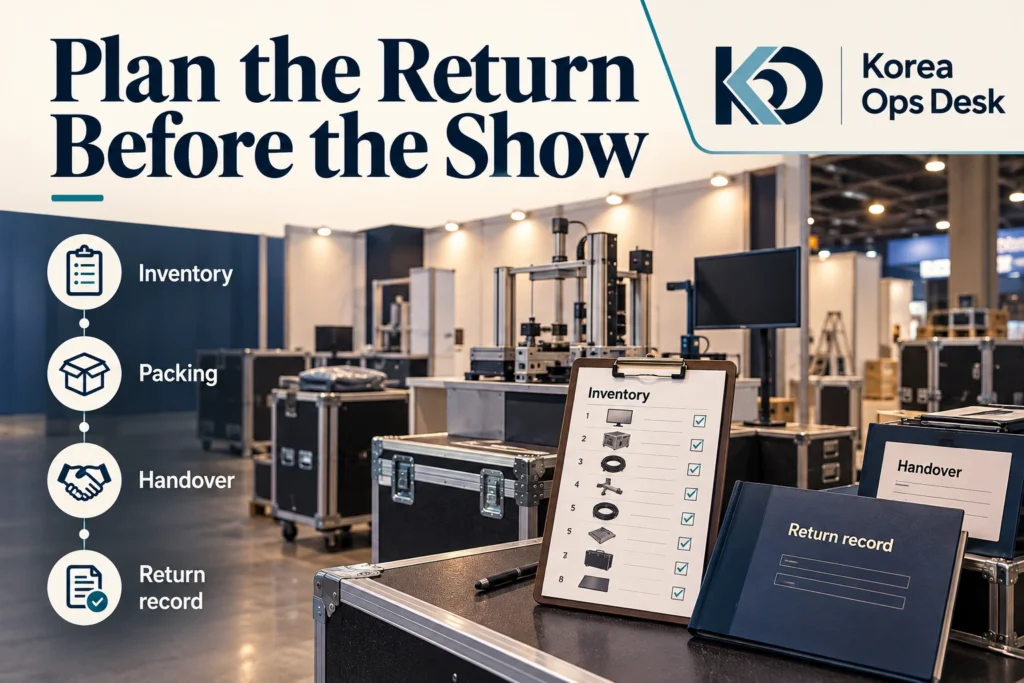
Your team leaves Korea on the last evening of a trade show. The demonstration machine is still at the booth, its accessories are in three different boxes and the forwarder is waiting for a named handover contact. This is the situation a return plan should prevent. Make the return arrangements before shipping the equipment to Korea, then keep one inventory from arrival through collection and the final return record.
1. Decide what will return before you choose the import procedure
Start with a list of everything being sent. Separate equipment that will return unchanged from items intended to be consumed, given away, sold, repaired or left in Korea. These are different movements even when the items travel in the same shipment. A machine used for a demonstration and hundreds of promotional samples should not be treated as one undifferentiated “exhibition shipment.”
An ATA Carnet is a temporary-admission document used for eligible goods and purposes. It is not a universal permission to import any exhibition material. The Korean Customs Service ATA Carnet notice, effective 2 January 2026 excludes purposes including sale, consumption, rental, repair and processing from the relevant carnet procedure. Other applicable import requirements still need to be addressed.
| Item group | What to establish | Working record |
|---|---|---|
| Demo equipment returning overseas | Identity, purpose and proposed route | Model, serial number, carnet/list reference |
| Reusable accessories | Whether included and how identified | Cables, tools, adapters and case numbers |
| Giveaways or consumable samples | Separate import/use arrangements | Description, quantity and recipient/use |
| Items that may stay in Korea | Decision and approved procedure before disposal | Owner, proposed action and responsible contact |
| Replacement or damaged items | How the changed movement will be handled | Identity, reason, instructions and records |
Ask the issuing association and your appointed clearance/logistics contact about the actual equipment, itinerary and purpose. The ICC ATA Carnet directory and overview helps identify issuing associations and participating territories. Do not assume every country accepts the same categories or the same digital process.
 Korea Ops Desk
Separate the shipment by what happens next
- 01
Return
Reusable demo equipment
- 02
Consume
Materials used during demonstrations
- 03
Give away
Promotional goods or samples
- 04
Change plan
Items sold, repaired or left behind
2. Build an inventory that another person can actually use
An inventory is useful only when someone who did not pack the shipment can identify every item. Use stable item numbers, clear descriptions, manufacturer/model information and serial numbers where present. Photograph distinguishing labels and the equipment with its case. For similar accessories without serial numbers, record a count and a recognizable description.
| Inventory field | Example format | Why it matters |
|---|---|---|
| Item reference | D-01 / accessory D-01-A | Links related pieces without losing identity |
| Description | Demo controller, model [model] | Avoids vague labels such as equipment |
| Serial number | As marked on the actual unit | Matches the returning unit |
| Quantity | One unit / two adapters | Makes missing accessories visible |
| Document reference | General-list item / packing-list line | Connects the physical and document records |
| Case reference | Case 02 of 04 | Supports packing and pickup |
| Photo reference | D-01-label / D-01-overall | Lets a remote colleague identify the item |
| Status | At booth / packed / handed over | Shows the latest physical stage |
Use the same identifiers in the packing list, photo folder and handover sheet. If a document uses a different numbering system, add a cross-reference column. Do not silently rename an item after the import documents have been prepared; ask the responsible contact how corrections should be recorded.
Before the shipment leaves the origin country, obtain a complete packing view and the critical identifying photographs. Keep a copy accessible to the Korea-side coordinator. The team on site should not have to wait for a sleeping colleague overseas to explain which unlabelled black case contains the controller.
Accessories are often the weak point
List detachable power supplies, cables, adapters, tooling, remote controls and demonstration fixtures. Decide which items travel inside the main case and which are packed separately. A returned machine without a proprietary adapter may be physically home but unavailable for the next demonstration.
3. Assign the paperwork, deadlines and document custody
Name the person responsible for the temporary-import and re-export process, the freight booking, the venue collection and the equipment itself. These may be different people. Record their direct contact details and backup contacts, including who is available after the show team has left Korea.
The Korean notice links temporary admission and re-export records to specified goods and applicable deadlines. For a particular shipment, ask your appointed clearance contact to identify the operative re-export deadline, carnet validity, required endorsements and any other relevant time limits. Do not calculate the deadline from the show closing date alone.
| Responsibility | Question to settle before arrival |
|---|---|
| Carnet/document holder | Who holds the original or applicable document at each stage? |
| Clearance contact | Who prepares the required customs steps and checks endorsements? |
| Freight contact | Who books the return route and communicates changes? |
| Venue contact | Who confirms move-out access and collection arrangements? |
| Equipment owner | Who approves substitutions, damage actions or changes of use? |
| Local handover contact | Who meets the carrier and records the actual items collected? |
| Final record owner | Who follows up until the return file is complete? |
Where a representative acts for the holder, confirm the necessary authorization with the responsible parties. Make the document handover explicit: who receives it, when and how receipt is recorded. A folder left at a hotel reception is not a document-custody plan.
If you expect an extension or a change of purpose, raise it before the applicable deadline or action. Do not sell or leave the equipment behind on the assumption that the paperwork can be fixed afterward. Keep the decision and instructions from the responsible clearance contact in the shipment file.
4. Plan packing and venue collection around the actual move-out rules
Obtain the organizer’s or venue’s current move-out instructions. Record when equipment may be dismantled, where empty cases are stored, who can enter, how the vehicle reaches the collection point and what handling equipment or approved contractor is required. A carrier booking for the right date can still fail if the booth is inaccessible or the cases have not been released.
- Confirm the equipment shutdown and packing owner with the exhibitor.
- Bring the original inventory and case plan to the booth before dismantling.
- Check quantities and visible condition while items remain identifiable.
- Record agreed photographs before closing the cases.
- Pack using the equipment owner’s and appointed packing provider’s instructions.
- Label cases with the agreed shipment and case references.
- Confirm the collection contact, location, access instructions and time window.
- Have a backup instruction if packing or pickup is delayed.
Arrange technical dismantling, lifting and specialist packing with the people responsible for those tasks. A local business coordinator can organize contacts and document a handover; the handling method should come from the equipment owner and appropriate service providers.
Korea Ops DeskWork backward from the collection window
- 01
Access confirmed
Venue rules, vehicle route and contact
- 02
Equipment ready
Shutdown and packing responsibilities
- 03
Inventory checked
Items, accessories and photographs
- 04
Carrier handover
Cases, receipt and next destination
Keep passports, travel tickets and personal belongings out of equipment cases. Keep the documents required at the next stage accessible to the party who needs them. Confirm whether batteries, liquids or other regulated contents require separate transport arrangements rather than discovering them at the loading point.
5. Use a written return brief before the show opens
Subject: Return coordination brief: [show] / [equipment reference]
Please confirm the return arrangements for our demonstration equipment after [show, venue, dates].
Equipment: [inventory and serial-number list attached]
Cases: [number, identifiers and planned packing arrangement]
Temporary-import reference: [reference]
Responsible clearance contact: [name and details]
Re-export/carnet deadlines to be confirmed by: [name]
Original/document custody: [holder and handover plan]
Packing owner and ready time: [details]
Venue move-out/access instructions: [link or attachment]
Carrier and collection window: [details]
Local handover contact and backup: [details]
Return destination and receiving contact: [details]
Please identify any missing information, required authorizations or transport restrictions. After collection, please send the handover receipt and confirm which further records will evidence the relevant export/return steps.
If the plan changes, please notify all named contacts before taking action.
Make the brief a controlled working document with a revision date. After a change, circulate the revised version and state what changed: for example, “Collection moved to Friday morning; the local contact remains the same; cases will stay in the approved storage location overnight.” This prevents different teams acting on different versions.
Keep an open-items list beneath the brief. Each item needs an owner and a next action. “Return shipping pending” is too broad; “Forwarder to confirm pickup slot after organizer issues move-out vehicle pass” is an actionable dependency.
6. Record the handover without confusing it with customs completion
At collection, record the cases and items actually handed over, the collecting party, the location and time, and any visible discrepancy. Use the inventory references. Obtain the receipt or handover acknowledgment available from the collecting party and save it with photographs that show the shipment identity.
A collection receipt establishes a handover. It does not by itself prove every required re-export endorsement, onward transport step or final receipt has been completed. Ask the clearance and freight contacts which records they will supply and who reviews them. Keep these milestones separate in your tracker.
| Milestone | Evidence to request | Status wording |
|---|---|---|
| Packed at venue | Inventory check and packing photographs | Ready for collection |
| Collected | Named carrier/agent acknowledgment | Handed over |
| Required export procedure | Relevant record confirmed by clearance contact | Export step confirmed / awaiting evidence |
| In transit | Booking/tracking information as applicable | Moving / delayed |
| Received at destination | Recipient acknowledgment and discrepancy check | Received |
| Temporary-admission file reviewed | Required records checked by responsible party | File complete / open items remain |
If documents are missing, ask for the exact missing record and the party responsible. Avoid asking every contact to “confirm everything is done.” One precise question—“Who has the endorsed re-export record, and when can it be shared with the holder?”—is easier to resolve.
7. Resolve missing items, damage and changed plans explicitly
| Situation | Immediate coordination task |
|---|---|
| An adapter is missing | Compare inventory, booth storage and packing photos; assign a search owner |
| A case contains a different unit | Record both identities and obtain instructions before shipment |
| Damage is visible | Document condition and notify the equipment owner and relevant providers |
| Carrier misses the window | Confirm permitted storage, revised access and a named local contact |
| Original paperwork is unavailable | Contact its custodian and clearance lead before proceeding |
| Buyer wants to purchase the demo | Pause the disposal decision and obtain the proper change-of-plan instructions |
| Return deadline is approaching | Escalate to the responsible clearance contact with exact dates and open tasks |
Do not replace missing facts with a clean-looking report. State what was observed, what another party reported and what remains unconfirmed. For example: “Case 03 collected; internal accessory count not observed because the case was sealed by the exhibitor.” This lets the owner decide whether further evidence is needed.
Korea Ops DeskClose each exception with a named action
- 01
Identify
Item and discrepancy
- 02
Record
Photos, documents and current location
- 03
Assign
Responsible person and next action
- 04
Resolve
Instruction, corrected record and confirmation
Korea Ops Desk can help keep these local tasks moving when your team has already left: contacting the exhibitor and venue, coordinating agreed access, gathering visible evidence and following up with the appointed logistics contacts. Send the current inventory and the specific issue so the response starts with the actual equipment.
8. Worked example: the team flies out before collection
An overseas exhibitor brings a demo controller, a display unit and two accessory cases to a Korean exhibition. The staff fly home after closing, while the appointed forwarder collects the next morning. The return plan names a local handover contact, records the four case references and assigns the clearance paperwork to the forwarder’s designated contact.
- Before closing, the exhibitor checks the item list and photographs the packed contents and labels.
- The local contact receives the agreed inventory, collection instructions and named carrier details.
- At pickup, the contact records four cases and notes a damaged outer corner on one case.
- The owner receives the photographs and the collecting party’s acknowledgment.
- The tracker marks collection complete but leaves the required export-record item open.
- The clearance contact supplies the relevant record; the responsible file owner reviews it and follows through to destination receipt.
The value is not a longer checklist. It is knowing who can act in Korea after your team leaves, and having a record that connects the same equipment through each stage. Prepare that arrangement while the show is still ahead of you.
Who will handle your demo equipment after your team leaves Korea?
Send Korea Ops Desk your show schedule and equipment list. We can coordinate agreed local inventory checks, venue contacts, collection handover and English follow-up with your appointed freight and clearance contacts.
Send us: Show and venue, equipment/case list, arrival and return plan, appointed logistics contact, move-out instructions and the tasks you need handled locally.
24/7 inquiries · colin@koreaopsdesk.com
Related practical guides
Expanded on 2 November 2026. Worked transactions and message templates are illustrative examples.