Replacing a Korean Gearbox or Geared Motor: Match the Model, Ratio and Mounting Before Ordering
Build a Korean gearbox replacement RFQ: nameplates, ratio, mounting, drawings, substitutions and order-release checks, with a practical supplier email.
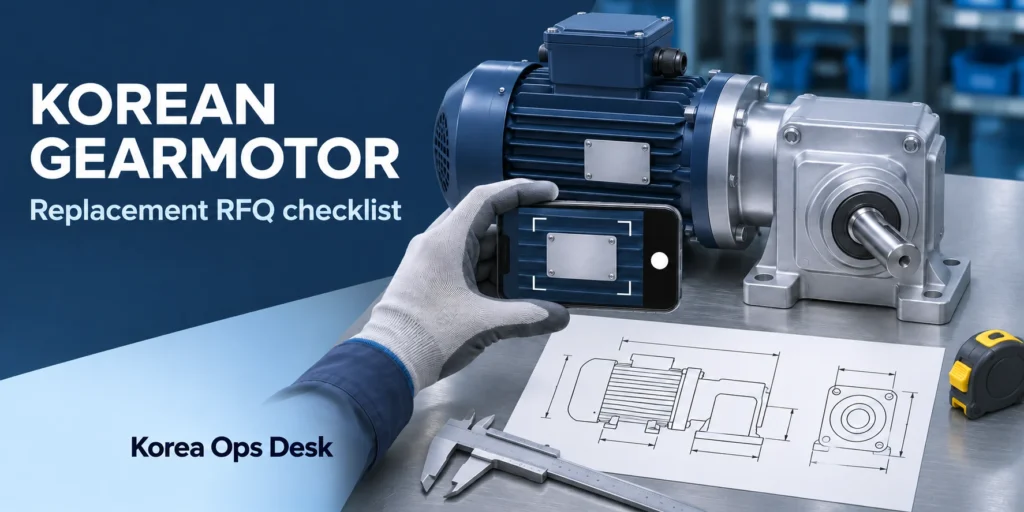
A replacement gearbox from Korea needs more than a matching power rating. Hyosung Heavy Industries’ official drawing index separates units by type, size and reduction-ratio range, while its geared-motor range includes different shaft and mounting arrangements. For an overseas buyer, the practical task is to connect the existing unit, the supplier’s complete offer and the drawing that the installation team can approve.
This guide explains how to build that purchasing record when a nameplate is incomplete, the original model may have changed or a Korean supplier proposes an alternative. It is a procurement guide based on manufacturer references checked on 3 November 2026, not an announcement of a new product or stock availability.
1. Define what needs replacing before asking for a price
A motor supplies rotational power. A gearbox, also called a gear reducer in these references, changes the relationship between input and output rotation. A geared motor combines a motor and reduction unit. These names describe different supply scopes: a quotation for a reducer alone is not the same purchase as a complete assembled geared motor.
Ask the person responsible for the machine to mark the intended scope on a photograph: motor only, reducer only or the complete assembly. Add the machine maker, machine model and internal asset reference. If the maintenance team has not determined which component needs replacement, record that as an unresolved technical decision rather than asking several sellers to assume different scopes.
Also identify what must remain in place. For example, an existing coupling, mounting base or driven shaft may have to be retained. Tell the supplier which interfaces the proposal must match and who will review the drawing. Purchasing does not need to redesign the equipment to organize this information; it needs a named technical owner and an unambiguous question.
 Korea Ops Desk
Three records must stay connected
- Existing unitOriginal nameplates, machine reference and installed arrangement
- Supplier’s offerComplete proposed designation, supply scope and declared differences
- Approved basisAccepted drawing revision, technical decision and purchase-order reference
2. Build an identification packet that can survive a handover
Start with records already held by maintenance, purchasing and the equipment supplier. Look for the previous purchase order, bill of materials, spare-parts list, machine manual and old drawing. A bill of materials is the equipment’s component list; its item number can help the machine maker locate the original assembly even when the visible motor model is incomplete.
Then ask authorized site personnel for clear photographs obtained under the site’s safe-access procedures. Request a close-up of each available motor and reducer plate, plus a wider view showing where each plate belongs. A second angle can help with glare. Keep the full original image as well as any readable close-up; cropping away the manufacturer or serial information can remove a useful identification route. Do not ask someone to remove guards or reach moving equipment merely to complete a procurement file.
| File or field | Where to obtain it | What to record |
|---|---|---|
| Motor and reducer plates | Authorized maintenance/site contact | Complete visible designation, serial if present, ratings and which component each image shows |
| Installed assembly views | Site contact | Overall orientation, attachment points and the connection to the driven equipment |
| Old PO or spare-parts reference | Purchasing or machine maker | Original supplier, part number, options and whether motor or complete assembly was supplied |
| Outline drawing | Document control, machine maker or manufacturer | Drawing number, revision, units and the equipment to which it applies |
| Application brief | Maintenance/engineering | Machine function, intended operating duty and any known change from the original application |
Use simple file names such as Asset-17_reducer-plate, Asset-17_motor-plate and Asset-17_installed-view. In the covering sheet, distinguish “read from plate,” “copied from old PO” and “not yet confirmed.” If a character might be a zero or the letter O, attach the photograph and mark the ambiguity. Do not silently choose the character that produces a search result.
3. Turn the information into a comparison sheet
The first useful comparison is not supplier A’s price against supplier B’s price. It is the existing installation against each supplier’s complete proposed configuration. A short deviation list records differences from the requested basis, including an item that remains unanswered. It makes the technical review manageable and gives purchasing a record of what was accepted.
The following is a buyer’s collection checklist, not a universal engineering specification. Ask the technical owner which fields and dimensions are necessary for this machine. Where a value is unknown, give it an owner rather than filling it with a typical value.
| Comparison field | What the buyer collects | What the supplier confirms |
|---|---|---|
| Complete identity and scope | Existing plate/part references; motor, reducer or assembly required | Full orderable designation and every included component |
| Reduction ratio and output requirement | Recorded ratio; required output speed/application information from engineering | Offered ratio and the stated operating basis |
| Shaft arrangement and connection | Existing solid/hollow arrangement and approved interface information | Matching offered arrangement and relevant drawing references |
| Mounting and envelope | Base/flange/shaft mounting, orientation and clearance constraints | Mounting configuration and dimensioned outline drawing |
| Motor and accessories | Required supply details and identified brake, encoder or other options | Motor configuration; which accessories are included or excluded |
| Application and duty | Driven equipment, operating pattern and conditions supplied by the technical owner | Manufacturer’s response to that stated application and any remaining questions |
| Document control | Existing document references and approval owner | Quote revision, drawing number/revision and written deviations |
Reduction ratio describes the relationship between the reducer’s input and output speeds. It is not a power rating. Mounting describes how the unit is attached to the installation. A hollow shaft and a solid output shaft are different connection arrangements, so their names are not interchangeable descriptions of the same order.
Hyosung’s geared-motor page lists hollow and solid shafts, and foot, flange and shaft mounting for its K series. That is a concrete reason to request the whole configuration rather than accepting “K-series, same kW” as a complete specification.
Korea Ops DeskFour questions behind “Will it replace the old unit?”
- Identity
What exact unit and supply scope are being offered?
- Connection
Which shaft, mounting and interface drawing apply?
- Operation
Has the technical owner reviewed ratio, duty and motor requirements?
- Difference
What changes, and who has accepted each change?
4. Ask for the drawing that applies to the exact offer
Hyosung’s Standard Gearbox Drawings index demonstrates why a family and size are not enough to select a reference. For SHA size 12, the index lists drawing EK1DO00060 for the 2–2.8 ratio range, EK1DO00061 for 3.15–4.5, and EK1DO00062 for 5–6.3. This establishes that different ratio groups have different drawing references; it does not establish which dimension differs between them.
Ask the supplier to identify the drawing number and revision in its quotation. Your technical reviewer should compare the relevant interfaces—such as shaft connection, mounting-hole arrangement, flange interface, centre height and available installation space—against the existing installation or approved machine drawing. Record the units. A photograph with a tape measure may help explain a question, but it does not replace a dimensioned drawing or a required tolerance.
The official Hyosung gear-reducer catalogue treats unit identification, mounting and shaft arrangement as selection information, alongside ratio, load and dimensions. Its technical selection guidance also distinguishes actual driven load from motor rating. Use the catalogue to formulate questions, then obtain the manufacturer’s answer for the proposed unit and application. Its publication/revision date was not established during this check.
If no drawing is available, ask the original machine maker for the spare-parts drawing or request a manufacturer-issued outline for the offered configuration. If the supplier sends a generic brochure, reply with the exact missing reference: “Please identify the drawing and revision covering the quoted mounting and shaft arrangement.” Keep the fit review open until the responsible technical person has enough evidence to decide.
5. Send one focused replacement request
An RFQ, or request for quotation, tells a supplier what it should price and what evidence is needed to evaluate the offer. Put the identity packet, requested quantity and required date in the first request. Attach a short list of unresolved points instead of scattering corrections across several unrelated messages.
Example email — replace the bracketed fields
Subject: Replacement identification request — [existing model / machine reference]
Hello [Name],
Please review the attached motor and reducer nameplate photographs for [machine/asset reference]. We need [motor only / reducer only / complete assembly], quantity [ ], for use in [destination country]. Our required delivery date is [date]; please distinguish your dispatch date from arrival at our site.
Please confirm the complete proposed model, reduction ratio, shaft and mounting configuration, drawing number/revision, and items included. Is this an exact replacement or a proposed alternative?
If the original is unavailable, please identify the proposed successor and list the differences for our technical review. The interfaces that must remain unchanged are [approved drawing/reference or attached list]. Please flag missing information rather than assuming a configuration.
Please also confirm stated availability, the event that starts the lead time, packing details and quotation validity. Our technical contact will review the configuration before purchase-order release.
Best regards,
[Name / company / contact]
If you do not yet have the original drawing, say so and request it. A supplier may need the serial number, machine maker’s reference or additional photographs before it can identify a successor. Give each follow-up request a numbered response line, a responsible contact and an agreed response date. When a reply arrives, update the comparison sheet rather than treating the entire request as answered because one attachment was supplied.
6. Handle substitutions and incomplete replies without losing the trail
“Equivalent” is the beginning of a review, not its conclusion. Ask whether the proposal is an unchanged replacement, a manufacturer-designated successor or a different product offered for the application. For a successor, request the cross-reference or written manufacturer explanation. For a different configuration, obtain a deviations list and send it to the technical owner before comparing the offers as like-for-like supply.
| What blocks the order | Next action | Evidence needed to close it |
|---|---|---|
| Plate is unreadable | Send original photos plus machine/old-PO references; ask which additional identifier would resolve the unit | Written identification with the source and any uncertainty recorded |
| Same power, ratio omitted | Ask for the offered ratio and application basis | Complete quotation and technical review of the relevant requirement |
| Drawing conflicts with the quotation | Point to the two exact references and ask which is current | Corrected, mutually consistent quote and drawing revision |
| Original model is unavailable | Request proposed successor or alternative, differences and current availability | Supplier’s identification basis plus buyer approval of the proposed configuration |
| Supplier has not replied | Follow up on the missing numbered fields through its established business contact | Answer, promised response date, or a documented decision to seek another offer |
| Configuration changes after approval | Return the changed fields to the technical owner and revise the order basis | New approval and matching supplier acknowledgement |
Purchasing example: two offers that are not yet comparable
Suppose an overseas maintenance team asks for a complete geared-motor assembly. One offer repeats the old model and power but omits the ratio. Another identifies a successor but shows a different mounting arrangement. Neither offer is ready to be treated as an equivalent replacement.
The buyer sends both suppliers the same identification packet and asks for complete designations, drawings and differences. The first missing field belongs to the supplier; the mounting decision belongs to the buyer’s technical reviewer. Only after these questions are resolved can purchasing compare the accepted scope, price and delivery basis. This is an illustrative workflow, not a KOD customer result.
Keep changes visible in a simple status column: confirmed, awaiting supplier, awaiting technical review or not applicable—with reason. A blank cell is not approval. If a phone call helps resolve the Korean-language exchange, send the agreed points back in writing and attach the resulting confirmation to the quotation record.
7. Freeze the order, then check what is actually ready to dispatch
Once the technical review is complete, make the accepted configuration easy to find in the purchase order and supplier acknowledgement. Include the full designation, quantity, motor/reducer/assembly scope, agreed accessories, drawing revision and accepted deviations. Keep the supplier’s stated availability separate from a confirmed readiness date; ask what starts any quoted lead time and which date is a dispatch commitment rather than an estimate.
Before pickup, request permitted photographs of the supplied unit’s nameplate and its packing reference, linked to the PO. Compare them with the approved configuration and packing list. If the nameplate differs, ask for the explanation before treating the shipment as cleared. Packaging photos and identity checks answer what is being offered for dispatch; any agreed operational test needs its own stated method and result.
Korea Ops DeskOrder-release and dispatch decision path
- Identity or scope missing?Return the specific question to the supplier; keep the order basis open.
- Technical difference proposed?Obtain the drawing and deviation record; send them to the technical owner.
- Accepted configuration documented?Carry the same references into the PO and supplier acknowledgement.
- Dispatch evidence matches?Record the unit and packing references against the approved order; resolve any mismatch before release.
For the commercial comparison, see how to compare Korean supplier quotations on the same basis. If the replacement includes a motor for a different electrical environment, use the separate 50 Hz configuration guide to organize the electrical questions. For an unfamiliar seller, keep supplier-identity checks alongside—not in place of—the product review.
Official sources and information date
- Hyosung Heavy Industries — Standard Gearbox Drawings: model, size, ratio-group and drawing references.
- Hyosung Heavy Industries — Geared Motors: product families and shaft/mounting options.
- Hyosung USA — Gear Reducer catalogue (PDF): identification and selection context.
Sources checked on 3 November 2026. The drawing index and product page do not display a publication date; the PDF revision date was not established. The purchasing workflow, comparison sheets and email above are KOD’s practical guidance, not manufacturer-issued replacement approvals.
Have the Korean part reference, but not a complete replacement offer?
Korea Ops Desk can contact the Korean manufacturer or supplier, request missing model information and drawings, follow up on quotations and organize the answers for your purchasing and technical teams. Where useful, we can coordinate an agreed local photo-check or visit to clarify what is available.
Send what you have: nameplate photographs; the old quotation, parts list or drawing; the quantity; destination country; and the date you need the replacement. You can start with incomplete records—we can help identify the next questions to ask.
24/7 inquiries · colin@koreaopsdesk.com
Explore industrial parts sourcing in Korea
Information checked: 3 November 2026. Korea Business Insights is published by Korea Ops Desk, operated by JS Network Inc.