Ordering Custom Parts from Korea? Confirm the Drawing Revision Before Production
Connect the drawing revision, reviewed sample and production instruction when ordering custom parts from Korea, with a document register, worked example and supplier email.
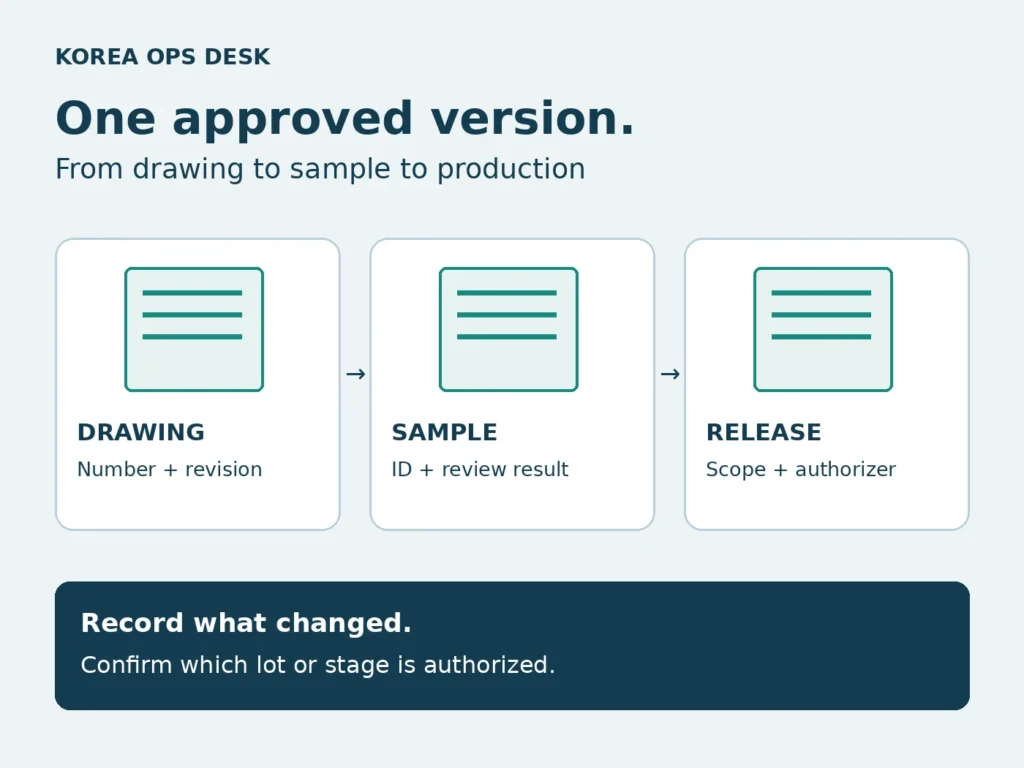
Before a Korean supplier starts making your custom parts, connect the approved drawing revision, the reviewed sample and the production instruction in one written record. State exactly what was approved, which quantity or stage may proceed and who has authority to release it. A short “looks good” reply can leave those questions unanswered.
This guide is for overseas buyers ordering parts made to their drawings. It explains how to prepare a release packet, review sample evidence and manage a change after an order has started. The workflow and templates are Korea Ops Desk’s purchasing recommendations. The manufacturer requirements cited below apply to those manufacturers’ supply chains; your own contract and technical approval process determine what your supplier must deliver.
Practical buyer guide · Sources checked 6 November 2026
1. Identify the drawing that controls the order
A drawing revision identifies a particular version of a technical drawing. The part number identifies what you are buying; the revision identifies which definition of that part applies. A filename such as “final-new.pdf” is not a reliable substitute for the drawing number, revision and approval status shown in the document.
Ask your engineering or design owner for the released drawing, any associated CAD model and the specifications referenced by the drawing. CAD is the computer-aided design file used to describe geometry; a PDF may also contain tolerances, material or finish notes that are not obvious from a three-dimensional model. Record the exact filenames and versions together. If the model and drawing disagree, ask the authorized design owner which information controls before the supplier acts on either interpretation.
Compare that packet with the quotation and purchase-order line. A supplier may have quoted revision B while the engineer later sent revision C. Ask the supplier to confirm whether the new version changes its price, tooling, material, inspection work or promised schedule. Purchasing should resolve commercial changes with engineering’s technical decision, rather than assuming an updated attachment automatically updates the order.
ISO 10013:2021 describes guidance for developing and maintaining documented information tailored to an organization’s needs. It supports deliberate document control, but does not prescribe this article’s file naming or approval template. For a concrete manufacturer example, Parker’s Global Supplier Quality Requirements Manual v10, effective 1 July 2026, addresses applicable document versions at points of use in §7.2.1. Ask how the confirmed version reaches the people actually manufacturing and inspecting your order.
 Korea Ops Desk
Four references must point to the same requirement
PO number, item and part number.
Drawing revision, CAD file and referenced specifications.
Sample ID and the report that evaluates it.
Authorized quantity or stage, conditions and decision-maker.
2. Build a release packet the supplier can acknowledge
Create a short document register rather than forwarding an entire historical email chain. Include the current files and a list identifying what each file is for. Preserve previous versions in your own history, clearly marked as superseded, so a later dispute can be traced. Do not silently overwrite the only record of what was originally quoted.
| Record | What to enter | Who should confirm it |
|---|---|---|
| Order identity | Buyer, supplier, PO, line, part number and quantity | Purchasing and supplier sales/project contact |
| Drawing and model | Document number, revision, date, file names and approval status | Design owner and supplier technical contact |
| Technical requirements | Material, finish, critical features and referenced specifications | Buyer’s engineering/quality reviewer |
| Sample plan | Sample quantity and IDs, manufacturing condition, reports and review steps | Supplier quality contact and buyer reviewer |
| Production permission | Stage/quantity allowed, open conditions and named authorizer | The person authorized under the purchase agreement |
| Change route | Who must approve changes and how approval will be recorded | Both parties’ designated owners |
Ask the supplier to return the register with a clear acknowledgement and list any missing or conflicting input. “Files received” confirms receipt. It does not establish that the supplier accepts a tolerance, can perform a test or has changed the manufacturing instruction. Ask those questions separately.
Share only the technical and commercial information needed for the assignment through the agreed channel. If the drawing is confidential or controlled under your company’s rules, establish the permitted recipients and handling conditions before distributing it further. A coordination request should not become unrestricted circulation of a complete design package.
3. Connect the sample to its evidence
A useful sample review starts with identity. Ask the supplier to label each submitted sample and state the drawing revision, material and manufacturing condition it represents. A prototype made by a different process may help assess shape or fit while leaving production-process questions open. Have your technical reviewer specify what that sample can establish.
Agree the characteristics to inspect, measurement method and acceptance limits before requesting a report. A ballooned drawing adds numbered references to features so each report row can be matched to a requirement. Your engineer should decide which features and tests are necessary; a purchasing coordinator should not invent tolerances or substitute a photograph for a required measurement.
Danfoss’s December 2025 Supplier Quality Manual, revision 9.7, §§5.1–5.2, connects production samples with reports and calls for actual measurement data for variable characteristics, traceable to specific submitted samples. It also describes identified retained master samples. These are Danfoss PPAP requirements, not a universal sample count or approval procedure. PPAP means Production Part Approval Process, a formal submission used in some supply relationships. Follow it when your agreement requires it; do not label a simple email-and-photo review “PPAP approved.”
For each agreed feature, compare the requirement with the reported result and sample ID. If a report only says “OK,” ask your reviewer whether actual values and method information are required. Where appearance matters, agree a separate basis for color, texture or visible defects, including the conditions under which it will be judged. A dimensional pass does not settle a finish question that nobody reviewed.
Korea Ops DeskMake a sample review repeatable
Sample S-01, part and drawing revision.
Agreed feature, method and reported result.
Named technical reviewer and precise acceptance scope.
Report, decision and agreed reference sample or photos.
4. Write an approval with a defined scope
Record the decision in the format required by your contract or quality procedure. It should identify the documents and samples reviewed, the accepted characteristics, unresolved items, any permitted exceptions and the production stage or quantity being released. Name the person making the decision and the date.
A deviation is an authorized departure from a specified requirement. If your technical team considers a temporary exception, identify the affected part, lot or quantity, the exact difference, its permitted duration and the required authorizer. Do not turn a temporary acceptance into an undocumented permanent drawing change. Parker’s current manual makes that distinction in §8.7.3. Its §8.7.1.1 also requires the applicable deviation form rather than treating an email alone as a substitute. Use the actual procedure governing your order.
Separate technical approval from commercial release when different people own those decisions. Engineering may approve a sample’s dimensions while purchasing still needs confirmation of the revised price or production quantity. The supplier should receive one consistent instruction that resolves both, not contradictory messages from separate departments.
5. Handle a revision after production starts
Start by asking what has already happened: material ordered, tooling completed, parts in process, finished stock or goods packed. Request quantities by stage and the revision used. Do not assume every unit is still changeable because dispatch has not occurred.
Have the design owner explain the technical difference and the supplier assess the affected work. Ask which existing samples or reports remain relevant and which checks need repeating. Agree the transition point: for example, a defined production lot or the next order. Keep old and new revision quantities separately identified, including packaging and inspection records where relevant.
Parker’s §7.2.3 requires its suppliers to record when a change enters production. For your own order, a dated change record and explicit affected-lot boundary serve a similar practical purpose. They let the receiving team understand what arrived without reconstructing weeks of messages.
Korea Ops DeskA new revision needs a transition decision
Material, tooling, in-process parts, finished goods and packed stock.
Technical effect, repeat checks, cost and schedule.
Which lot or quantity changes, and who approves it?
Updated shop documents, labels and records for the agreed scope.
6. Work through a mixed-revision example
Illustrative case: the sample follows revision B, but the order says C
A buyer receives a custom bracket sample marked S-01. Its report identifies drawing BR-10 revision B. The purchase order references revision C, which changes a hole position. The supplier asks for an “OK to produce” reply.
First, record the mismatch and send it to the design owner. Ask the supplier to state which revision was actually used for the sample and whether tooling or production has already started. The engineer determines whether the old sample can support any part of the review and what new evidence is required for the changed feature.
Then agree the revised sample or inspection work, associated cost and schedule, and the applicable production release. Do not rewrite the old report to show revision C if it did not assess revision C. Keep the original evidence and add the new result. The final release should identify the approved version and the exact scope allowed to proceed.
This is a hypothetical purchasing example, not a KOD customer case. BR-10 and S-01 are illustrative references.
7. Send a focused supplier request
Use this coordination template before the agreed release point. Replace the brackets, remove already-resolved questions and attach only the current authorized files. It requests information; it does not itself approve production or replace a required technical form.
Subject: Confirm drawing revision and sample approval status — [PO / part]
Hello [Name],
Before we issue the production instruction for [PO / line / quantity], please confirm the following:
- The drawing number, revision, date and PDF/CAD filenames your team will use.
- Any difference between those files, your quotation and our purchase order, including the proposed cost or schedule effect.
- The IDs of the submitted samples and the drawing revision and manufacturing condition they represent.
- The inspection-report references, remaining checks and any proposed deviation requiring our review.
- The current production status and quantity at each stage, if work has already started.
Please return the document register and identify the person responsible for updating the production and inspection instructions. Our technical reviewer is [name/role]; production release will come from [authorized person] through [agreed process].
Please identify any missing input needed from us and reply by [actual required date].
Best regards,
[Name / Company]
8. Close gaps and decide the next step
- The supplier has no drawing register: send a simple list with the order, document number, revision and filename. Ask it to acknowledge each entry and identify the production contact.
- The sample has no label: request a supplier-issued identifier and link it to the report and shipment. Do not assign an identity retrospectively without agreement about which item it describes.
- The reply is late: follow up with the exact unresolved references and the decision they are delaying. Ask whether the sales contact needs engineering or quality staff to answer.
- A change adds cost or time: request the affected work and revised terms in writing. Obtain the appropriate buyer approval before issuing a changed instruction.
- Different departments disagree: consolidate the issue list and send it to the designated technical and commercial owners. Keep the supplier’s position distinct from the buyer’s approval.
- A subcontractor makes the part: ask the contracting supplier how the agreed requirements and revisions reach that production site. Confirm the order-specific evidence required from that step.
The endpoint is a usable release record: matching references, reviewable sample evidence, closed or expressly authorized exceptions, and a clear instruction for the next stage. For later machinery acceptance, use the separate factory acceptance test planning guide. For material traceability, see how to connect material certificates to a shipment.
Official sources and scope
- ISO 10013:2021 official abstract, edition 1, March 2021: documented-information guidance. The full paid standard was not used.
- Parker Global Supplier Quality Requirements Manual v10, effective 1 July 2026: §§7.2.1, 7.2.3 and 8.7.1.1–8.7.3. The live PDF’s cover date controls, not the older date in its URL.
- Danfoss Supplier Quality Manual, December 2025, revision 9.7: §§5.1–5.4, sample identification, dimensional data and appearance review.
Original sources checked 6 November 2026. Manufacturer-specific procedures illustrate the evidence needed for a controlled review; they are not presented as Korean legal requirements or mandatory terms for every supplier.
View the Original ISO Guidance Summary
Need a clear drawing or sample-status answer from Korea?
Korea Ops Desk can contact your named Korean supplier, relay the agreed questions, request missing drawings or sample records and organize the replies in English. We can coordinate the communication while your authorized technical team makes the design and acceptance decisions.
For the initial inquiry, redact unrelated commercial or personal information and send confidential technical files only through an agreed channel.
Send what you have:
- Supplier name and contact details.
- PO or part reference and the current drawing version.
- Sample photos or report references, if available.
- The conflicting or unanswered questions.
- Your review contact and required decision date.
You do not need a complete packet before asking. Start with the correspondence and the question holding up your order so we can scope the follow-up.
24/7 inquiries · colin@koreaopsdesk.com