Buying Hydraulic Hose Assemblies from Korea? Match the Hose, Fittings and Drawing
A practical sourcing guide to hose markings, fitting connections, assembly drawings and supplier records, with verified Korean manufacturer examples and an RFQ template.
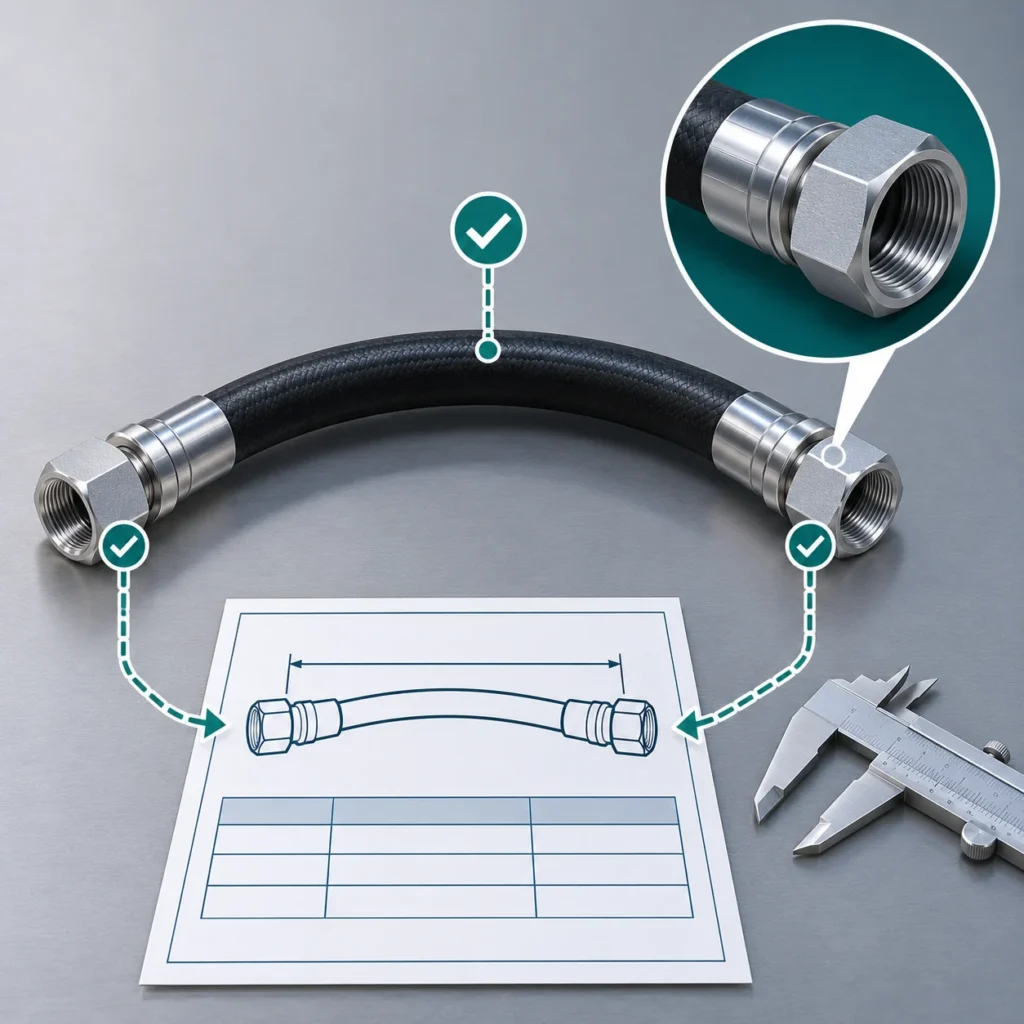
A hose marked “1/2 inch, 275 bar” may look like a straightforward replacement order. Korean manufacturer KOMAN’s own catalogue shows why it is not: two hose entries share those nominal size and operating-pressure figures but have different outside diameters and bend radii. The end connections introduce another question. Two fittings can share a thread designation while using different sealing angles.
For overseas buyers ordering hydraulic hose assemblies from Korea, the useful purchasing unit is the complete assembly: the identified hose, both end fittings, the approved combination and a drawing that defines length and orientation. This guide uses verified manufacturer examples to show what to request, how to compare an offer and which questions to close before production.
Buyer guide · Information checked 4 November 2026. Manufacturer examples below come from KOMAN’s Edition 2Q 2024 catalogues; the purchasing workflow is KOD’s practical analysis.
1. What the Korean catalogues actually show
KOMAN publishes separate hydraulic hose and fitting catalogues on its official catalogue page. Keeping those two documents together matters: one describes the flexible hose, while the other identifies end connections and fitting families. A hose entry alone is not a complete assembly specification.
Same bore and pressure, different dimensions
Page 10 of the Edition 2Q 2024 hose catalogue lists the following entries. “Bore” means the internal passage size. Outside diameter is the diameter measured across the outside of the hose; bend radius describes the listed curvature limit, not the assembly’s total length.
| Catalogue field | ES/EW208 | ES/EW1608 |
|---|---|---|
| Listed hose specification | SAE 100R2AT / EN 853 2SN | SAE 100R16 |
| Nominal bore / listed internal diameter | 1/2 inch / 12.5 mm | 1/2 inch / 12.5 mm |
| Operating pressure | 275 bar | 275 bar |
| Outside diameter | 22.1 mm | 20.6 mm |
| Listed bend radius | 180 mm | 90 mm |
The buying implication is specific: a reply matching only bore and pressure leaves the hose family and physical envelope unresolved. Ask the supplier to identify the exact offered series and confirm the current specification against the machine’s approved requirement. This comparison illustrates how to read a catalogue; it does not approve either hose as a substitute for the other.
Same thread, different sealing description
The fitting catalogue provides a second example. Its C202-12-08 entry is described as a female JIC 37° flared swivel; E202-12-08 is a female SAE 45° flared swivel. Both list a 3/4-16 thread and 1/2-inch hose bore. Thread designation alone therefore does not establish the sealing geometry. The C202 page also notes a dual-seat option, so the precise variant needs confirmation rather than a blanket assumption about interchangeability.
Record both the thread and the sealing form. For the JIC and SAE flare examples, the thread draws the specified sealing faces together. Other connection families use different sealing arrangements, including tapered threads. A fitting photograph, or the fact that a nut appears to screw onto an adapter, does not settle those details.
 Korea Ops Desk
One assembly, two interfaces to confirm
Exact hose series, size and fitting family. Supplier-approved combination and assembly process.
Thread, seal geometry, mating port and end configuration. Confirm each end separately.
2. Build an identification file before requesting a price
Start with the equipment maker’s parts list or approved assembly drawing. Ask your maintenance or engineering colleague for the machine model, serial reference, hose assembly part number and drawing revision. A revision identifies which version of the drawing is being ordered. If the original record exists, it gives the supplier a better starting point than a description reconstructed from a worn hose.
Ask qualified personnel to obtain photographs only when the equipment is in a safe condition under its isolation procedure. Procurement should request the evidence, not direct someone to loosen a live hydraulic connection. Useful photographs show the complete hose marking, the whole assembly, each end from the side and the relevant sealing face where safely accessible.
Label the ends A and B in every photograph and sketch. Preserve all legible characters in the hose marking, including the manufacturer, family, size, specification and any date or lot information. Do not silently fill in a damaged character. Mark it as unreadable and ask the supplier what additional evidence would resolve it.
| File item | Where to obtain it | What to record |
|---|---|---|
| Original assembly identity | Equipment parts list, OEM or engineering file | Part number, drawing number and revision |
| Hose identification | Legible marking photos and original specification | Full series, bore, stated pressure and available lot/date marks |
| End A and End B | Drawing, fitting reference and safe photographs | Connection family, size/pitch, sealing form, straight/elbow and swivel/fixed |
| Mating connections | Machine or adapter documentation | Port/adapter part numbers and relevant drawing |
| Installed arrangement | Engineering-approved route or safe overview photos | Space, movement, supports, heat and abrasion exposure |
If no drawing exists, send the evidence as an identification request first. Ask the supplier to return a proposed, dimensioned assembly drawing for technical review. Keep “identified from existing documentation” separate from “supplier-proposed identification.” That distinction prevents an assumption from becoming the specification simply because it appeared in a quotation.
3. Describe the operating conditions in separate fields
A pressure figure without its context is incomplete. Ask the equipment or engineering team for the maximum system pressure, including relevant peaks, and the unit used. Keep this distinct from normal operating pressure and from a catalogue burst-pressure figure. Burst pressure is not an allowable operating setting. The finished assembly rating can also be limited by either end fitting, so the hose’s printed pressure alone does not establish the assembly rating.
Also separate fluid temperature from ambient temperature. The fluid inside the hose and the air or nearby heat sources outside it can create different requirements. Identify the fluid by product/type and concentration where relevant rather than writing only “oil.” The hose tube, cover, fittings and seals all form part of the compatibility review described in Parker’s technical handbook.
Describe whether the assembly moves, how it is routed and where it might rub or encounter heat. Provide the required application facts to the proposed manufacturer or assembler, then request written confirmation of the selected assembly. Do not choose a new hose from a pressure table while leaving the fitting family and installation constraints unchanged by assumption.
When a value is unknown, name the person who can provide it. For example, record “peak pressure awaiting OEM confirmation” rather than substituting the pump’s nameplate figure. An initial supplier conversation can identify the missing inputs, but production approval should use the completed specification.
4. Agree the assembly drawing and both interfaces
“One metre long with two elbows” leaves important measurement questions open. Assembly length can be defined between different reference points depending on the end geometry. Require a drawing showing the actual points, units and tolerance. Tolerance is the permitted variation around the stated dimension. Have the technical reviewer agree that variation for the application.
If both ends have elbows, their relative orientation also matters. Ask the supplier to show the angle and the viewing direction used to define it. The length and orientation guidance in Parker’s handbook (Aa-12–Aa-13) illustrates these reference conventions. Keep the same end labels on the drawing, quotation and photographs. A verbal “90 degrees” without a view reference can describe a different assembly to each party.
The approved drawing should identify hose series and size, both fitting codes, length definition, orientation where relevant, and guards or other required accessories. Ask who manufactures the hose and where final assembly takes place as separate questions. A Korean seller’s address does not by itself establish the manufacturing origin of every component.
Korea Ops DeskTurn photographs into one approved drawing
Original part reference, complete marking and End A / End B evidence.
Length reference points, units, tolerance and elbow orientation.
Supplier confirms components, application and every proposed difference.
Technical reviewer approves the numbered revision used in the order.
For example, suppose a buyer has an old assembly photo but no readable marking, and a Korean supplier offers a similar-looking hose. The next useful action is to obtain the OEM reference or a proposed drawing and application confirmation, not to accept “same size” as technical approval. If the supplier proposes a different series, show the original requirement and proposed item side by side and send the differences to the responsible technical reviewer.
5. Specify the inspection and records you need
Buying an assembly and buying particular inspection evidence are related but separate requests. Ask the assembler which checks are included and which records it can supply. Do not assume that a catalogue’s burst or impulse-test statement means the exact assembly in your shipment will receive an individual proof test.
A proof test is a controlled test against a specified procedure and acceptance criteria. It is not the same as a destructive burst test. Your technical team should agree the applicable method, parameters, coverage and acceptance requirements with the supplier. Do not create a test pressure by multiplying a catalogue figure yourself.
RYCO’s assembly instructions distinguish inspection, conditional proof testing and documentation for specified contexts. The instructions provide examples of inspection, testing and record fields for their stated applications.
- Link the record: assembly identifier, order line and approved drawing revision.
- Identify the build: hose and fitting references, plus traceability details agreed for the order.
- Identify the test: procedure/reference, test date, stated conditions and result.
- Identify responsibility: assembler or test provider and the responsible sign-off.
- Define coverage: every supplied assembly or an agreed sample, clearly stated.
If cleaning, capped ends, protective packaging or individual labels matter, specify them in the quotation request. Ask when the evidence will be supplied and whether a requested record or special check changes the price or schedule. This makes document availability part of the agreed order rather than a surprise after packing.
6. A supplier RFQ you can adapt
The following is an illustrative request, not a specification for a particular machine. Replace the bracketed fields with approved information and mark unresolved fields explicitly.
Subject: Hydraulic hose assembly RFQ: [drawing / equipment reference]
Hello [Name],
Please quote [quantity] assemblies to drawing [number and revision]. End A is [connection description and part reference]; End B is [description and reference]. The attached drawing defines assembly length, measurement points, tolerance and elbow orientation where applicable.
The application uses [fluid product/type], with fluid temperature [range], ambient temperature [range] and maximum system pressure including transients [value/unit]. Please review the attached routing and movement information and confirm the proposed assembly against these conditions.
Please identify the exact hose series/size, both fitting part numbers, approved hose-to-fitting combination and assembly working-pressure rating. State hose manufacturing origin and final assembly location separately. List every deviation from our drawing before production.
Please state the inspections included and propose any requested proof-test procedure, pressure, hold time, test medium, acceptance criteria, coverage and records for our technical review. Confirm cleaning, end-capping, labelling and packing arrangements, any additional charges, and the lead-time starting point.
Send the proposed drawing and requested evidence list for approval. Our remaining open questions are [list]. Please identify who will answer each point and the expected response date.
Best regards,
[Name / Company]
7. Resolve missing information and substitutions
A short follow-up should identify the exact gap and the decision it blocks. “Please send more details” is less useful than “your quote lists the thread but not the sealing form for End B; please confirm the fitting code and matching port before we approve the drawing.”
| Situation | Next request | Decision gate |
|---|---|---|
| Hose marking is unreadable | Obtain the OEM assembly reference or supplier identification proposal with supporting evidence | No assumed equivalent series |
| Quote gives only thread size | Ask for sealing form, exact fitting code and mating connection confirmation | Both ends identified |
| Length differs between email and drawing | Ask for one corrected revision with measurement points and units | One approved document governs production |
| Requested item is unavailable | Obtain a separately identified alternative and a list of differences | Technical approval before substitution |
| Test record is unavailable | Clarify what was requested, what is included, and whether the agreed evidence can be provided | Resolve acceptance requirements before release |
| Supplier reply is late | Contact the responsible person with the drawing reference and a short numbered question list | Record answers, owner and next date |
Keep commercial comparison separate from unresolved technical differences. A lower-priced assembly with an unidentified end connection is not yet a comparable offer. Once the configuration is agreed, compare quantity, currency, included records, packaging, delivery basis and lead-time starting point. The separate KOD quotation-comparison guide explains that commercial review in more detail.
8. Close the order and shipment checks
Before releasing the purchase order, connect every line to the approved drawing revision, quantity and agreed evidence. Ask the supplier to acknowledge these references in writing. Preserve the approved file rather than relying on whichever attachment was sent last.
Before dispatch, request the agreed assembly labels or identification photographs, quantities and inspection records. Compare them with the order and drawing. If the shipment includes several assemblies, make sure each item can be connected to the relevant line and record. An attractive overall photograph cannot replace a missing identification link.
Korea Ops DeskKeep the order connected to the supplied assembly
Line, quantity and approved drawing revision.
Identified hose, End A, End B and agreed label.
Requested inspection/test record and relevant photographs.
Open differences closed by the responsible reviewer.
The practical completion point is a coherent order file: exact components, an approved drawing, stated application conditions, agreed records and a named decision-maker for any deviation. If the remaining problem is Korean-language communication or an unanswered supplier question, a defined local follow-up assignment can help close it.
Official sources
- KOMAN official catalogue library: Edition 2Q 2024 hose catalogue, page 10; fitting catalogue, printed B2 and B4. Catalogue specifications require current supplier confirmation for an order.
- Parker technical handbook: selection conditions, assembly length/orientation and connection identification.
- Parker safety guide: working-pressure, compatibility and safe handling principles; revised 28 September 2015.
- RYCO hose and coupling assembly instructions: inspection, testing and documentation sections. Requirements depend on the stated application and scope.
Sources checked 4 November 2026.
View the Original Manufacturer Catalogues
Need a complete answer from a Korean hose supplier?
Korea Ops Desk can contact the Korean manufacturer, distributor or assembler, request missing component references and drawings, follow up on quotations and organize the replies in English. Your purchasing and technical teams can then review the offer against one clear requirement.
Send what you have:
- Equipment or assembly part number and marking photographs.
- Current drawing or sketch, including both end connections.
- Quantity and delivery destination.
- Supplier quotation or unanswered email, if available.
- Required decision date and the questions holding up the order.
You can start with incomplete information. We can identify the next supplier questions and agree the Korea-side work.
24/7 inquiries · colin@koreaopsdesk.com
Before the product discussion, use our Korean supplier verification guide to connect the seller’s identity, role and contact information.