Buying Stainless Steel Parts from Korea? Match the Material Certificate to the Shipment
Link Korean stainless steel parts to the right material certificate: source heat, finished batch, package markings, missing records and a practical supplier email.
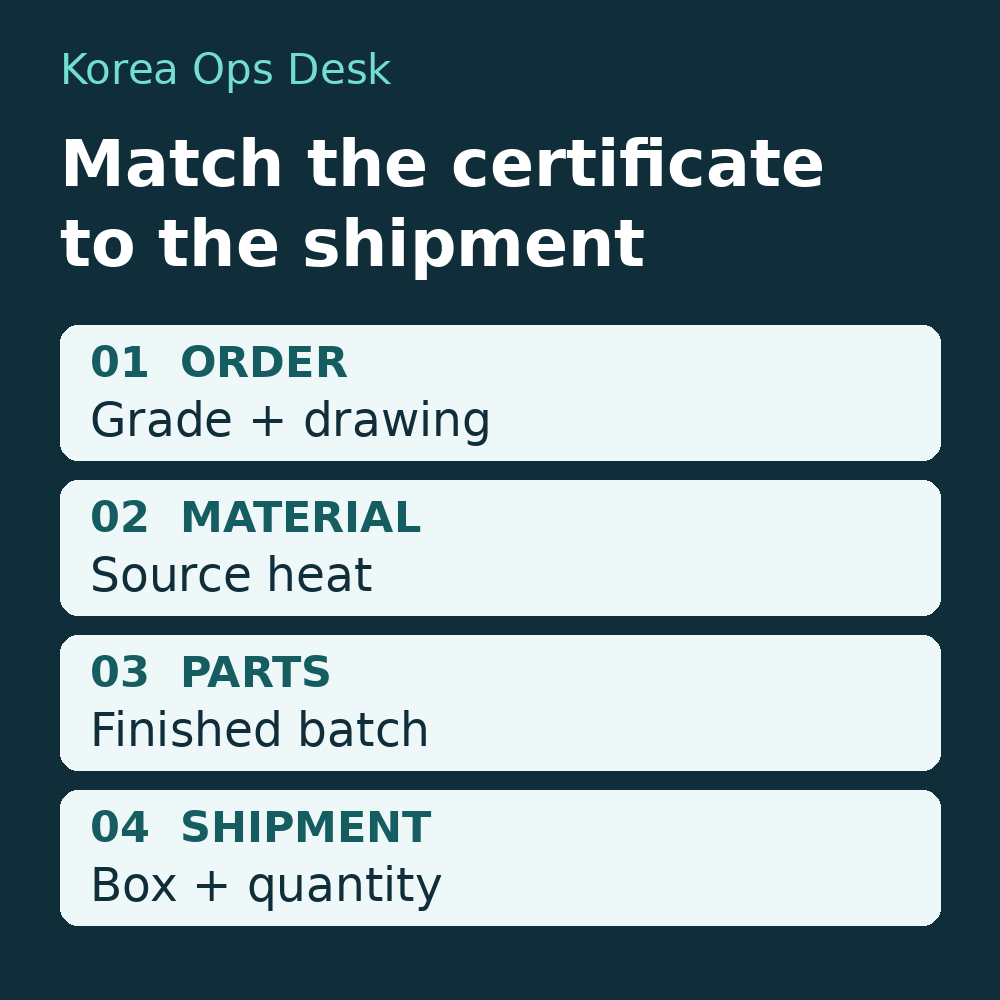
A mill certificate arrives in the inbox. The steel grade looks right. But which box of finished parts does it cover?
For an overseas buyer purchasing stainless steel parts from a Korean supplier, receiving a certificate is only one step. The useful result is a documented link between the purchase requirement, the source material, the finished-part batch and the shipment. That link needs particular attention when a distributor cuts stock, a workshop machines it or a supplier repacks several batches.
This guide explains a practical document-and-marking check before dispatch. It does not select a material grade for an engineering application. The buyer’s agreed specification and acceptance requirements remain the starting point.
Information checked: 2 November 2026. The workflow and worked example below are practical recommendations, not a report of a KOD customer transaction.
1. Define the requirement before requesting a certificate
“Please provide a steel certificate” leaves important choices open. Start with the purchase order, the accepted quotation and the current drawing revision. Ask the person responsible for material approval in your organization which specification, grade, condition, inspection document and additional tests the order actually requires. Put those requirements into the supplier’s order acknowledgement rather than relying on a later email attachment.
- Grade is the material designation under a stated specification. Record the specification as well as the short grade name; do not substitute a supposedly equivalent grade without the buyer’s technical approval.
- Heat number identifies a melt of metal. It is not normally a unique serial number for every finished part. It helps connect material to the relevant mill record.
- Batch or lot is a grouping reference used by the supplier or manufacturer. Ask what it groups: raw stock, a machining job, a finishing run or a packed delivery. Do not assume it means the same thing as a heat.
- Traceability means the records let you follow the supplied items through the relevant material and production references. If two numbers differ, the missing item may be a mapping record rather than a different certificate.
Names such as mill test certificate (MTC) and mill test report (MTR) are useful shorthand, but the title alone does not settle the document’s scope. The British Stainless Steel Association’s EN 10204 guide distinguishes inspection-document types from the steel specification. Type 3.1 concerns specific inspection results validated by the manufacturer’s authorized representative independent of manufacturing; it does not automatically mean an outside inspection company inspected the shipment. Type 3.2 involves an additional purchaser’s or officially designated inspector. Ask for the type required by the order, not the most impressive-looking label.
Write this into the buying brief: PO line and part number; drawing revision; material specification and grade; required supply condition; inspection-document type; any separately specified tests; and how the finished parts will remain identifiable through packing. Ask the supplier to confirm each item or list deviations before production starts.
2. Collect a shipment-specific document pack
Send the request to your existing sales contact and ask them to involve the quality or document-control person responsible for this order. Name the PO and the planned shipment. A generic sample certificate can explain the format during quotation, but it should be stored separately from the evidence for the actual goods.
- Original material certificate: request the complete file for each source heat used, including all relevant pages, the issuer’s identity and certificate reference. Keep the file as received.
- Finished-part mapping: ask for a supplier record linking the finished batch or job to the source heat. For machined parts, this is the bridge between the stock certificate and the items in the box.
- Packing allocation: request the PO line, part number, quantity, package ID and applicable batch or heat reference. The packing list may need an accompanying traceability schedule if its standard format has no suitable column.
- Marking photographs: ask for a readable close-up of the relevant part, bundle or tag identification and a wider photograph showing which goods or package it belongs to. A close-up with no context can be difficult to allocate.
- Order-specific processing or test records: request these when the agreed supply condition or acceptance requirements call for them. Identify the required record rather than asking for “all certificates.”
A mill certificate can cover more material than your order. Do not ask the supplier to alter the original to make its quantity match your shipment. Ask for the allocation record connecting the portion supplied to that original. Preserve the original and the supplier’s explanation as separate files.
3. Build a reconciliation table before reviewing the results
Create one row for each distinct material or finished-batch allocation. Copy identifiers exactly, including letters, leading zeros and separators. If the same part comes from two heats, use two rows. Enter “not received” rather than leaving an ambiguous blank.
| Field | Where to obtain it | What to compare |
|---|---|---|
| PO line / part / revision | Your approved order and drawing | Supplier acknowledgement and finished-part record |
| Specification / grade / condition | Your material requirement | Certificate and relevant processing record |
| Finished batch → source heat | Supplier’s production or allocation record | Certificate heat reference and goods identification |
| Package / quantity | Packing list and package evidence | Batch allocation and ordered quantity |
| Certificate reference / open issue | Original file and review notes | Issuer verification result, missing evidence and responsible owner |
Save the table with the original documents and review date. Use an issue column such as “Box B: source-heat certificate not received; supplier quality contact to provide.” That tells a colleague what remains to be done. A general “documents checked” tick does not.
4. Check authenticity and the material match separately
POSCO’s Steel-N certificate guidance provides QR and original-document lookup routes for checking its certificates and a route for reporting suspected alterations. That is a useful issuer-specific check when the document is a POSCO certificate. It is not a universal verification service for every Korean steel maker.
Use the issuing organization’s genuine website or an established contact route to understand its verification process. Record the certificate reference, the source used and the result. A successful document lookup still does not prove that the parts in your shipment came from the identified material. The physical identification and supplier mapping must also connect.

Korea Ops Desk
Two checks. Neither replaces the other.
- 01 · Document authenticity
Does the issuer recognize this certificate and reference? - 02 · Material identity
Do the goods, supplier batch and source heat connect to that record? - 03 · Buyer acceptance
Do the requirement, evidence and any deviation support the next decision?
The BSSA’s warning about certificate misuse emphasizes the relationship between the document and the actual material, including grade, dimensions and heat identification. A discrepancy deserves a specific clarification; it is not automatically proof of fraud.
Check the supply condition as well as the identity. Brown Metals’ explanation of its own certificate system illustrates why subsequent processing matters: re-rolling can change dimensions and mechanical properties, so a source-mill record may not describe the final supplied condition by itself. Its exact fields are company-specific. For your Korean order, ask which records cover the actual condition you purchased.
Identification methods also vary by product. INOXPA’s certificate finder, for example, uses heat references for some products and batch references for others. The practical question is therefore “Which identifier on this product or delivery record connects to its certificate?” rather than “Why is every reference not called a heat number?”
5. Worked example: 40 brackets, two source heats
Illustrative document check—not a KOD customer case. Suppose an order contains 40 machined stainless steel brackets. The supplier’s allocation shows Box A with 24 pieces from JOB-A and HEAT-A, and Box B with 16 pieces from JOB-B and HEAT-B. Only the certificate for HEAT-A has arrived.
Korea Ops Desk
One order can contain more than one heat
- 01 · Box A · 24 brackets
JOB-A → HEAT-A → Certificate A received - 02 · Box B · 16 brackets
JOB-B → HEAT-B → Certificate B missing - 03 · Required follow-up
Obtain Certificate B and the batch-to-heat mapping; keep that allocation open for review.
Do not attach the HEAT-A certificate to all 40 parts because the stated grade looks the same. Ask for the HEAT-B certificate and the record connecting JOB-B to that source heat. Check that the box identification and quantities agree with the allocation. Keep Box B’s document status open until the missing evidence is reviewed by the person authorized to accept it.
If the supplier explains that its finished-job references differ from the mill’s heat references, request the mapping in writing. The buyer does not need to make the numbers identical. The buyer needs a supported relationship between them. Neither a photograph nor a tidy spreadsheet establishes chemical composition by itself.
6. What to do when the records do not line up
- The original marking disappeared during cutting or machining. Ask how the workshop retained the material identity in its job, traveler or batch records and how that record identifies the finished parts. Do not ask it to invent a retrospective marking as a substitute for evidence.
- The certificate is missing or promised later. Name the missing heat or batch, ask who owns the request and get a proposed delivery date. Tell your internal shipment-release owner which requirement remains unresolved. A promised file is not a received and accepted file.
- The packing list and certificate show different references. Send the exact two references back to the supplier and ask for their relationship. If an issuer’s document contains an error, request an issuer-corrected version with the change explained; do not edit its test values yourself.
- The supplier sends only a sample certificate. Explain that the format is understood and ask for the shipment-specific record and allocation. Keep the sample labeled separately so it is not later mistaken for release evidence.
- Your customer asks for an additional test. Clarify the test method, acceptance requirement, sample identity and responsible provider before agreeing that a new report will satisfy the request. Have the buyer’s quality or engineering owner decide what is required.
- The material has already arrived. Retain the packaging, labels and records. Keep the disputed allocation identifiable under your receiving process while the responsible person decides the next action. Do not mix away the evidence while waiting for clarification.
Korea Ops Desk
Close the evidence gap before closing the issue
- 01 · Identify the gap
Record the exact part, batch, package and missing or conflicting reference. - 02 · Ask the responsible person
Request the original record or a written explanation, with a proposed response date. - 03 · Review the new evidence
Compare it with the requirement and update the reconciliation row. - 04 · Record the decision
The authorized buyer reviewer records acceptance, further action or continued hold.
Close an issue only when the required evidence is received and the responsible reviewer has recorded the decision. If a deviation is accepted, preserve who accepted it and the scope of that acceptance. Do not turn an unanswered question into a pass simply because the shipping date is close.
7. A supplier request you can adapt
Subject: Material certificate and heat-to-package mapping for PO [number]
Hello [Name],
Before dispatch, please send the complete material certificate for each heat used in PO [number], together with a table linking our PO line and part number to your finished-part batch, source heat, package number and quantity.
Please include clear photographs of the relevant material or batch markings. If cutting or machining removed the original marking, please explain how your production records link the finished parts to the source material.
For [specific item], we received [document/reference], but the packing list shows [different or missing reference]. Please clarify the relationship and provide the missing or issuer-corrected document. Please preserve the original certificate rather than editing its test results.
Who is responsible for resolving this item, and when can the complete document pack be supplied?
Best regards,
[Name / company]
Attach only the relevant PO lines, drawing requirements and discrepancy table. If you need a date, state your required decision date and ask the supplier to confirm whether it can meet it. A focused request is easier to assign than an unexplained collection of attachments.
Before your team authorizes the next step
- The requirement is the approved one, not a remembered grade name.
- Each shipped allocation has a supported route to its relevant material record.
- Document authenticity and physical-material identification were considered separately.
- Missing records and deviations have a named owner and recorded decision.
- The final files, package references and approval record can be retrieved together.
Korea Ops Desk
Have the certificates, but not a clear answer from the Korean supplier?
KOD can contact your nominated supplier, request the missing original records and marking photographs, organize the discrepancies and follow up on the promised next steps. Your team receives a clear English record of the replies and remaining questions for its acceptance decision.
Send the materials you have:
- Relevant PO lines or drawing requirements.
- The certificate files already received.
- Packing list or marking photographs.
- Supplier name and existing contact details.
- Your required dispatch or decision date.
You do not need every item ready to start an inquiry. Send the unresolved question and the available records first.
Send your document-follow-up inquiry →
24/7 inquiries · colin@koreaopsdesk.com
Official and first-party sources
Sources were checked on 2 November 2026. These pages explain their respective document systems and guidance; none verifies a particular buyer’s shipment.
- POSCO Steel-N: certificate verification guidance
- BSSA: EN 10204 inspection-document types
- BSSA: misuse of material test certificates
- Brown Metals: its certificate and mill-document chain
- INOXPA: product-specific certificate lookup