Food Week Korea 2026: Build a Buyer Meeting Plan Before Seoul
Plan Food Week Korea 2026 buyer meetings: food sample records, supplier documents, equipment briefs, meeting emails and post-show follow-up at COEX on 4–7 November.
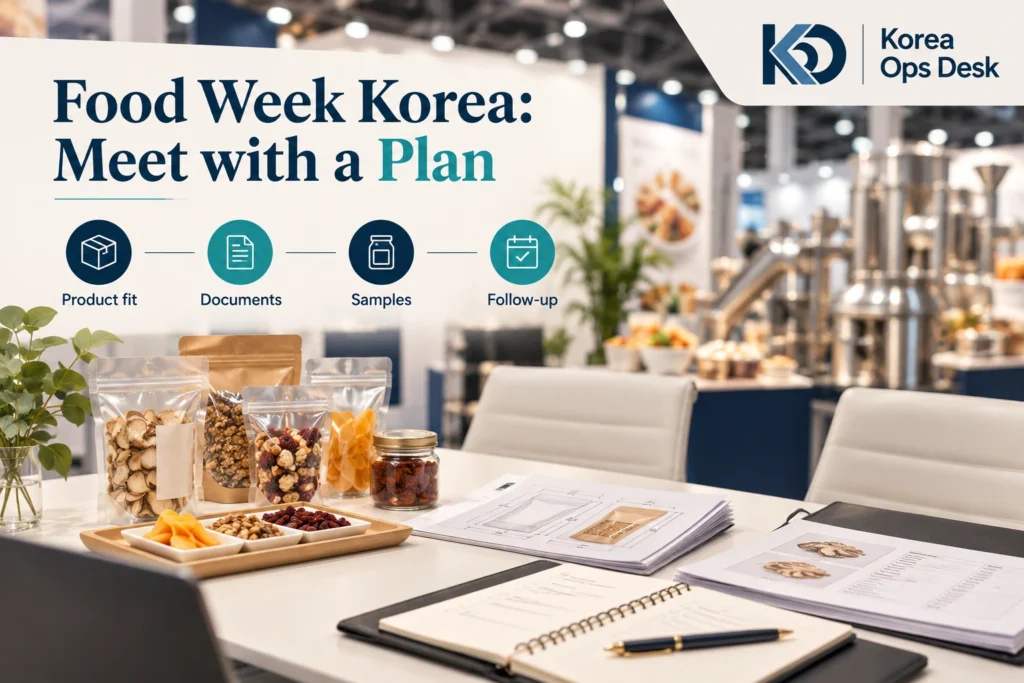
A food buyer can leave a trade show with a bag of samples and still lack the information needed to place an order. Food Week Korea 2026 runs on 4–7 November at COEX in Seoul. Use the visit to identify exact products, obtain the right documents and leave every priority meeting with a named follow-up contact.
1. What Food Week Korea 2026 covers
The official overview identifies food and beverages, HORECA supplies, and food technology and AI among the exhibition’s areas. These span finished foods and ingredients through commercial kitchen products, processing and packaging equipment, and smart production systems. COEX and Korea’s Ministry of Agriculture, Food and Rural Affairs are listed as organizers; COEX and the Korea Agro-Fisheries & Food Trade Corporation as hosts. See the official show overview.
Buyer analysis: that breadth makes a defined purchasing brief valuable. A distributor looking for shelf-ready products and a factory manager evaluating a packaging line need different questions, documents and follow-up contacts. Decide which kind of decision the visit should support before arranging meetings.
2. Build two different meeting briefs—not one generic supplier checklist
For finished foods or ingredients, start with the intended destination market and sales channel. Identify the product category, preferred pack format, anticipated order size and whether the discussion concerns an existing brand or private-label production. Ask the supplier to connect each answer to an exact product reference.
- Product fit: request the specification, ingredient and allergen information, shelf life and storage conditions for the proposed item.
- Commercial fit: clarify minimum order quantities, sample arrangements, production lead time and what the quotation includes.
- Next evidence: identify which documents the supplier can provide for the buyer’s import and product review, and who will send them.
For processing or packaging equipment, take a different brief: the material or food being handled, required output, package format, available utilities and installation constraints. Ask which machine configuration is being discussed, what a demonstration would establish, and what information is needed for a meaningful quotation. Service arrangements, spare parts and cleaning requirements belong in this conversation too.
A useful meeting ends with a specific information request. “Please email your catalog” is less actionable than asking the responsible contact to send the specification and quotation for an identified product or machine configuration.
3. Build a product file for every food sample you want to pursue
A sample becomes useful when your team can trace it to the product that would actually be supplied. Give it a reference at the booth and connect that reference to the supplier, product name, pack size and the documents requested. Do not let a tasting note become the only record of a promising item.
| File item | Question at the booth | Why it helps the next review |
|---|---|---|
| Exact product | Which product code and pack version is this? | Connects the sample to the quotation |
| Ingredients and allergens | Can you send the current specification and label information? | Gives your product team a reviewable document |
| Shelf life and storage | What are the stated conditions for this exact item? | Supports handling and commercial planning |
| Order structure | What are the MOQ and pack/case quantities? | Makes a trial-order discussion concrete |
| Private label | What can be changed and what starts development? | Separates standard stock from a new project |
| Export documentation | Which requested documents can you provide for our market? | Identifies the next document owner |
| Sample movement | Can this sample be released and how should it be handled? | Avoids collecting an unidentified or unsuitable item |
Ask for the current document version and the person who owns it. A sales brochure may describe a product family while the sample uses a different recipe or pack. If the supplier proposes a change, keep the existing and proposed versions separate. Your destination-market review needs the product that would actually be ordered.
For foods needing temperature control, plan handling before collection. Record the supplier’s instructions, the intended recipient and the agreed transport arrangement. A sample should not spend the day in a general brochure bag simply because the booth offered it. Coordinate the actual contents with the receiving team and transport provider before shipment.
 Korea Ops Desk
Keep the sample connected to the buying file
- 01
Identify
Supplier, product code and pack
- 02
Document
Specification and label information
- 03
Handle
Storage and agreed transport
- 04
Review
Feedback, open questions and next order step
For example, a distributor tasting a sauce may like its flavor but need a different pack size. The next request should identify the tasted product and ask which pack versions exist, which require development, and which specification applies. That is more useful than asking for a general price list.
4. Give equipment exhibitors an application they can quote
A processing or packaging machine needs a different meeting brief from a finished food. Describe what enters the machine, what must leave it and the operating conditions. If the project is still exploratory, mark unknown values clearly and ask which information the supplier needs next.
| Application field | Information to take to the meeting |
|---|---|
| Input | Food/material, physical form and relevant handling conditions |
| Output | Desired process result and package format |
| Capacity | Required output and how you define an acceptable finished unit |
| Changeovers | Products and pack sizes that must share the machine |
| Site | Available space and known utilities |
| Cleaning | Your cleaning process and access questions |
| Integration | Equipment before and after the proposed machine |
| Support | Installation, training, consumables and spare-parts expectations |
During a demonstration, record the material, pack, settings and configuration shown. A successful demonstration on one material does not answer every question about another. Ask the supplier to explain differences and propose the next assessment for your own application. Request the model-specific specification and installation information for your technical team.
Subject: Food Week meeting request: [application/product]
We are reviewing [food product or equipment application] for [market/site]. We would like to meet your relevant export or technical colleague at Food Week Korea.
Our requirement: [short brief]
Product/model we wish to discuss: [reference]
Key questions: [three to five questions]
Documents requested: [list]
Preferred meeting time: [date/time KST]
Please confirm the booth, contact and whether the relevant product or demonstration will be available. If another colleague handles this request, please introduce us.
Korea Ops DeskA useful equipment meeting has four outputs
- 01
Configuration
Exact proposed model and options
- 02
Evidence
Documents and observed demo conditions
- 03
Gaps
Application questions still open
- 04
Next action
Technical response or scoped quotation
If you cannot attend, send the same brief to KOD with your priority exhibitors. A prepared booth visit can obtain the right documents and contact, then give your engineers a clear list of unresolved questions for their direct review.
5. Run a practical follow-up after the last booth meeting
At the end of each day, sort contacts while the conversations are fresh. Give each supplier one next step: request a specification, obtain a quotation, clarify a sample, arrange a technical call or close the lead. Record why the next step matters. This avoids returning home with a long contact list and no priority order.
| Stage | Action | Owner |
|---|---|---|
| After the meeting | Label documents and samples; record promised replies | Visitor or local representative |
| Internal review | Choose products/configurations worth pursuing | Buying and technical teams |
| Supplier request | Send the exact missing questions and references | Named buyer/KOD contact |
| Comparison | Normalize product, packing, quantity and delivery basis | Purchasing |
| Next commitment | Agree sample or further technical review | Responsible decision maker |
Subject: Food Week follow-up: documents for [product/model]
Thank you for discussing [product/model] at Food Week Korea on [date]. Our team would like to review [next decision].
Please send the current [specification/ingredient and allergen information/installation document] for [exact reference], together with [quotation or sample details].
Please confirm the quantity basis, pack or configuration, lead-time starting point and delivery basis. The remaining questions are [list].
Who will provide each answer, and when should we expect the next update?
Suppose three suppliers offer similar snack products. One quotes a standard retail pack, another a private-label development project and a third a bulk pack. Do not rank them on unit price alone. First ask each supplier to respond against the intended channel, pack, quantity and document requirements, then compare the resulting offers.
Korea Ops DeskLeave the show with a next action for every priority lead
- 01
Organize
Contact, product and materials
- 02
Prioritize
Fit and missing evidence
- 03
Request
Specific document and owner
- 04
Follow through
Reply, review and next decision
KOD can pursue promised Korean supplier replies and organize the resulting documents in English. Send the booth contacts and the exact gaps holding up your decision, whether your team attended the exhibition or used local coverage.
6. Make the booth visit produce a usable record
Rank prospective exhibitors by relevance and leave room between priority meetings. Confirm meeting locations and the person attending rather than assuming the export contact will always be at the booth. Share a concise question set beforehand when a contact route is available.

During each discussion, record the company, contact, exact product or model, supplier’s answers and unresolved points. Ask permission before taking photographs. Label collected materials so they remain connected to the right conversation. Before leaving, agree who will provide the next document and the expected date.
After the show, separate promising leads from those missing essential information. Request comparable quotations rather than treating differently scoped prices as equivalent. Our guide to comparing Korean supplier quotes explains how to make that next review more useful.
7. Official buyer programs and visitor admission are different steps
The organizer’s business-program page describes overseas-buyer activities, including a Global Big Buyer Zone and networking. It also identifies certain visits as being for hosted buyers or group delegations. Ask the secretariat which program fits your team and what participation requires; ordinary visitor registration should not be treated as confirmation of a hosted-buyer place or an arranged supplier meeting. View the official business program.
8. Practical information for the Seoul visit
- Dates: 4–7 November 2026.
- Venue: COEX Halls A, B and C, and The Platz, Seoul.
- Hours: 10:00–18:00 on 4–6 November; 10:00–17:00 on 7 November. Last entry is one hour before closing. These are local Seoul times (KST).
- Overseas admission: the visitor guide describes free registered overseas admission subject to secretariat approval, and onsite registration with valid foreign-visitor identification.
Check the registration deadline directly: the English visitor guide states 3:00 p.m. on 3 November, while the English FAQ still states 17 October. Both were visible when checked on 2 November. Confirm the applicable cutoff with the secretariat rather than relying on either date alone. The FAQ also says a new entry pass is needed each day.
Secretariat: foodweekkorea@outlook.com, +82-2-6000-8164 / 1115. Review the visitor guide and visitor FAQ before travel.
9. Official sources
The linked Food Week Korea show overview, business program, visitor guide and visitor FAQ were checked on 2 November 2026. These pages do not display a publication date. The meeting-planning recommendations above are KOD’s practical analysis, separate from the organizer’s event information.
Need useful answers from Food Week exhibitors?
Korea Ops Desk can visit selected booths, ask your product or equipment questions, gather available materials and permitted photographs, and follow up with the relevant Korean contacts.
Send us: Priority exhibitors, product or equipment brief, destination market, documents needed and the decision your team is trying to make.
24/7 inquiries · colin@koreaopsdesk.com
Related practical guides
Expanded on 2 November 2026. Worked transactions and message templates are illustrative examples.