Buying Battery-Powered Equipment from Korea? Get the Matching UN 38.3 Test Summary
Obtain the matching UN 38.3 test summary for battery-powered equipment from Korea, map equipment and battery models, describe spares and prepare a complete logistics handover.
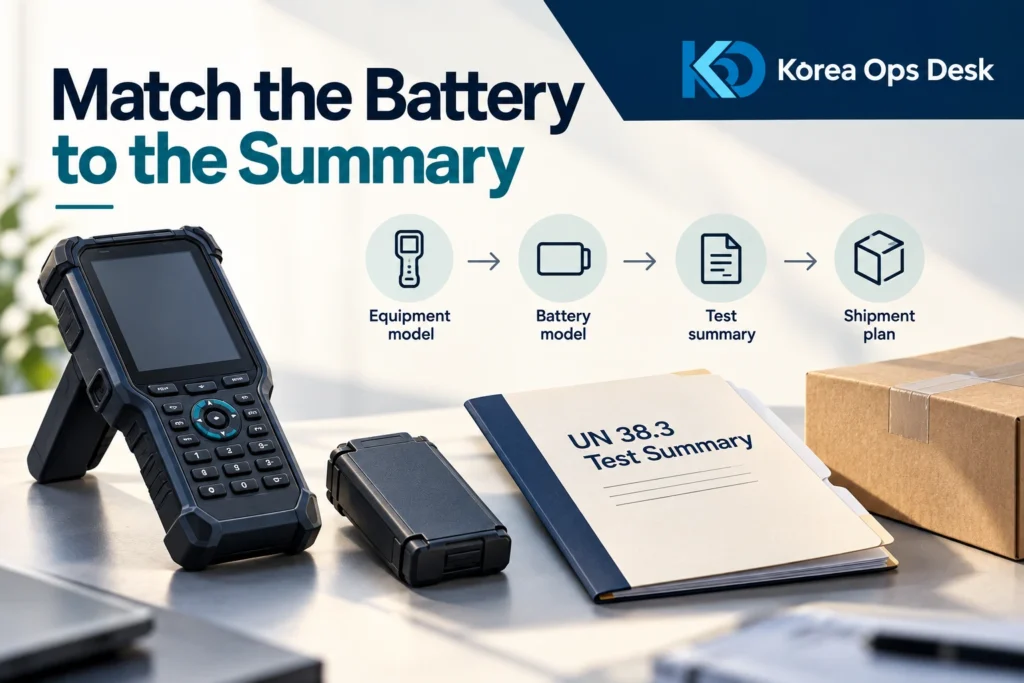
Your Korean supplier has finished the equipment and is asking when the courier will collect it. The logistics provider asks for a UN 38.3 test summary, but the supplier sends a safety data sheet or a file for a different battery. The task is now specific: connect the equipment being shipped, the battery actually supplied and the correct document before the collection plan is confirmed.
1. Ask for a test summary, not an unspecified battery certificate
UN 38.3 refers to battery design-type testing in the UN Manual of Tests and Criteria. The test summary is a defined record of identifying and test information. Calling every battery-related PDF a “certificate” makes it easy for the supplier and buyer to discuss different documents.
The IATA Battery Guidance Document revised for 2026 addresses availability of applicable test summaries and distinguishes them from SDS documents. It permits electronic access; it does not prescribe routinely enclosing a paper summary with every consignment, subject to relevant State or operator requirements. Ask for a usable file or link for the actual battery, rather than imposing an invented document format.
| Document received | Useful next question |
|---|---|
| UN 38.3 test summary | Which supplied battery or product model does it cover? |
| Full test report | Where is the applicable summary and how is the supplied model identified? |
| SDS/MSDS | Please also provide the requested test summary or its working link |
| General product brochure | Which battery is fitted and where is its corresponding summary? |
| A file for a different model | Please explain the mapping or provide the correct document |
| Website link requiring access | Please provide access that the reviewing transport contact can use |
Keep the logistics provider’s exact request in the supplier email. If the provider needs clarification beyond the summary, ask it to identify that question specifically. This prevents a cycle in which the supplier keeps sending the same file because nobody has explained why it does not answer the request.
 Korea Ops Desk
Connect the shipment to its evidence
- 01
Equipment
Exact model and supplied variant
- 02
Battery
Manufacturer and model fitted or included
- 03
Test summary
Document covering the relevant type
- 04
Shipment review
Actual configuration assessed by the transport provider
2. Build an equipment-to-battery mapping
A product’s marketing name may differ from its technical model, and the battery may have another manufacturer and reference. Ask the supplier to explain that relationship in writing. This is especially useful when the battery is enclosed and the buyer cannot see its label without disassembly.
| Field | What to obtain from the supplier |
|---|---|
| Equipment reference | Full model, variant and order line |
| Battery identity | Manufacturer and model for the unit actually supplied |
| Battery information | Type/chemistry and relevant manufacturer ratings requested by logistics |
| Relationship | Which battery is installed or included with which equipment |
| Evidence | Manufacturer document, accessible label photo or written mapping |
| Spare batteries | Separate models and quantities, if any |
| Change control | Confirmation that a later battery substitution will be disclosed |
Do not dismantle equipment simply to obtain a label photograph. Request the manufacturer’s information where the identifier is inaccessible. If a photograph is available through normal authorized access, use it to support the mapping, while retaining the supplier’s written identification.
For a mixed order, create a separate row for each equipment/battery combination. A summary for the battery in Product A may not cover the battery in Product B even when both are sold by the same company. Make the difference visible before sending the pack to the logistics provider.
3. Check that the summary contains identifiable information
PHMSA’s July 2024 test-summary guidance lists the core elements, including manufacturer and laboratory contacts, report identifier/date, battery description and models, test results and the applicable test-manual reference. Use those elements to organize a completeness query, while leaving the shipment assessment to the responsible transport specialist.
| Review group | What you are trying to establish |
|---|---|
| Manufacturer/product identity | The document can be connected to the supplied battery or product |
| Laboratory and report reference | The test information has identifiable supporting references |
| Battery description | Model and relevant characteristics match the supplied configuration |
| Tests/results | The issued summary contains the applicable reported test information |
| Responsible information | The document includes the required issuer/responsibility information |
| Access and completeness | The reviewing party can read the entire file or working source |
A purchasing check is not a new laboratory assessment. Your useful contribution is to spot a missing page, an unexplained model difference or an inaccessible link and send that precise question to the supplier. Do not edit the document to make the identifiers match, add a missing signature or create your own “approved” summary.
A single summary may cover more than one model. The question is whether the relevant supplied model is properly identified and the required information is present, not whether every model must have a separate PDF. Ask the supplier to point to the applicable entry and have the transport reviewer assess any remaining ambiguity.
4. Describe the physical shipment, including spare batteries
The logistics provider needs to know what will actually be packed. Distinguish equipment with batteries installed, batteries packed with equipment and batteries shipped on their own. List spare batteries separately and do not hide them inside a generic quantity of “accessories.”
| Shipment detail | Useful answer |
|---|---|
| Equipment quantity | Number of units per model |
| Installed batteries | Battery model and quantity per equipment unit |
| Additional batteries | Separate spare model and quantity |
| Packing arrangement | Which items are together and which are in separate packages |
| Condition | Actual condition and any relevant defect, recall or damage information |
| Route | Origin, destination and proposed transport mode |
| Timing | Requested collection and delivery dates |
| Responsible shipper | Party preparing the shipment and transport documents |
The FedEx Korea lithium-battery FAQ confirms that packing and marking requirements apply to batteries, including those with equipment. It does not amount to acceptance of a particular package. Give the carrier or qualified logistics provider the actual information and obtain its shipment-specific instructions.
Do not apply one state-of-charge percentage, packaging instruction or label to every battery shipment. Requirements depend on the actual classification and configuration. Ask the responsible transport contact to state the applicable preparation and acceptance conditions, then relay those instructions accurately to the supplier.
Korea Ops DeskGive logistics a description of the real consignment
- 01
Installed
Batteries inside the supplied equipment
- 02
Packed alongside
Batteries accompanying equipment
- 03
Separate or spare
Additional batteries identified explicitly
- 04
Actual route
Mode, destination and carrier review
5. Use a complete supplier request
Subject: Battery identification and UN 38.3 summary: [order / equipment]
Our logistics provider is reviewing shipment of [equipment model/variant, quantity] under order [reference].
Please provide:
1. Battery manufacturer and model actually supplied with each equipment variant
2. The corresponding UN 38.3 test summary or accessible download link
3. A written mapping if the equipment and battery use different identifiers
4. Relevant manufacturer battery specifications requested in the attached logistics questions
5. Whether batteries are installed, packed alongside equipment or supplied separately
6. Every spare battery model and quantity
7. Proposed package arrangement and the responsible shipping contact
Please identify any document or model information still pending and its expected availability. Notify us before substituting a different battery.
Specific logistics questions: [list]
Thank you.
Send the request to the sales contact with a clear invitation to involve its product engineer, battery supplier or export-document colleague. The person who answers commercial emails may not hold the test summary. Identifying the internal document owner is often the fastest way to stop repeated unproductive follow-ups.
If the supplier supplies only a web link, test whether the logistics contact can open it and locate the relevant model. Record the URL and retrieved document reference. A link to a general homepage is not a useful substitute when the recipient cannot identify which file applies.
6. Manage missing and inconsistent documents as specific actions
| Problem | Next action | What remains open |
|---|---|---|
| SDS supplied instead of summary | Repeat the exact document request and explain the missing record | Test-summary availability |
| Battery model not listed | Ask the supplier to explain the model mapping or supply the correct document | Identity match |
| Summary covers several products | Request the entry applicable to this equipment/battery | Applicable coverage |
| Battery is inaccessible | Request manufacturer identification and mapping | Evidence of installed type |
| Link cannot be opened | Request an accessible copy or usable access route | Document access |
| Spares added late | Update quantities/configuration and return to logistics review | Shipment acceptance |
| Battery type changes | Obtain the new mapping and corresponding evidence | Change review |
Keep received information and accepted shipment instructions in different columns. “Supplier sent the summary” is a fact about collection. “Carrier accepted this shipment under these conditions” is a separate operational milestone. If the carrier has not completed its review, do not convert a document receipt into a collection authorization.
For deadlines, track the document owner and next update as well as the requested pickup date. If a document is due after the planned collection, resolve the sequence before booking. A clear list of two missing answers is more actionable than a status report saying “battery paperwork pending.”
Subject: Open battery-document items before collection: [reference]
The following items remain outstanding for the logistics review:
• [Model/document mismatch and exact question]
• [Missing shipment detail]
Documents received so far: [references]
Please identify the person responsible for each remaining answer and the next update date. We will confirm the collection arrangement after the transport provider completes its review of the actual consignment.
Thank you.
7. Check the final handover against the reviewed configuration
Before dispatch, confirm that the supplier is packing the same equipment and battery configuration that was reviewed. Ask whether any spares, replacement batteries or additional devices have been added. Keep the final packing list and transport instructions together with the document mapping.
- Confirm equipment models and quantities.
- Confirm installed and spare battery identities and quantities.
- Resolve document/model discrepancies identified by the reviewer.
- Obtain shipment-specific preparation and acceptance instructions.
- Confirm the responsible party has prepared the shipment accordingly.
- Check final packages and documents against the reviewed consignment.
- Record collection and tracking references.
- Retain the evidence and correspondence for future repeat orders.
For repeat orders, reuse the organized record as a starting point, then ask whether the battery or product configuration has changed. A previous successful shipment does not answer whether the new order contains the same items or follows the same route and current requirements.
Korea Ops DeskClose the handover in the right order
- 01
Identity resolved
Equipment and batteries mapped
- 02
Documents available
Relevant summary accessible
- 03
Transport review complete
Actual consignment and conditions confirmed
- 04
Collection arranged
Final goods match the reviewed plan
8. Worked example: two devices and an extra spare
A buyer orders two industrial handheld devices from Korea. Each contains a battery. Before collection, the seller adds a spare battery “as a courtesy.” The additional item changes the information the logistics provider is assessing, even if the seller regards it as a free accessory.
- List the two installed batteries and the spare separately.
- Confirm the spare model and whether the existing summary covers it.
- Describe the proposed package arrangement to the logistics provider.
- Obtain updated instructions for the actual consignment.
- Ask the supplier to prepare the final shipment to that reviewed plan.
- Keep the final quantities, mapping and acceptance record in the order file.
The coordination work is straightforward when the right people receive the right questions. Korea Ops Desk can contact the Korean supplier, find the document owner, clarify model relationships and relay your logistics provider’s questions. You receive an English action list showing what has arrived, what has been clarified and what still prevents collection.
Need the matching battery documents from your Korean supplier?
Korea Ops Desk can follow up the exact battery model and test-summary request, coordinate your logistics provider’s questions and organize a clear English handover record.
Send us: Supplier, equipment model/variant, quantity, any spare batteries, destination, planned route and the document questions from your logistics provider.
24/7 inquiries · colin@koreaopsdesk.com
Related practical guides
Expanded on 2 November 2026. Worked transactions and message templates are illustrative examples.