Sending Equipment to Korea for Repair? Confirm the Return Before Pickup
Plan equipment repair in Korea from supplier acceptance to return: serial records, repair approvals, customs questions, invoice details, progress tracking and return-shipment checks.
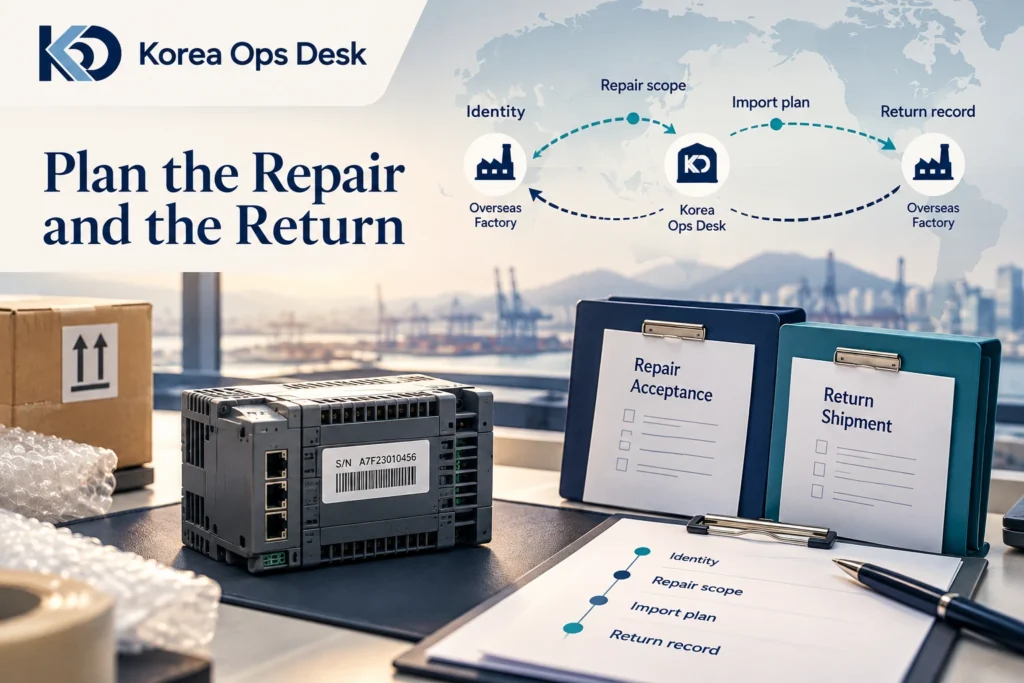
A Korean supplier says, “Send the controller back and we will check it.” That is the beginning of the repair arrangement, not a complete shipping instruction. Before the parcel leaves your factory, establish who will receive it, which unit is being sent, what work is authorized and how that unit will return. These answers protect the schedule as much as the paperwork.
1. Get written repair acceptance before booking collection
Confirm the actual repair destination. A sales office, distributor and service centre may have different addresses and responsibilities. Ask for the receiving legal entity, delivery address, contact person, telephone number and repair or RMA reference. RMA means return merchandise authorization; suppliers may use another name for the same internal return reference.
| Point to agree | Question for the supplier |
|---|---|
| Equipment to send | Complete machine, module or selected accessories? |
| Reason for return | What fault or issue will be investigated? |
| Initial work | Diagnosis only, warranty assessment or approved repair? |
| Costs | Diagnostic fee, repair charges and what requires approval? |
| Receiving arrangement | Who can accept the delivery and identify the repair? |
| Expected sequence | Receipt confirmation, diagnosis, quotation, approval and completion |
| Return outcome | Same unit, possible exchange or another proposed outcome? |
If the supplier has not yet decided whether the issue is covered by warranty, say so in the record. “Sent for warranty assessment” is different from “repair confirmed free of charge.” Ask what happens if the fault is outside the warranty or the unit cannot be repaired, including any diagnosis, return or storage charge that could apply.
Do not include every cable or accessory simply because it came with the original purchase. Ask what the repair team needs to reproduce the fault. List what you will send and what will remain with you. This prevents an otherwise successful repair from ending with an argument about a missing accessory.
 Korea Ops Desk
Agree the complete repair journey
- 01
Acceptance
Correct receiver, reference and scope
- 02
Outbound shipment
Identity, documents and customs plan
- 03
Repair decision
Diagnosis, cost and written approval
- 04
Return
Same-unit record, report and dispatch documents
2. Create a fault report the repair team can use
Describe what happens, when it started and under what conditions it occurs. Separate observed symptoms from your suspected cause. “Display shows error [code] after approximately [condition]” gives the supplier more to work with than “the controller is bad.” Include the exact error text and photographs where available.
- Manufacturer, full model, serial number and firmware/software version if relevant and known.
- Observed symptom and exact error message.
- When the issue occurs and whether it is continuous or intermittent.
- Operating context and any recent change your technical team considers relevant.
- Checks already performed by appropriate personnel and their results.
- Available photographs, logs or a short video.
- Required return date and the operational effect of the downtime.
Keep original files and label them with the equipment reference. If a video shows a fault on one unit but several units are being returned, identify which serial number appears in it. Do not let a general fault description become the only record for a mixed shipment.
Subject: Repair acceptance and diagnosis plan: [model / serial]
We propose returning [model / serial] for investigation of [observed fault]. The fault report and photographs are attached.
Please confirm:
1. Receiving company, address, contact and repair reference
2. Equipment/accessories required
3. Initial diagnosis scope and any charge
4. Whether repair work requires our written quotation approval
5. Expected receipt, diagnosis and next-update dates
6. Whether the same serial-numbered unit is expected to return
7. Responsibility for transport and other agreed charges in each direction
Please identify any information needed before shipment.
Thank you.
3. Confirm the customs procedure in both countries before dispatch
Korea Customs Service includes qualifying repair imports in its conditional re-export relief guidance. Its repair and re-export FAQ refers to matching Korean ten-digit tariff classifications before and after repair and a repair period recognized by customs. These are eligibility conditions to resolve for the actual goods; a note saying “repair and return” does not itself grant relief.
The separate KCS application-timing guidance says relief applications generally precede acceptance of the import declaration, subject to specified exceptions. Arrange the review before shipment so the receiving party and person handling the declaration have the information and authority they need.
| Side of the journey | Question to resolve before collection |
|---|---|
| Departure country | How should the outgoing equipment and intended return be documented? |
| Korean import | Who is the importer/consignee and which procedure will be used? |
| Eligibility and timing | What conditions, documents and deadlines apply to this shipment? |
| During repair | Who monitors the permitted period and any change of plan? |
| Korean departure | Who prepares the export/re-export record and evidence of departure? |
| Home-country return | What original export and repair evidence is needed for re-import? |
Ask the shipping and clearance contacts to answer in relation to your model, serial list, repair purpose and proposed timeline. Korean import treatment and your home country’s return treatment are separate questions. A confirmation from one side should not be copied into the other country’s file as if it answers both.
If the proposed outcome changes from repair of the same unit to replacement, exchange, disposal or sale, reopen the document plan before acting. Those outcomes may change the declarations, evidence and commercial records needed. Give the responsible shipping/clearance contacts the facts and request updated instructions.
4. Prepare one consistent identity and shipping document pack
Photograph the equipment and label before packing. Create a serial list that records the manufacturer, model, serial number, quantity, accessories and visible condition. Use this same reference list in the repair acceptance, shipping instructions and return comparison. For several units, give each a separate line.
| Document or record | Prepared or supplied by | What to check |
|---|---|---|
| Repair acceptance/RMA | Korean supplier or service receiver | Correct entity, address and unit |
| Fault report | Buyer’s technical team | Symptoms linked to the correct serial |
| Identity and accessory list | Buyer before packing | Counts and readable label photos |
| Invoice for shipment | Sender using the agreed shipment requirements | Actual goods, purpose, values and parties |
| Packing list | Packing/sending team | Package count, contents, dimensions and weight |
| Original purchase/shipping records | Buyer’s existing file | Available records linked to this unit |
| Customs instructions | Responsible clearance contacts | Procedure, document requirements and deadlines |
FedEx’s documentation guidance calls for specific descriptions and consistent shipment information, including values. Descriptions such as “parts” or “not for resale” alone do not identify the equipment. DHL’s invoice guide likewise emphasizes clear goods descriptions and brand, model or serial details where available.
For example, identify the actual industrial controller, its model and serial, quantity and repair purpose rather than describing the parcel only as “warranty item.” Ask the responsible clearance contact how equipment value, repair charges and any no-sale situation should be presented. Do not invent a zero or nominal value because the repair is free or no new sale is taking place.
Korea Ops DeskThe same identity should appear throughout the file
- 01
Before packing
Equipment label and serial list
- 02
Outbound documents
Description and repair reference
- 03
Repair record
Work tied to the received unit
- 04
Return documents
Returned serial and any explained changes
5. Make packing and handover part of the assignment
Ask the repair receiver for packing requirements relevant to the unit, including any protective transport fixtures or original packaging it expects. Provide the carrier with the actual package information and contents before booking. If the equipment contains batteries, residual chemicals or other relevant materials, disclose them so acceptance and preparation can be resolved.
Record what was packed before the box is closed. A useful sequence is an overall equipment photo, label photo, accessory inventory, protective packing photo and closed-package photo. Give the package a reference that connects to the packing list. Keep the tracking or transport document with the same repair file.
| Milestone | Evidence to obtain | Owner to identify |
|---|---|---|
| Packed | Contents, protection, package dimensions and weight | Sender/packing team |
| Collected | Collection reference and actual handover status | Carrier/sender |
| Arrived in Korea | Transport tracking and any clearance request | Transport/clearance contact |
| Delivered to repair receiver | Delivery record and receiving contact | Supplier receiver |
| Accepted for diagnosis | Supplier receipt confirmation and unit identity | Repair coordinator |
Delivery tracking and repair acceptance are different milestones. A courier may show delivery while the service team has not matched the package to its repair reference. Ask for a short receipt confirmation stating the serial number, accessories received and expected diagnosis update. Resolve a discrepancy while the packaging and delivery records are still easy to inspect.
6. Track decisions during the repair, not just the completion date
Use a short tracker with the current stage, next action, owner and next update date. “Repair in progress” is too vague if the supplier is actually waiting for quotation approval or an unavailable component. Ask what prevents the next stage and whether the stated date is a target or a confirmed commitment.
| Stage | Useful supplier update | Buyer action |
|---|---|---|
| Diagnosis | Fault found or further investigation required | Clarify any unanswered technical question |
| Quotation | Work proposed, parts, charge and expected time | Approve, decline or ask specific questions |
| Parts pending | Part required and current supply status | Assess schedule consequence |
| Work complete | Work performed and result record available | Review report and unresolved issues |
| Ready for return | Packing and documents prepared | Approve collection after checks |
Subject: Repair status and next action: [repair reference]
Please provide the current status for [model / serial / repair reference].
• Current stage and work completed
• Any decision, information or part still required
• Proposed next action and responsible person
• Expected completion or next update date, with assumptions
• Any change to the unit, scope or quoted cost
Please obtain our written approval before additional chargeable work beyond the agreed scope.
Thank you.
If the repair is delayed, check the transport plan and any customs deadline at the same time. Do not wait until the unit is ready to discover that an earlier permission or return arrangement needs attention. Keep the supplier’s explanation and the follow-up action together in the record.
7. Check the return pack before equipment leaves Korea
Request the repair report, work performed, replaced-parts information, relevant test/result record and the serial number of the unit being returned. Compare them with the outbound record. If the supplier proposes a replacement unit, obtain the new identity and explanation before collection and update the clearance plan with the responsible parties.
- Same model and serial, or an explicitly documented change.
- Accessories returned compared with the original inventory.
- Repair work and charges consistent with the approved scope.
- Warranty or service terms for the completed work, where agreed.
- Return invoice and packing information consistent with the goods.
- Final packed dimensions, weights and package count.
- Return receiver, contact and delivery details.
- Required export/re-export and home-country return records assigned to responsible contacts.
Do not treat a “repair complete” email as proof that the shipment is ready. The report may be ready while the crate, invoice or export arrangement is not. Ask for a defined ready-for-collection confirmation after those items have been resolved. Keep the actual departure record, then confirm arrival and receipt against the same identity list.
Korea Ops DeskClose the repair with evidence on both sides
- 01
Repair result
Report and approved work
- 02
Return identity
Serial and accessories matched
- 03
Dispatch file
Packing and required documents
- 04
Receipt
Arrival condition and buyer follow-up
8. Worked example: a controller return with an exchange proposal
An overseas factory sends a faulty controller to Korea after receiving a diagnosis-only acceptance. The supplier later proposes an exchange unit because repair would take longer. That may be a useful commercial solution, but it is a change to the original plan.
- Obtain the proposed replacement model, serial, condition, cost and service terms.
- Have the buyer’s technical team assess compatibility and acceptance.
- Tell the transport/clearance contacts that the same serial-numbered unit will not return and obtain revised instructions.
- Agree what happens to the original unit and document the decision.
- Update the commercial and packing records before collection.
- Check the received replacement against the accepted offer and retain both outbound and return records.
The practical value of coordination is keeping these decisions connected. Korea Ops Desk can reach the repair contact, pursue the missing answers, organize the documents and report the next action in English. Send the existing correspondence and the unresolved stage; we can help turn “we are waiting” into a specific follow-up assignment.
Is your Korea repair waiting on an answer or document?
Korea Ops Desk can follow up with the supplier or nominated repair contact, clarify the agreed scope and next step, and organize the records needed for your return plan.
Send us: Supplier and repair reference, model/serial, fault summary, correspondence, current shipment stage and the date you need the equipment back.
24/7 inquiries · colin@koreaopsdesk.com
Related practical guides
Expanded on 2 November 2026. Worked transactions and message templates are illustrative examples.