ROBOTWORLD 2026: November 4–7 at KINTEX, With a Buyer’s Planning Checklist
Plan ROBOTWORLD 2026 with an application brief, demonstration evidence record, integration and support questions, current admission notes and supplier follow-up templates.
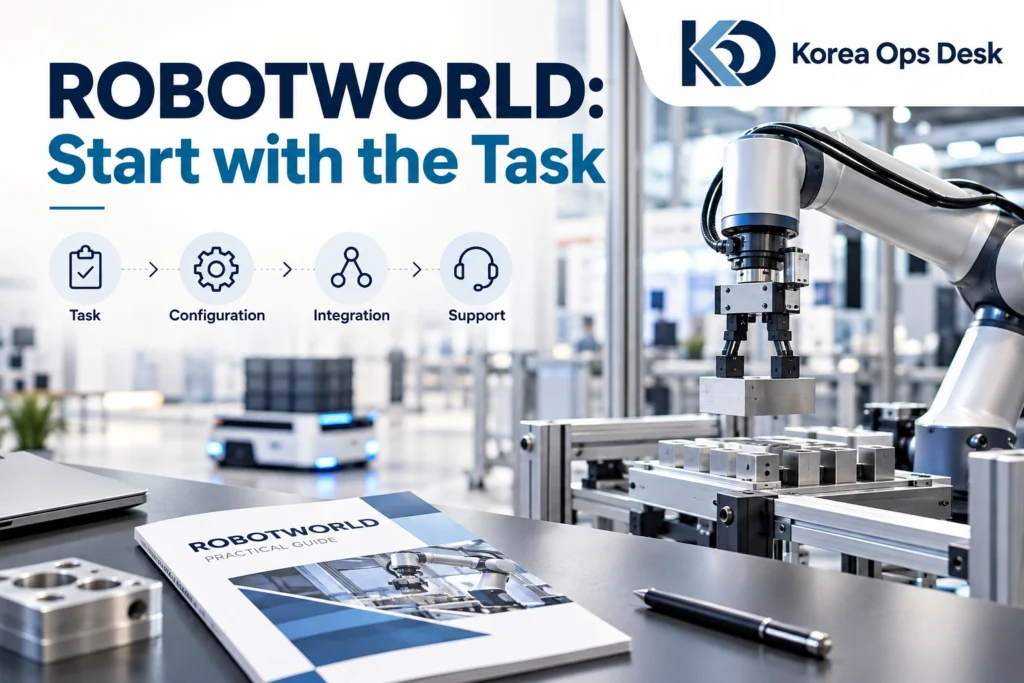
ROBOTWORLD 2026 runs on 4–7 November at KINTEX Exhibition Center I, Halls 3–5, in Goyang. Start with the task your business needs to automate, then use booth meetings to identify the proposed configuration, integration owner and evidence needed for the next technical discussion.
1. ROBOTWORLD 2026 dates, hours and registration
The official English visitor guide lists the following arrangements:
- Dates: Wednesday, November 4, through Saturday, November 7, 2026.
- Venue: KINTEX Exhibition Center I, Halls 3–5, Goyang, South Korea.
- Opening hours: 10:00–17:00 on November 4–6 and 10:00–16:00 on November 7, Korea Standard Time.
- Advance registration: The published free preregistration deadline was October 24, 2026 and has passed. Check current onsite or invitation admission arrangements.
- Ordinary adult on-site admission: KRW 12,000. Visitors should check the official guide for other ticket categories and eligibility conditions.
2. What is confirmed for the 2026 exhibition
According to the official exhibition overview, the display categories include manufacturing robots, professional and personal service robots, logistics robots such as automated guided vehicles and autonomous mobile robots, robot parts, smart-manufacturing solutions, smart applications and software, and drones.
The official 2026 English brochure identifies the host as the Ministry of Trade, Industry and Resources. The event website lists the Korea Association of AI Robot Industry, the Korea Institute for Robot Industry Advancement and the Institute of Control, Robotics and Systems as organizers.
Buyers should use the current exhibitor directory and contact their shortlisted companies to check the models, demonstrations and personnel available during their visit.
3. A long-running meeting point for the robotics industry
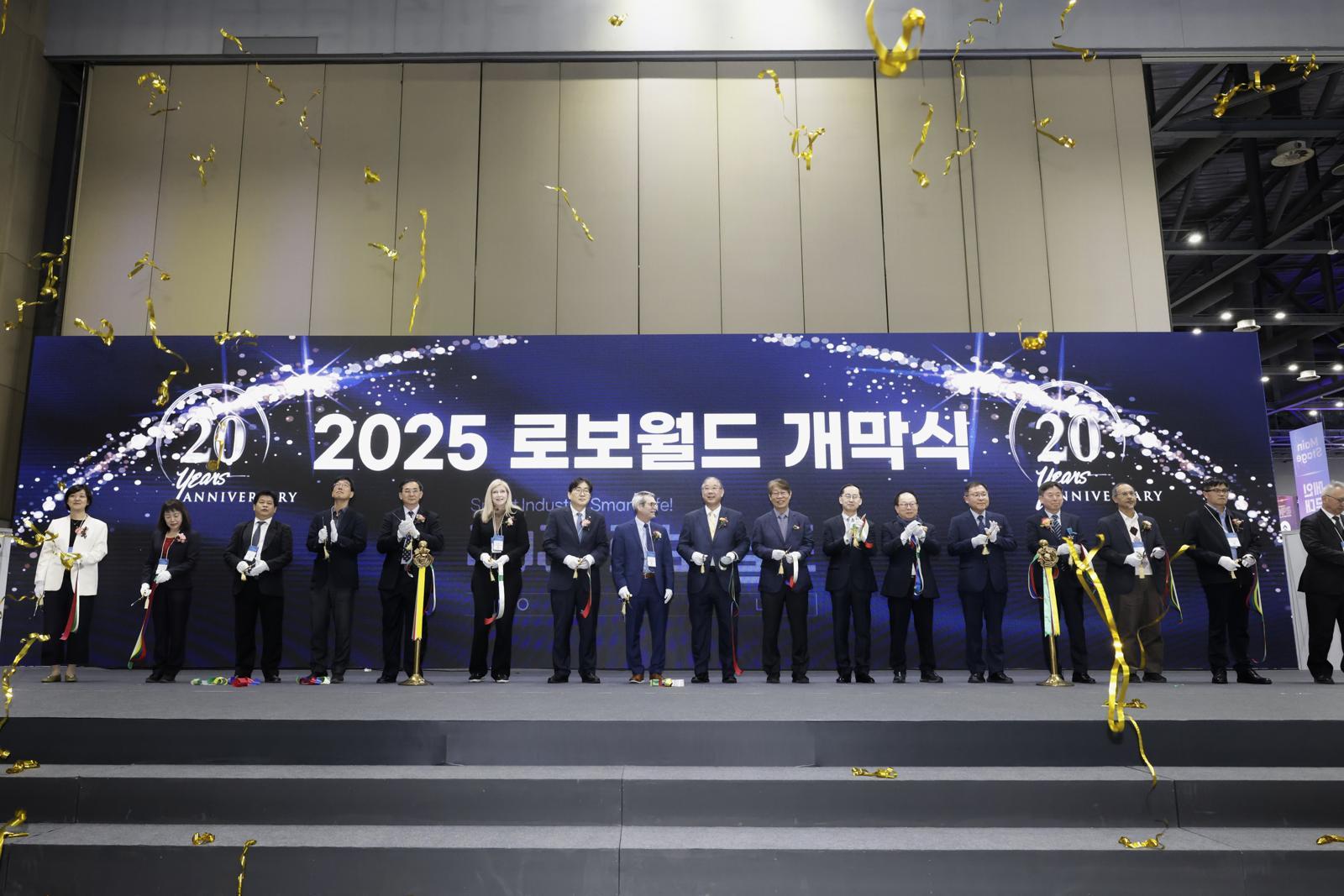
ROBOTWORLD marked its 20th anniversary in 2025. The official press archive’s report on that edition describes an industrial exhibition alongside the International Symposium on Robotics, bringing commercial displays and technical discussions into the same event program.
4. Prepare an application brief before comparing robot models
A robot specification becomes useful when it is connected to the task. Describe what must move, where it starts and ends, what happens around it and what output is required. If your team is still defining the project, state the unknowns and ask each supplier what it needs for an application assessment.
| Application | Brief to bring | Question that moves the discussion forward |
|---|---|---|
| Machine tending | Workpiece, presentation, machine interface and required sequence | Who assesses loading, tooling and machine communication together? |
| Pick and place | Object range, pickup conditions and placement requirement | What end effector and sensing does the proposed system need? |
| Palletizing | Cases, pallet pattern, layout and required output | Which conveyors, tooling and integration are included? |
| Mobile logistics | Load, pickup/drop points, route and operating environment | What site information is needed for a deployment assessment? |
| Component sourcing | Exact part/interface and intended system | Which model documents and compatibility information are available? |
Ask the supplier to distinguish the robot itself from the complete application. Tooling, vision, fixtures, software, guarding and integration may be supplied by different parties. Record who would own the overall system proposal and which responsibilities remain with your team or another provider.
For a mobile robot, prepare a layout and describe the actual traffic and pickup/drop process. For a robot arm, include the workpiece and the sequence rather than only a payload figure. These are starting points for the supplier’s engineering assessment, not a substitute for that assessment.
 Korea Ops Desk
Describe the work before selecting the robot
- 01
Task
Object, load and process
- 02
Environment
Layout, interfaces and operating conditions
- 03
System
Robot plus tooling, sensing and integration
- 04
Outcome
Required result and evidence to assess it
5. Record the full demonstration configuration
A fast demonstration can hide how much preparation makes it work. Record the model, end effector, sensors, fixtures, software and the object being handled. Ask which elements are standard, optional or supplied by an integration partner. Then note the differences between the demonstration and your intended application.
| Evidence field | What to record |
|---|---|
| Robot and controller | Exact models and relevant configuration |
| Tooling | Gripper/end effector and any special fixture |
| Sensing | Camera or other sensing used in the demonstrated task |
| Software | Functions or licenses involved |
| Workpiece/load | What was actually handled |
| Sequence | Observed operations and stated operating conditions |
| Integration | Company responsible for the full application |
| Open questions | Your site or process conditions not demonstrated |
Keep observed behavior separate from a supplier’s projected performance for your application. If the exhibitor quotes a cycle time, ask what the sequence includes and which conditions apply. Do not convert a short show-floor clip into an assumed production rate for your factory.
Subject: ROBOTWORLD follow-up: [application] assessment
At ROBOTWORLD we discussed [robot/system] for [application]. Please review the attached task brief and identify any further information required.
Please confirm the proposed robot/controller, tooling, sensing and software; the integration responsibilities; and the assumptions behind any performance estimate.
We also need the available technical documents, proposed assessment or demonstration steps, destination support route and the person responsible for the complete system proposal.
Our open questions are [list]. Please let us know who will answer each point and the expected next update.
Korea Ops DeskSeparate the demo from the proposed system
- 01
Observed
What the booth system did
- 02
Configured
Hardware, software and tooling used
- 03
Different
Conditions in your application
- 04
Next evidence
Assessment, documents or further demo
If a safety or conformity claim matters to your project, request the precise document and the equipment/system scope it covers. Keep that record for your technical review. A general promotional statement should not silently become an approval of the final installation.
6. Build a shortlist with an integration and support owner
For each candidate, identify who can deliver the complete agreed scope in the destination market. A component manufacturer, robot manufacturer and system integrator may all be valuable contacts, but their offers answer different buying questions. Label those roles so your team does not compare them as equivalent turnkey proposals.
| Shortlist field | Why it belongs in the report |
|---|---|
| Role | Manufacturer, component supplier, distributor or integrator |
| Application fit | Supplier response against your actual task brief |
| Proposed scope | Included equipment, software and integration |
| Evidence received | Documents and demonstration records |
| Deployment owner | Who coordinates installation and commissioning |
| Support route | Training, maintenance, parts and named contacts |
| Unresolved items | Questions preventing the next decision |
| Next step | Technical meeting, further assessment or quotation |
Worked example: three contacts for one machine-tending project
A buyer meets a robot manufacturer, a gripper supplier and an integrator. The manufacturer can discuss the arm, the gripper supplier needs workpiece details, and the integrator needs the machine interface and layout. A useful report preserves these roles and routes the same application brief to the appropriate contacts. The buyer can then identify the party proposing the overall system rather than adding three unrelated catalogue prices.
- Sort contacts by their role in the proposed application.
- Send the current brief and the exact gaps identified at the booth.
- Collect the relevant model documents and supplier assumptions.
- Ask the proposed integration owner to mark the complete scope.
- Choose the next technical assessment before treating prices as comparable.
Korea Ops DeskMake the next supplier meeting more focused
- 01
Role
What this company supplies
- 02
Scope
What the proposal covers
- 03
Evidence
What your team can review
- 04
Owner
Who takes the application forward
KOD can visit selected ROBOTWORLD booths, gather the available documents and permitted photographs, and follow up with the named Korean contacts. A precise application brief lets that work support your engineers and purchasing team after the exhibition closes.
7. Plan around the application, not just the robot
KOD practical analysis: A useful robotics sourcing brief starts with the work that needs to be done. A factory considering machine loading, for example, needs to define the part, payload, reach, cycle-time target and existing equipment interface. A warehouse reviewing mobile robots needs to describe load dimensions, travel routes, floor conditions and interaction with people and other vehicles.
This makes booth discussions easier to compare. A robot arm, a gripper, a vision system and integration work may come from different businesses. Buyers should establish which elements each exhibitor supplies directly and which depend on a partner. Use demonstrations to identify promising options and discuss the requirements for your own facility.
For component sourcing, the equivalent questions concern the exact part number, interface, technical documentation and compatibility with the intended system. Use photographs, catalogs and technical documents to build a shortlist for follow-up discussions.
8. Buyer checklist for ROBOTWORLD booth meetings
- Define the task. Bring a short, non-confidential application brief with the workpiece or load, operating environment and required output. Ask what additional information is needed to assess feasibility.
- Separate standard features from options. Record the demonstrated model and configuration. Ask which tooling, sensors, software licenses and integration services are included in a proposed scope.
- Check deployment responsibility. Identify who would design, commission and support the installation in the destination market. Ask about documentation language, training, spare parts and remote support.
- Request evidence. Collect relevant specifications and available test or certification documents for subsequent review.
- Agree on follow-up. Record a named technical contact, the unanswered questions and the documents promised after the show. Confirm permission before taking detailed photographs or recording a demonstration.
When an exhibitor becomes a sourcing candidate, KOD’s Korean supplier verification service can help review business information, check contact details and clarify questions with the company.
9. Visitor registration notes
Arrange priority meetings with shortlisted exhibitors and confirm the language support you need before your visit.
Review the current registration and badge-scanning terms before attending, and confirm priority meetings directly with the exhibitors.
10. Official sources and visitor planning
Need answers from ROBOTWORLD exhibitors without sending your whole team?
Korea Ops Desk can cover selected booths, ask your application questions, collect available technical materials and permitted photographs, and organize English findings and supplier follow-up.
Send us: Task/application brief, priority exhibitors, required documents, destination and the questions your technical or buying team needs answered.
24/7 inquiries · colin@koreaopsdesk.com
Related practical guides
Expanded on 2 November 2026. Worked transactions and message templates are illustrative examples.