How to Verify a Korean Supplier Without Visiting South Korea
Check a Korean supplier remotely using business identity records, NTS and DART sources, contact checks, product evidence and practical request templates.
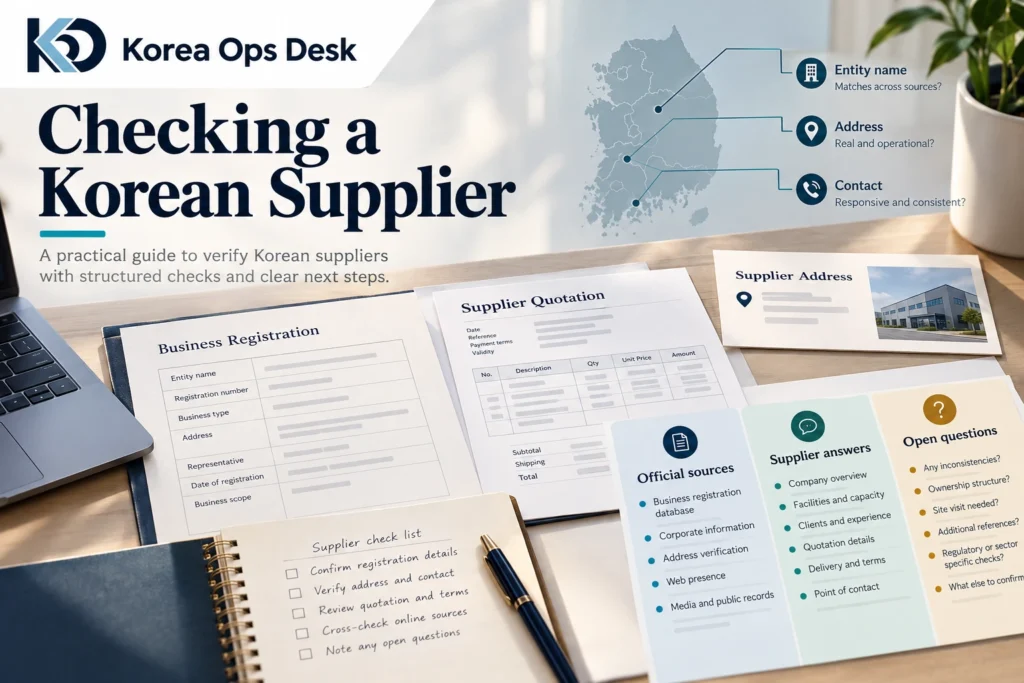
A Korean supplier has sent a professional quotation. The price looks workable, the website looks established, and the salesperson answers quickly. Before you place an order, you still need to connect four things: the business that exists, the person you are speaking with, the goods being offered, and the business that will invoice you. You can make substantial progress from overseas if you check those connections in a deliberate order.
1. Define the decision before collecting documents
Supplier verification is easier when you identify the decision it must support. Are you deciding whether to request samples, approve a first purchase, pay a deposit, accept a substitute part or send confidential drawings? Each decision raises different questions. A sample order may primarily need a consistent seller identity and a clear packing and shipment plan. A production order may also need evidence of manufacturing capability, an agreed specification, capacity information and an inspection plan.
Write one sentence at the top of the file: “We need to decide whether [legal buyer] can [next action] with [named supplier] for [product] by [date].” Then list the unanswered questions that could change that decision. This keeps a long internet search from becoming a folder of interesting but irrelevant screenshots.
| Question | Evidence to request or compare | What it helps you decide |
|---|---|---|
| Who is the seller? | Korean legal name, registration information, quotation entity | Which business would accept the order |
| Who is speaking for it? | Named contact, role, independently established communication route | Whether the contact can handle this transaction |
| What can it supply? | Exact model/specification, stock or manufacturing explanation | Whether the offer fits your request |
| What remains before shipment? | Written lead time, approval steps, packing and dispatch conditions | Whether the delivery plan is credible |
| Who receives the payment? | Invoice entity, beneficiary details and independently confirmed instructions | Whether the payment request matches the agreed transaction |
Do not begin by asking a small supplier for every corporate document imaginable. Explain the transaction, request the basic identity material first, and add questions for the gaps that matter. A focused request is easier for a real business to answer and easier for your team to review.
2. Build an identity sheet with the Korean legal name
An English trading name is useful for communication but may not be the best search key. Ask for the Korean legal business name exactly as it appears on the registration document, the English name used for invoicing, the business registration number and the business address. Preserve the Korean text rather than replacing it with your own translation. Similar English names and different romanizations can otherwise send you to the wrong company.
A Korean business registration certificate is commonly referred to as a 사업자등록증. Ask for a readable copy and identify the date on the document. A certificate supplied by a seller is one piece of evidence; it is not the same as independently confirming current business status or the authority of the person emailing you. If the business is a corporation, do not confuse its corporate registration number with its business registration number. Keep each identifier in its own field.
| Identity-sheet field | What to record | Common mismatch to resolve |
|---|---|---|
| Korean legal name | Original Korean characters from the document | Brand name used instead of the contracting business |
| English invoice name | Exact spelling the supplier will place on the invoice | Different abbreviations across quotation and invoice |
| Business registration number | Number exactly as supplied; keep original document | A number copied from another group company |
| Addresses | Registered address, actual office, factory and dispatch location separately | An office presented as the production site |
| Contact | Name, department, email, phone and how the route was established | A new personal account introduced without confirmation |
| Commercial role | Manufacturer, distributor, exporter, agent or another defined role | Factory claims supported only by a product catalogue |
Different addresses can have an ordinary explanation: an office, warehouse and factory may be separate. The task is to get that explanation and connect it to the proposed transaction. Ask which location makes the product, holds the stock, receives visitors and dispatches the order. Record “supplier states” when the answer comes only from the supplier; do not silently turn it into an independently confirmed fact.
 Korea Ops Desk
Connect the transaction to one identity
- 01
Legal business
Korean name and registration information
- 02
Commercial documents
Quotation, order and invoice names
- 03
Contact route
Named person and established channel
- 04
Goods and location
Product, actual role and dispatch site
3. Use Korean official records for specific questions
Business status and registration-information checks
The National Tax Service offers business-registration status and information-matching services. Its official public-data service description distinguishes a status lookup using a business registration number from a matching check that uses additional supplied details. These answer limited registration questions; they do not inspect the goods, establish stock ownership or prove that a particular email sender represents the business.
Start from the official Hometax portal when using the public tax service, and search for the relevant business-status service rather than following an unfamiliar login link sent by a salesperson. The public-data page is also a clear explanation of what the underlying checks cover; its API is a technical route, not a requirement for every buyer. If you cannot complete a lookup yourself, preserve the name, number and question you need checked so a Korean-speaking contact can work on the same identity.
DART filings, when the company is a filer
DART, operated by Korea’s Financial Supervisory Service, provides corporate disclosures and company information. Search the exact entity, open the relevant filing and record its reporting period. Read the underlying filing when an extracted figure matters. Open DART’s guidance explains that its periodic-report search covers companies that submitted those reports and that extracted information should be compared with the reports themselves.
Do not treat an empty English search as proof that a supplier is fictitious. First check the Korean name and entity, then consider whether the company is within the records you searched. Do not use a listed parent’s financial information as if it automatically described a small subsidiary or unrelated business with a similar name. A genuine filing can still belong to the wrong entity.
Save enough detail to repeat the check
For each result, save the source address, search term or identifier, date checked, relevant result and the question it answers. A screenshot without the company name, period or source is difficult for another colleague to review. If the result conflicts with the supplier’s document, pause that point and request an explanation rather than choosing whichever version makes the order easier.
| Source or material | Useful for | Does not settle by itself |
|---|---|---|
| Tax registration/status service | Specified registration and status questions | Product quality, stock or payment authority |
| Corporate filing | Reported information for the identified entity and period | Every supplier’s current operational capacity |
| Supplier website | Products, contact routes and the supplier’s own claims | Independent confirmation of those claims |
| Manufacturer’s official channel information | A stated distribution or authorization relationship | Every item’s condition or transaction-specific warranty |
| Supplier-issued certificate or photo | A claim or item that can be checked further | Authenticity or current scope without matching details |
4. Confirm the person, address and commercial role
Once the business identity is coherent, contact it through a route you established independently. For example, use a previously confirmed office number or a number found through a separately checked official company channel, then ask for the named salesperson or department. A reply from the same email thread is not independent confirmation of that thread. Explain that you are completing purchasing setup and want to connect the quotation to the correct business and contact.
Keep the call narrow. Ask whether the person works with the company, whether the quotation reference is theirs, which entity will issue the invoice, and who handles technical and dispatch questions. A receptionist may only be able to confirm a department; that is still useful if recorded accurately. Do not report a basic switchboard call as a full operational assessment.
Clarify manufacturer, distributor and exporter roles
A distributor can be a useful supplier, and a trading company may be the party that can actually handle export communication. The problem is uncertainty about the role. Ask who manufactures the product, who holds the stock, who invoices you, who provides warranty support and who will prepare export documents. If authorization is important for the brand, compare the stated relationship with the manufacturer’s current official information or ask the manufacturer through its own channel.
Subject: Supplier setup details for [product / quotation reference]
We are reviewing your quotation [reference] for [product]. To complete our supplier setup, please provide:
• Your Korean legal business name and the English name used for invoicing.
• Your business registration number and a readable registration document.
• Your office address, the relevant production or stock location, and the dispatch location.
• Your role for this order: manufacturer, distributor, exporter or another role.
• The name and contact details of the person responsible for technical questions and shipment coordination.
If any entity or address differs between these documents, please explain its role in this transaction.
We will use the information to review [next step] by [date].
Thank you,
[Name / Company]
Replace the bracketed fields and remove information already confirmed. State a real purchasing purpose instead of sending an unexplained demand for documents.
5. Check the offered product, not only the company
An established business can still quote the wrong configuration, misunderstand a specification or offer stock it has not secured. Move from company-level checks to the exact quotation line. Capture the full model, revision, material or drawing version, quantity, product condition, included accessories and the source of the availability claim. If the supplier offers an alternative, keep it separate from the requested item until your technical team approves it.
For stock goods, request photographs of the actual offered units where appropriate, including labels and identifying details. Ask whether the stock is physically held by the seller or must be obtained elsewhere. For manufactured goods, request the information needed to understand the process and approval sequence: drawing acceptance, sample or prototype stage, tooling responsibility, production milestone and proposed evidence before dispatch. A catalogue photo and a production photo answer different questions.
Match certificates and test documents to the product and the decision. Check the issuing organization, document number, holder, scope, applicable product or model and validity where relevant. A management-system certificate should not be presented as a product-specific performance test. A report for one model or lot should not be assumed to cover another. Ask for the relevant original document or issuer-verifiable reference when the claim affects your purchase.
Korea Ops DeskMove from a claim to usable evidence
- 01
Claim
“In stock”, “authorized” or “tested”
- 02
Precise question
Which units, relationship or test?
- 03
Matching material
Relevant photo, scope or record
- 04
Recorded conclusion
What was confirmed and what remains open
Where confidential drawings or customer information are involved, share only what is needed at the current stage and establish who is receiving it. You can often begin with a non-confidential product description and a capability question before sending detailed files. Keep the version of every document sent so later answers can be tied to the same requirement.
6. Resolve mismatches without guessing
A mismatch is a question to investigate, not an automatic verdict. Write down the two conflicting details and ask for a specific explanation. “Please clarify your company” is broad; “the quotation names Company A, but the requested beneficiary is Company B—what is the documented relationship and which entity accepts our order?” gives the supplier something concrete to answer.
| Situation | Next question or action | Record before proceeding |
|---|---|---|
| English and Korean names differ | Ask how the English trading name maps to the legal business | Original Korean identity and agreed invoice name |
| Factory address differs | Ask who owns or operates each location and where this order is made | Role of each address and evidence available |
| No matching DART result | Recheck the Korean entity and search scope | No result found in the specified source; not a universal conclusion |
| Certificate does not name the quoted model | Ask for scope or a document covering the offered product | Covered and uncovered items |
| Stock photo only | Request actual-unit identification or explain another evidence method | Whether actual availability remains unconfirmed |
| Bank instructions change | Verify through an established independent contact route | Who confirmed what, when and through which route |
Payment changes deserve their own check even with an established supplier. The FBI’s business-email-compromise guidance recommends independently checking contact routes and verifying changes to account or payment procedures. A real company name on an invoice does not by itself authenticate new payment instructions. Keep that verification separate from the supplier’s general commercial assessment.
Subject: Please clarify the entity details in quotation [reference]
We noticed the following difference while reviewing your documents:
• Quotation: [exact detail]
• Registration / invoice / other document: [exact detail]
Please explain the relationship between these details and confirm which legal entity will accept our purchase order and issue the invoice. Please provide the supporting document or a corrected quotation where appropriate.
We will review the clarification before proceeding with [next action].
Best regards,
[Name]
7. Turn the evidence into a practical decision record
Use a short findings table rather than a blanket “verified” badge. A colleague should be able to see the question, source, answer, unresolved point and next owner. Separate observations from explanations and decisions. “The phone call reached the named office” is an observation. “The supplier says the warehouse belongs to its logistics partner” is a reported explanation. “Purchasing approved a sample order” is a decision. Keeping those categories distinct makes the record useful later.
| Question | Evidence and date | Current finding | Next action |
|---|---|---|---|
| Identity | Registration copy plus specified official lookup | Names and number matched for this check | Retain original documents |
| Commercial role | Supplier’s written reply | Distributor; manufacturer separately identified | Check authorization if required |
| Availability | Quotation and catalogue image only | Actual units not yet confirmed | Request dated unit-specific evidence |
| Delivery | Email says “four weeks” | Starting event and dispatch date unclear | Obtain dated schedule |
| Payment | Initial invoice received | Beneficiary relationship needs clarification | Confirm through established route |
This is an illustrative record, not a result for a real supplier. In an actual file, use exact references and avoid turning a missing answer into “no issue.” If the remaining uncertainty is acceptable for a limited sample stage, document who approved that stage and what must be resolved before a larger order. If the uncertainty affects a deposit or production commitment, obtain the missing answer first.
Example: a promising quotation with three gaps
Suppose a supplier offers a small production component, but the quotation uses a brand name, the dispatch address is different from the office, and the only product image is from a catalogue. Your first step is not to collect unrelated financial reports. Obtain the legal seller details, ask how the dispatch location relates to the order, and request evidence of the actual product or production plan. You can then decide whether a sample order, further technical review or a local visit would answer the remaining question.
Korea Ops DeskA useful report ends with an action
- 01
Confirmed
Facts supported by the stated sources
- 02
Supplier response
Explanations attributed to the supplier
- 03
Open question
Specific information still missing
- 04
Next step
Action, responsible person and due date
8. Know when remote checks have reached their limit
Some questions are best answered by a targeted local task: collecting agreed documents, meeting the contact, observing a named location, photographing permitted items or coordinating sample pickup. Define the question before arranging the visit. “Visit the factory and tell us if it is good” produces an unclear assignment. “Confirm the entrance and contact, photograph the agreed stock labels, collect the signed packing list and report which requested items were unavailable” is a usable brief.
Obtain the supplier’s agreement to the visit, access and photography. Identify areas or documents that cannot be recorded and agree on an alternative before travel. If you need engineering tests, an audit to a defined standard or equipment performance assessment, specify that scope and the appropriate method separately. An ordinary business visit can provide valuable observations without being described as a technical certification.
- The seller’s Korean legal name and the quotation entity are connected.
- The contact route and commercial role are documented.
- The exact offered product is identified, including any deviations.
- Official checks record the source, date and scope.
- Contradictions have an explanation or a named follow-up action.
- Payment instructions have their own confirmation process.
- The person approving the next purchase stage can see the remaining questions.
Have a Korean supplier name but still need clear answers?
Send KOD the supplier details and the decision you need to make. We can help organize identity checks, contact the Korean business, request missing documents and turn the responses into a clear English findings record. Where a local task would help, we can discuss the exact visit or collection brief.
Send us: Supplier website and Korean name if available, quotation or email thread, product details, unanswered questions and your decision deadline.
24/7 inquiries · colin@koreaopsdesk.com
Related practical guides
- What to check when a Korean supplier changes bank details
- Compare Korean supplier quotes on the same basis
- Prepare a clear brief for on-site assistance in Korea
Expanded on 2 November 2026. Worked transactions and message templates are illustrative examples.